Special Order - allow 2+ weeks lead
Couldn't load pickup availability
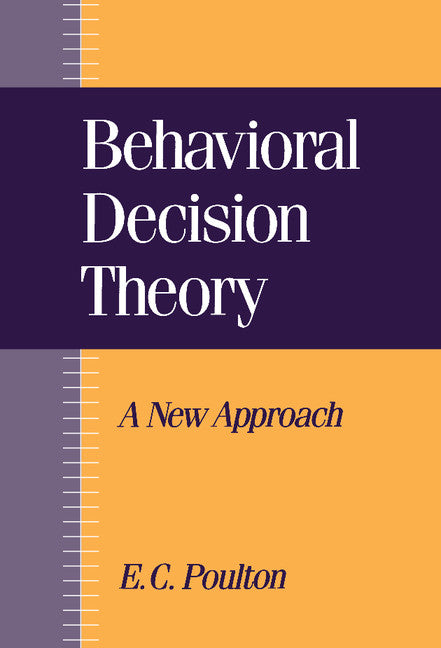
Behavioral Decision Theory
A New Approach
The book describes the errors that people commonly make in dealing with probabilities.
E. C. Poulton (Author)
9780521443685, Cambridge University Press
Hardback, published 30 September 1994
336 pages, 36 b/w illus. 46 tables
23.7 x 16 x 2.1 cm, 0.64 kg
"The book is well organized, with separate chapters devoted to each of the major biases....The author has incorporated several reader-friendly devices, such as chapter summaries, as well as sections in all the major chapters on practical examples of the bias described in the chapter and how to avoid it. The helpfulness of these sections varies greatly: Poulton does an excellent job of depicting the dangers that availability can lead to in clinical diagnosis....Poulton emphasises the limitations of behavioral decision research....Because of Poulton's methodological bent, he dissects key experiments- especially Kahneman and Tversky's seminal research-in more detail than do other introductory texts." Applied Cognitive Psychology
This book discusses the well known fallacies of behavioural decision theory. It shows that while an investigator is studying a well-known fallacy, he or she may introduce, without realizing it, one of the simple biases that are found in quantifying judgements. The work covers such fallacies as the apparent overconfidence that people show when they judge the probability of correctness of their answers to two-choice general knowledge questions using a one-sided rating scale; the apparent overconfidence in setting uncertainty bounds on unknown quantities when using the fractile method; the interactions between hindsight and memory; the belief that small samples are as reliable and as representative as large samples;; the regression fallacy in prediction; the availability and simulation fallacies; the anchoring and adjustment biases; and bias by frames. The aim of this book is to help readers to learn about the fallacies and thus to avoid them. As such, it will be useful reading for students and researchers in probability theory, statistics and psychology.
1. Outline of heuristics and biases
2. Practical techniques
3. Apparent overconfidence
4. Hindsight bias
5. Small sample fallacy
6. Conjunction fallacy
7. Regression fallacy
8. Base rate fallacy
9. Availability and simulation fallacies
10. Anchoring and adjustment bias
11. Expected utility fallacy
12. Bias by frames
13. Simple biases accompanying complex biases
14. Problem questions
15. Training
16. Uncertainties.
Subject Areas: Probability & statistics [PBT], Psychological theory & schools of thought [JMA]