Freshly Printed - allow 7 days lead
Couldn't load pickup availability
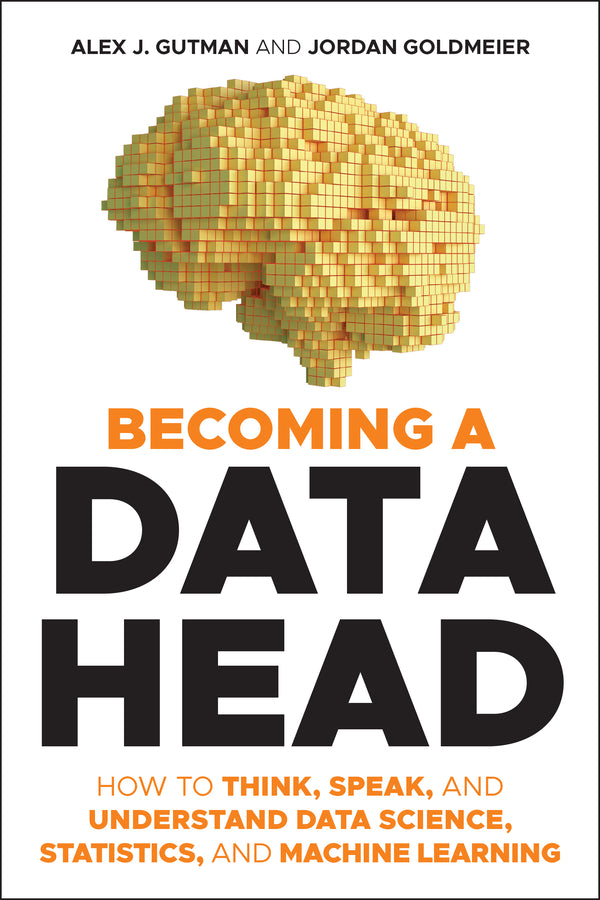
Becoming a Data Head
How to Think, Speak, and Understand Data Science, Statistics, and Machine Learning
"Big Data, Data Science, Machine Learning, Artificial Intelligence, Neural Networks, Deep Learning...It can be buzzword bingo, but make no mistake, everything is becoming “datafied” and an understanding of data problems and the data science toolset is becoming a requirement for every business person. Alex and Jordan have put together a must read whether you are just starting your journey or already in the thick of it. They made this complex space simple by breaking down the 'data process' into understandable patterns and using everyday examples and events over our history to make the concepts relatable." "What I love about this book is its remarkable breadth of topics covered, while maintaining a healthy depth in the content presented for each topic. I believe in the pedagogical concept of 'Talking the Walk,' which means being able to explain the hard stuff in terms that broad audiences can grasp. Too many data science books are either too specialized in taking you down the deep paths of mathematics and coding ('Walking the Walk') or too shallow in over-hyping the content with a plethora of shallow buzzwords ('Talking the Talk'). You can take a great walk down the pathways of the data field in Alex and Jordan’s without fear of falling off the path. The journey and destination are well worth the trip, and the talk." "The most clear, concise, and practical characterization of working in corporate analytics that I’ve seen. If you want to be a killer analyst and ask the right questions, this is for you." "THE book that business and technology leaders need to read to fully understand the potential, power, AND limitations of data science." "You've heard it before: 'We need to be doing more machine learning. Why aren't we doing more sophisticated data science work?' Data science isn't the magic unicorn that will solve all of your company's problems. Becoming a Data Head brings this idea to life by highlighting when data science is (and isn't) the right approach and the common pitfalls to watch out for, explaining it all in a way that a data novice can understand. This book will be my new 'pocket reference' when communicating complicated concepts to non-technically trained leaders." "Individuals and organizations want to be data driven. They say they are data driven. Becoming a Data Head shows them how to actually become data driven, without the assumption of a statistics or data background. This book is for anyone, or any organization, asking how to bring a data mindset to the whole company, not just those trained in the space." "What is keeping data science from reaching its true potential? It is not slow algorithms, lack of data, lack of computing power, or even lack of data scientists. Becoming a Data Head tackles the biggest impediment to data science success, the communication gap between the data scientist and the executive. Gutman and Goldmeier provide creative explanations of data science techniques and how they are used with clear everyday relatable examples. Managers and executives, and anyone wanting to better understand data science will learn a lot from this book. Likewise, data scientists who find it challenging to explain what they are doing will also find great value in Becoming a Data Head." "Becoming a Data Head raises the level of education and knowledge in an industry desperate for clarity in thinking. A must read for those working with and within the growing field of data science and analytics." "Gutman and Goldmeier filter through much of the noise to break down complex data and statistical concepts we hear today into basic examples and analogies that stick. Becoming a Data Head has enabled me to translate my team’s data needs into more tangible business requirements that make sense for our organization. A great read if you want to communicate your data more effectively to drive your business and data science team forward!" "As an aerospace engineer with nearly 15 years experience, Becoming a Data Head made me aware of not only what I personally want to learn about data science, but also what I need to know professionally to operate in a data-rich environment. This book further discusses how to filter through often overused terms like artificial intelligence. This is a book for every mid-level program manager learning how to navigate the inevitable future of data science." "A must read for an in-depth understanding of data science for senior executives." "Gutman and Goldmeier offer practical advice for asking the right questions, challenging assumptions, and avoiding common pitfalls. They strike a nice balance between thoroughly explaining concepts of data science while not getting lost in the weeds. This book is a useful addition to the toolbox of any analyst, data scientist, manager, executive, or anyone else who wants to become more comfortable with data science." "Gutman and Goldmeier have written a book that is as useful for applied statisticians and data scientists as it is for business leaders and technical professionals. In demystifying these complex statistical topics, they have also created a common language that bridges the longstanding communication divide that has — until now — separated data work from business value."
– Milen Mahadevan, President of 84.51°
– Kirk Borne, Data Scientist and Top Worldwide Influencer in Data Science
– Kristen Kehrer, Data Moves Me, LLC and LinkedIn Top Voices in Data Science & Analytics
– Jennifer L. L. Morgan, PhD, Analytical Chemist at Procter and Gamble
– Sandy Steiger, Director, Center for Analytics and Data Science at Miami University
– Eric Weber, Head of Experimentation & Metrics Research, Yelp
– Jeffrey D. Camm, PhD, Center for Analytics Impact, Wake Forest University
– Dr. Stephen Chambal, VP for Corporate Growth at Perduco (DoD Analytics Company)
– Justin Maurer, Engineering and Data Science Manager at Google
– Josh Keener, Aerospace Engineer and Program Manager
– Cade Saie, Chief Data Officer
– Jeff Bialac, Senior Supply Chain Analyst at Kroger
– Kathleen Maley, Chief Analytics Officer at datazuum
Alex J. Gutman (Author), Jordan Goldmeier (Author)
9781119741749, Wiley
Paperback / softback, published 24 June 2021
272 pages
22.6 x 15.2 x 1.5 cm, 0.318 kg
"Turn yourself into a Data Head. You'll become a more valuable employee and make your organization more successful." You've heard the hype around data - now get the facts. In Becoming a Data Head: How to Think, Speak, and Understand Data Science, Statistics, and Machine Learning, award-winning data scientists Alex Gutman and Jordan Goldmeier pull back the curtain on data science and give you the language and tools necessary to talk and think critically about it. You'll learn how to: Becoming a Data Head is a complete guide for data science in the workplace: covering everything from the personalities you’ll work with to the math behind the algorithms. The authors have spent years in data trenches and sought to create a fun, approachable, and eminently readable book. Anyone can become a Data Head—an active participant in data science, statistics, and machine learning. Whether you're a business professional, engineer, executive, or aspiring data scientist, this book is for you.
Thomas H. Davenport, Research Fellow, Author of Competing on Analytics, Big Data @ Work, and The AI Advantage
Acknowledgments xiii Foreword xxiii Introduction xxvii Part One Thinking Like a Data Head Chapter 1 What Is the Problem? 3 Questions a Data Head Should Ask 4 Why Is This Problem Important? 4 Who Does This Problem Affect? 6 What If We Don’t Have the Right Data? 6 When Is the Project Over? 7 What If We Don’t Like the Results? 7 Understanding Why Data Projects Fail 8 Customer Perception 8 Discussion 10 Working on Problems That Matter 11 Chapter Summary 11 Chapter 2 What Is Data? 13 Data vs. Information 13 An Example Dataset 14 Data Types 15 How Data Is Collected and Structured 16 Observational vs. Experimental Data 16 Structured vs. Unstructured Data 17 Basic Summary Statistics 18 Chapter Summary 19 Chapter 3 Prepare to Think Statistically 21 Ask Questions 22 There Is Variation in All Things 23 Scenario: Customer Perception (The Sequel) 24 Case Study: Kidney-Cancer Rates 26 Probabilities and Statistics 28 Probability vs. Intuition 29 Discovery with Statistics 31 Chapter Summary 33 Part Two Speaking Like a Data Head Chapter 4 Argue with the Data 37 What Would You Do? 38 Missing Data Disaster 39 Tell Me the Data Origin Story 43 Who Collected the Data? 44 How Was the Data Collected? 44 Is the Data Representative? 45 Is There Sampling Bias? 46 What Did You Do with Outliers? 46 What Data Am I Not Seeing? 47 How Did You Deal with Missing Values? 47 Can the Data Measure What You Want It to Measure? 48 Argue with Data of All Sizes 48 Chapter Summary 49 Chapter 5 Explore the Data 51 Exploratory Data Analysis and You 52 Embracing the Exploratory Mindset 52 Questions to Guide You 53 The Setup 53 Can the Data Answer the Question? 54 Set Expectations and Use Common Sense 54 Do the Values Make Intuitive Sense? 54 Watch Out: Outliers and Missing Values 58 Did You Discover Any Relationships? 59 Understanding Correlation 59 Watch Out: Misinterpreting Correlation 60 Watch Out: Correlation Does Not Imply Causation 62 Did You Find New Opportunities in the Data? 63 Chapter Summary 63 Chapter 6 Examine the Probabilities 65 Take a Guess 66 The Rules of the Game 66 Notation 67 Conditional Probability and Independent Events 69 The Probability of Multiple Events 69 Two Things That Happen Together 69 One Thing or the Other 70 Probability Thought Exercise 72 Next Steps 73 Be Careful Assuming Independence 74 Don’t Fall for the Gambler’s Fallacy 74 All Probabilities Are Conditional 75 Don’t Swap Dependencies 76 Bayes’ Theorem 76 Ensure the Probabilities Have Meaning 79 Calibration 80 Rare Events Can, and Do, Happen 80 Chapter Summary 81 Chapter 7 Challenge the Statistics 83 Quick Lessons on Inference 83 Give Yourself Some Wiggle Room 84 More Data, More Evidence 84 Challenge the Status Quo 85 Evidence to the Contrary 86 Balance Decision Errors 88 The Process of Statistical Inference 89 The Questions You Should Ask to Challenge the Statistics 90 What Is the Context for These Statistics? 90 What Is the Sample Size? 91 What Are You Testing? 92 What Is the Null Hypothesis? 92 Assuming Equivalence 93 What Is the Significance Level? 93 How Many Tests Are You Doing? 94 Can I See the Confidence Intervals? 95 Is This Practically Significant? 96 Are You Assuming Causality? 96 Chapter Summary 97 Part Three Understanding the Data Scientist’s Toolbox Chapter 8 Search for Hidden Groups 101 Unsupervised Learning 102 Dimensionality Reduction 102 Creating Composite Features 103 Principal Component Analysis 105 Principal Components in Athletic Ability 105 PCA Summary 108 Potential Traps 109 Clustering 110 k-Means Clustering 111 Clustering Retail Locations 111 Potential Traps 113 Chapter Summary 114 Chapter 9 Understand the Regression Model 117 Supervised Learning 117 Linear Regression: What It Does 119 Least Squares Regression: Not Just a Clever Name 120 Linear Regression: What It Gives You 123 Extending to Many Features 124 Linear Regression: What Confusion It Causes 125 Omitted Variables 125 Multicollinearity 126 Data Leakage 127 Extrapolation Failures 128 Many Relationships Aren’t Linear 128 Are You Explaining or Predicting? 128 Regression Performance 130 Other Regression Models 131 Chapter Summary 131 Chapter 10 Understand the Classification Model 133 Introduction to Classification 133 What You’ll Learn 134 Classification Problem Setup 135 Logistic Regression 135 Logistic Regression: So What? 138 Decision Trees 139 Ensemble Methods 142 Random Forests 143 Gradient Boosted Trees 143 Interpretability of Ensemble Models 145 Watch Out for Pitfalls 145 Misapplication of the Problem 146 Data Leakage 146 Not Splitting Your Data 146 Choosing the Right Decision Threshold 147 Misunderstanding Accuracy 147 Confusion Matrices 148 Chapter Summary 150 Chapter 11 Understand Text Analytics 151 Expectations of Text Analytics 151 How Text Becomes Numbers 153 A Big Bag of Words 153 N-Grams 157 Word Embeddings 158 Topic Modeling 160 Text Classification 163 Naïve Bayes 164 Sentiment Analysis 166 Practical Considerations When Working with Text 167 Big Tech Has the Upper Hand 168 Chapter Summary 169 Chapter 12 Conceptualize Deep Learning 171 Neural Networks 172 How Are Neural Networks Like the Brain? 172 A Simple Neural Network 173 How a Neural Network Learns 174 A Slightly More Complex Neural Network 175 Applications of Deep Learning 178 The Benefits of Deep Learning 179 How Computers “See” Images 180 Convolutional Neural Networks 182 Deep Learning on Language and Sequences 183 Deep Learning in Practice 185 Do You Have Data? 185 Is Your Data Structured? 186 What Will the Network Look Like? 186 Artificial Intelligence and You 187 Big Tech Has the Upper Hand 188 Ethics in Deep Learning 189 Chapter Summary 190 Part Four Ensuring Success Chapter 13 Watch Out for Pitfalls 193 Biases and Weird Phenomena in Data 194 Survivorship Bias 194 Regression to the Mean 195 Simpson’s Paradox 195 Confirmation Bias 197 Effort Bias (aka the “Sunk Cost Fallacy”) 197 Algorithmic Bias 198 Uncategorized Bias 198 The Big List of Pitfalls 199 Statistical and Machine Learning Pitfalls 199 Project Pitfalls 200 Chapter Summary 202 Chapter 14 Know the People and Personalities 203 Seven Scenes of Communication Breakdowns 204 The Postmortem 204 Storytime 205 The Telephone Game 206 Into the Weeds 206 The Reality Check 207 The Takeover 207 The Blowhard 208 Data Personalities 208 Data Enthusiasts 209 Data Cynics 209 Data Heads 209 Chapter Summary 210 Chapter 15 What’s Next? 211 Index 215
Subject Areas: Business applications [UF]