Freshly Printed - allow 10 days lead
Couldn't load pickup availability
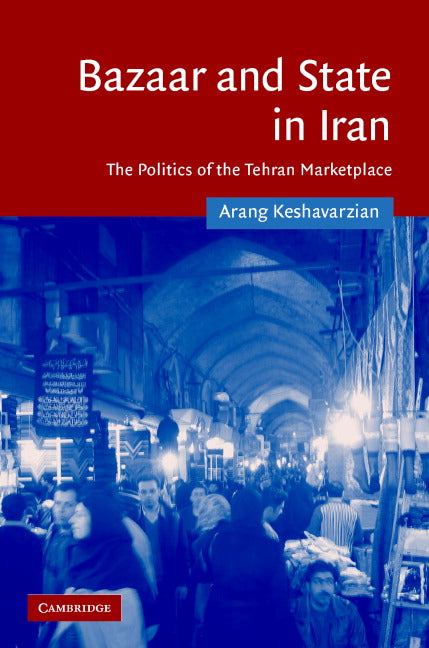
Bazaar and State in Iran
The Politics of the Tehran Marketplace
Keshavarizian's book affords unusual insights into the politics, economics and society of Iran across four decades.
Arang Keshavarzian (Author)
9780521866187, Cambridge University Press
Hardback, published 12 April 2007
320 pages, 3 maps
23.5 x 16.2 x 2.5 cm, 0.655 kg
'Keshavarzian shows how the bazaar exercised its political and economic influence under the shah. He then lays out the paradox that the revolution in which the bazaar was so central brought in a government that has systematically weakened the bazaar to the point that the bazaar is no longer a significant political player. … [Keshavarzian] provides lots of colorful details.' Foreign Policy
The Tehran Bazaar has always been central to the Iranian economy and indeed, to the Iranian urban experience. Arang Keshavarzian's fascinating book compares the economics and politics of the marketplace under the Pahlavis, who sought to undermine it in the drive for modernisation and under the subsequent revolutionary regime, which came to power with a mandate to preserve the bazaar as an 'Islamic' institution. The outcomes of their respective policies were completely at odds with their intentions. Despite the Shah's hostile approach, the bazaar flourished under his rule and maintained its organisational autonomy to such an extent that it played an integral role in the Islamic revolution. Conversely, the Islamic Republic implemented policies that unwittingly transformed the ways in which the bazaar operated, thus undermining its capacity for political mobilisation. Arang Keshavarizian's book affords unusual insights into the politics, economics and society of Iran across four decades.
1. The puzzle of the Tehran Bazaar under the Pahlavi monarchy and the Islamic Republic
2. Conceptualising the bazaar
3. Bazaar transformations: networks, reputations and solidarities
4. Networks in the context of transformative agendas
5. Carpets, tea and teacups: commodity types and sectoral trajectories
6. Networks of mobilisation under two regimes
7. Conclusions
Selected bibliography
Index.
Subject Areas: Politics & government [JP], Sociology & anthropology [JH], Islam [HRH], Asian history [HBJF]