Freshly Printed - allow 10 days lead
Couldn't load pickup availability
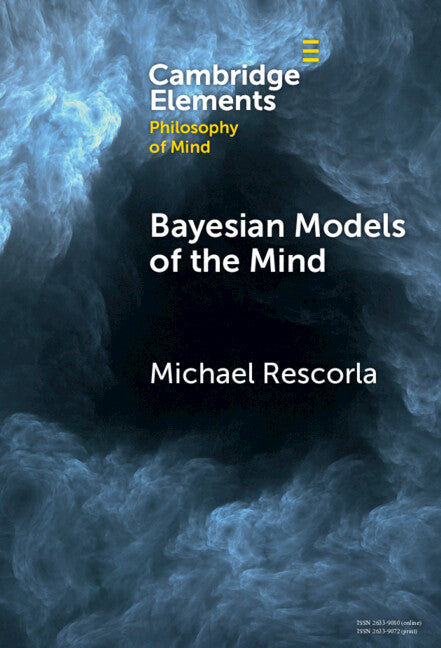
Bayesian Models of the Mind
This Element explores what we can learn about the mind from the Bayesian models offered by cognitive scientists.
Michael Rescorla (Author)
9781009517805, Cambridge University Press
Hardback, published 30 January 2025
108 pages
22.9 x 15.2 x 0.8 cm, 0.296 kg
Bayesian decision theory is a mathematical framework that models reasoning and decision-making under uncertain conditions. The Bayesian paradigm originated as a theory of how people should operate, not a theory of how they actually operate. Nevertheless, cognitive scientists increasingly use it to describe the actual workings of the human mind. Over the past few decades, cognitive science has produced impressive Bayesian models of mental activity. The models postulate that certain mental processes conform, or approximately conform, to Bayesian norms. Bayesian models offered within cognitive science have illuminated numerous mental phenomena, such as perception, motor control, and navigation. This Element provides a self-contained introduction to the foundations of Bayesian cognitive science. It then explores what we can learn about the mind from Bayesian models offered by cognitive scientists.
1. Introduction
2. The probability calculus
3. Bayesian decision theory
4. Bayesian cognitive science
5. Realism and instrumentalism
6. Mental representation
7. Anti-representationalism
8. Conclusion
9. Appendix: Foundations of probability theory.
Subject Areas: Philosophy of mind [HPM]