
Freshly Printed - allow 7 days lead
Couldn't load pickup availability
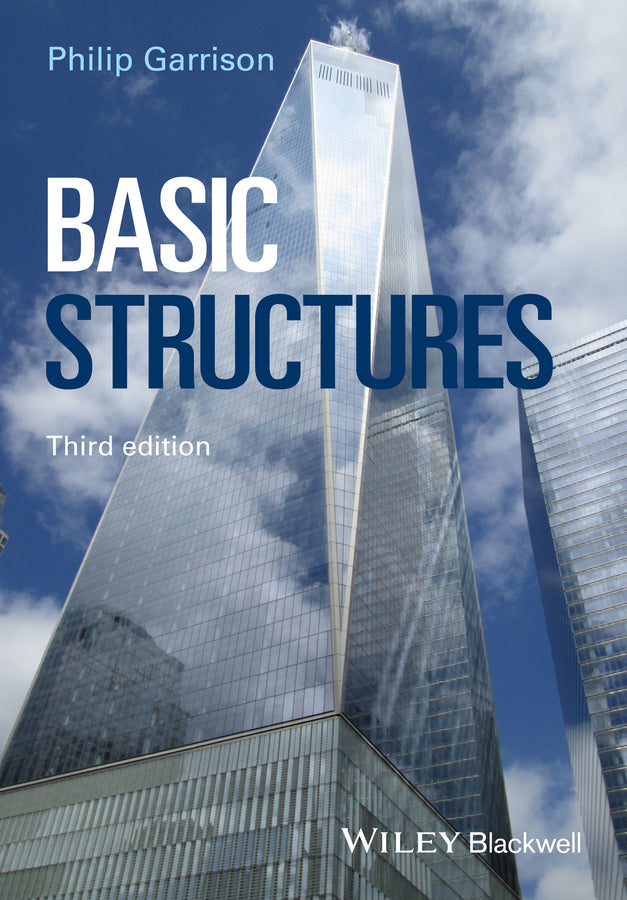
Basic Structures
Philip Garrison (Author)
9781118950876, Wiley
Paperback / softback, published 5 February 2016
432 pages
24.4 x 17.3 x 1.8 cm, 0.835 kg
Basic Structures provides the student with a clear explanation of structural concepts, using many analogies and examples. Real examples and case studies show the concepts in use, and the book is well illustrated with full colour photographs and many line illustrations, giving the student a thorough grounding in the fundamentals and a 'feel' for the way buildings behave structurally. With many worked examples and tutorial questions, the book serves as an ideal introduction to the subject.
Acknowledgements ix Introduction x 1 What is structural engineering? 1 2 Learn the language: a simple explanation of terms used by structural engineers 8 3 How do structures (and parts of structures) behave? 11 4 Force, mass and weight 26 5 Loading – dead or alive 32 6 Equilibrium – a balanced approach 38 7 More about forces: resultants and components 43 8 Moments 54 9 Reactions 67 10 Different types of support – and what’s a pin? 73 11 A few words about stability 81 12 Introduction to the analysis of pin-jointed frames 93 13 Method of resolution at joints 98 14 Method of sections 119 15 Graphical method 127 16 Shear force and bending moments 137 17 This thing called stress 168 18 Direct (and shear) stress 173 19 Bending stress 184 20 Combined bending and axial stress 205 21 Structural materials: concrete, steel, timber and masonry 218 22 More on materials 229 23 How far can I span? 235 24 Calculating those loads 242 25 An introduction to structural design 252 26 More on structural types and forms 291 27 An introduction to deflection 310 28 Shear stress 324 29 Buckling and torsion 333 30 Frames and three-pinned arches 344 31 Virtual work 356 32 Squares and circles of stress: An introduction to Mohr’s Circle 363 33 Trusses (no numbers) 380 34 Plastic analysis 388 Further reading 402 Appendix 1: Weights of common building materials 403 Appendix 2: Conversions and relationships between units 405 Appendix 3: Mathematics associated with right-angled triangles 407 Appendix 4: Symbols 409 Appendix 5: A checklist for architects 410 Appendix 6: Getting more out of civil engineering 411 Index 413
Subject Areas: Civil engineering, surveying & building [TN]