Freshly Printed - allow 10 days lead
Couldn't load pickup availability
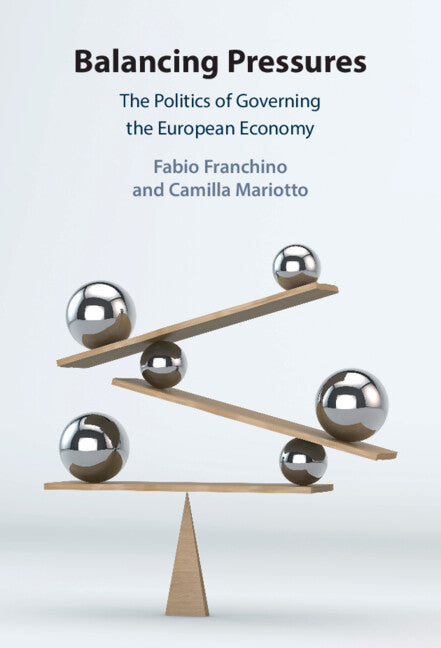
Balancing Pressures
The Politics of Governing the European Economy
Analyses how the economy, national politics, and supranational politics shape economic policymaking in the European Union.
Fabio Franchino (Author), Camilla Mariotto (Author)
9781009595810, Cambridge University Press
Hardback, published 22 May 2025
274 pages
22.9 x 15.2 x 1.8 cm, 0.561 kg
'This path-breaking book offers a new theoretical framework to examine European public policymaking. By looking at ideas, cleavages, negotiations, timing, political ideology, public opinion and more, the authors provide a detailed analysis of the policy process that is sophisticated and informative: a must-read for anyone who seeks to understand the intersection of comparative politics and international relations in Europe.' Amy Verdun, Professor of Political Science, University of Victoria
Balancing Pressures analyses how the economy, national politics, and supranational politics shape economic policymaking in the European Union. Economic theories alert policymakers of the problems associated with policy initiatives. Economic uncertainties shape political positioning during negotiations, while actual economic conditions affect both negotiations and implementation. National pressures to win office and pursue policies systematically influence negotiating positions, implementation patterns, and outcomes. Supranational pressures are associated with membership in the euro area, the expected and actual patterns of compliance, or the context of negotiations. Spanning the period of 1994 to 2019, this book analyses how these pressures shaped the definition of the policy problems, the controversies surrounding policy reforms, the outcome, timing, and direction of reforms, the negotiations over preventive surveillance, the compliance with recommendations, and the use and effectiveness of the procedure to correct excessive fiscal deficits. It concludes by assessing the effectiveness, fairness, and responsiveness of the policy.
1. Governing the European economy as balancing pressures
Part I. Defining the Policy Problem: 2. The subtle influence of ideas: austerity needs no rules
Part II. Negotiating and Designing Economic Governance: 3. The battle lines: noncompliance risk, asymmetric power, and enforcement
4. Compromises, procedures, and the costs of failure
5. Governance design under uncertainty, threats, and politicisation
Part III. Implementing Economic Governance: 6. Supranational bargaining, credibility, and preventive surveillance
7. Navigating the pressures of preventive compliance
8. Causes and consequences of overseeing fiscal deficits
9. Effectiveness, fairness, and responsiveness.
Subject Areas: Constitution: government & the state [JPHC]