Freshly Printed - allow 10 days lead
Couldn't load pickup availability
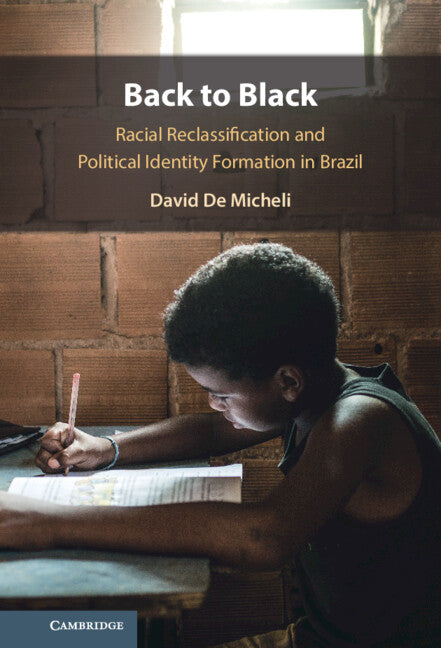
Back to Black
Racial Reclassification and Political Identity Formation in Brazil
This book documents and explains an underexamined paradigm shift in Brazil's racial politics and subjectivity in recent decades.
David De Micheli (Author)
9781009472395, Cambridge University Press
Hardback, published 17 October 2024
318 pages
23.5 x 16 x 2.2 cm, 0.62 kg
'In Back to Black, David De Micheli convincingly documents Brazil's surge in non-white racial identification and asks how this counter-intuitive 'reclassification reversal' occurred. His persuasive argument is that egalitarian social policies interact with and challenge racial hierarchies in ways that promote politicized group consciousness - even in a context of significant racial fluidity like Brazil. Evidence from multiple sources - including interviews, extensive field work, original survey experiments, administrative and survey data - demonstrates how massive state-led educational expansion produced a cascade of (unplanned) consequences that activated black and brown identities and transformed how these identities map onto politics. This groundbreaking contribution helps set a new agenda for comparative race and ethnic politics research, placing ethnoracial group formation at the center of our understandings of political contestation in Latin America.' Jana Morgan, Professor, University of Tennessee
As Latin America's flagship 'racial democracy,' Brazil is famous for its history of race mixture and fluid racial boundaries. Traditionally, scholars have emphasized that this fluidity has often led to whitening, where individuals seek classification in white, or lighter, racial categories. Yet, Back to Black documents a sudden reversal in this trend, showing instead that individuals are increasingly opting to identify with darker, and especially black, racial categories. Drawing on a wealth of quantitative and qualitative data, David De Micheli attributes this sudden reversal to the state's efforts at expanding access to education for the lower classes. By unleashing waves of upward mobility, greater education increased individuals' personal exposure to racial hierarchies and inequalities and led many to develop racial consciousness, further encouraging black identification. The book highlights how social citizenship institutions and social structures can work together to affect processes of identity politicization and the contestation of inequalities.
List of tables
List of figures
1. Introduction
2. The puzzle of racial reclassification
3. Theory: racial reclassification as political identity formation
4. Education as a mechanism of exposure
5. Education and reclassification: testing the hypothesis
6. Affirmative action and reclassification
7. Implications for national politics
8. Conclusion
References
Appendix A. supplementary information to chapters two and three
Appendix B. supplementary information to chapter four
Appendix D. supplementary information to chapter five
Appendix C. supplementary information to chapter six
Appendix E. supplementary information to chapter seven.
Subject Areas: Constitution: government & the state [JPHC]