Freshly Printed - allow 7 days lead
Couldn't load pickup availability
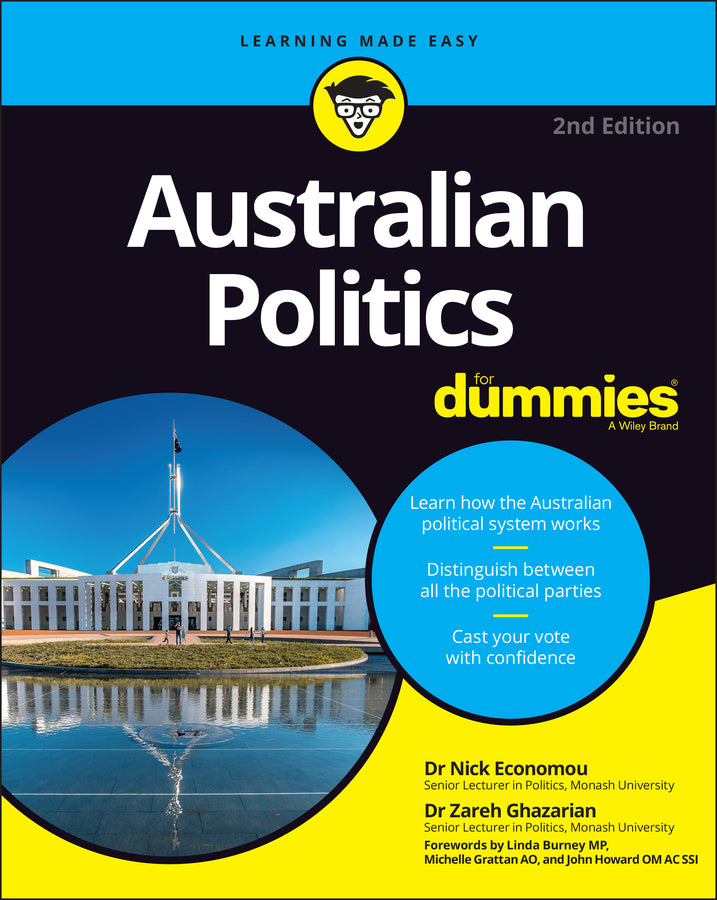
Australian Politics For Dummies
Nick Economou (Author), Zareh Ghazarian (Author), Linda Burney (Foreword by), Michelle Grattan (Foreword by), John Howard (Foreword by)
9780730395423, Wiley
Paperback / softback, published 4 March 2022
384 pages
2.4 x 1.8 x 0.2 cm, 0.624 kg
Understand Aussie politics and make your vote count! Australian Politics For Dummies gives you a helping hand as you get to grips with the good, the bad and the ugly of Australian politics. Seasoned political punters and voting novices alike will find fascinating facts and top thrills in in this essential guide. Master the ins and outs of elections, parties and policies. In no time, you'll be discussing and debating the biggest issues with ease. Down under, we all have to vote. It's one of the many beautiful things about this land of ours, and this book will help you learn why (and how) to cast that ballot. This updated edition gives you everything you need to cast your vote with confidence. You'll identify what makes the Australian political system tick, distinguish between the different political parties and understand the influence of the media in Australian politics. You want to know more about Australian politics, but, if we're being realistic, it's very complicated. Australian Politics For Dummies clears it all up.
Foreword xv Introduction 1 About This Book 1 Foolish Assumptions 3 Icons Used in This Book 3 Where to Go from Here 4 Part 1: Politics: You’re in It 5 Chapter 1: Australian Politics: The Basics 7 What is Politics? 8 Compulsory Voting 9 A Lot of Government 9 Governing the nation 10 Governing the states 11 Administering the territories 11 Roads, rates and rubbish: Local government 12 From Government to Politics 12 Political parties 13 A two-party system? 15 Interest Groups: Fighting for Causes and Advancing Interests 15 Promotional interest groups 16 Sectional interest groups 16 Umbrellas and peaks 18 Understanding Politicians 19 Who becomes a politician? 19 A ‘boys’ club’? 19 Heavy hitters: Interest group politicians 20 Politics: You Can’t Escape It 21 Chapter 2: Hot Topics in Australia: The Political Debate 23 Apathetic or Engaged? 24 Awareness of issues 24 The ‘isms’ in politics 25 Things We Never Tire of Talking About 28 Tariffs 29 The role of the unions 29 Immigration 31 Reconciliation 33 Women in politics 34 Great and powerful friends 36 New Things We’re Talking About 38 COVID-19 and the pandemic 38 The environment and climate change 38 Climate change and water 40 The republic 41 Globalisation 42 Nation building 42 Complex Issues, Simple Choices 43 Part 2: The Australian System of Government 45 Chapter 3: One Country, Many Rulebooks 47 Australia is a Federation 47 The Constitution and power-sharing 48 The constitutions as rulebooks 48 The Path to Federation 48 The constitutional conventions 49 The states came first 49 The need for a national government 51 Big States and Small States 54 A house for the states: The Senate 54 You get at least five lower house seats if 55 Changing the Constitution 56 The Australian System of Constitutional Government 57 The governors and the governor-general 57 The Executive in Council 58 Ministers of the Crown 59 The parliament 60 The electors 61 The courts 62 Australian Constitutionalism: More than the Written Word 65 Chapter 4: Westminster: Much More than Big Ben 67 A Constitution without a (Written) Constitution 68 What do conventions cover? 68 The Crown 69 The parliament 70 The executive 72 Responsible Government 74 Forming a Responsible Government 74 Resign! Resign! 75 Collective Responsibility 75 Ministerial Responsibility 76 Westminster as Adversarial Politics 77 The alternative prime minister 77 The shadow ministry 78 Westminster and Party Politics 78 Tyranny of the executive? 79 Winner takes all? 79 Westminster and Australia 80 Chapter 5: Washminster: The Australian Hybrid 83 British or American? 84 American federalism: A model for Australia 84 A Senate, a court and a written constitution: The American legacy 85 Limits to Americanisation: Responsible Government 85 Responsible Government the Australian Way 86 Executive in Council or Cabinet? 87 The governor-general or the prime minister? 87 What about the states? 87 House of Representatives or the Senate? 88 Deadlocks 90 The joint sitting 91 Clash of the Houses: The 1975 Constitutional Crisis 92 The politics of the crisis 92 The crisis: The deferral of supply 93 The governor-general: The reserve powers exercised 93 The governor-general’s actions: The controversies 95 The meaning of the 1975 crisis 95 Kerr’s argument: Parliamentary Responsibility 96 After the crisis 97 Chapter 6: Parliament: The House on the Hill 99 Housing the Houses of Parliament 100 The new house 100 The old house 101 Westminster parliaments: An overview 103 Never the twain shall meet? 104 Who’s Who? Putting People in Their Place 104 The Speaker 104 The President 106 Frontbenchers and backbenchers 106 The crossbenchers 106 In the Senate? 107 The Whips 109 Question Time 109 Pairing 109 Voting in the Parliament 110 Ring the bells! The division 111 Crossing the floor 111 Conscience voting 112 Government rules, OK? 112 Making Laws in the Parliament 112 Amended bills 113 Legislating: The Representatives versus the Senate 114 The People’s Forum or a Rubber Stamp? 115 Adjournments and grievances 115 The rise of standing committees 116 What about Hung Parliaments? 117 How common are hung parliaments? 118 Who governs while the crossbenchers are making up their minds? 119 The role of the governor 120 Minority or coalition? 121 Stable or volatile? 122 Chapter 7: Governing the Great Southern Land 123 The Constitution and the Division of the Powers of Government 124 Section 51 124 Federal–State Relations 126 Adopting (and challenging) the Uniform Tax system 126 Controlling the purse strings 127 Cooperative Federalism 130 From COAG to National Cabinet 131 Ministerial councils 131 Intergovernmental agreements 132 Uncooperative Federalism 132 The High Court of Australia 133 The Federal Court 133 Policy-making Australian Style 133 Public policy 134 Cabinet government the Australian way 134 Creating policy 135 Ministerial advisers 137 Statutory authorities 137 Big Government or Small Government? 138 Part 3: Party time! 139 Chapter 8: Parties, Parliament and Politics 141 What is a Party? 142 Majors and Minors 143 Oddities of the Australian majors 143 Issues for the Australian minors 144 Minor parties in the parliament 145 Beyond the Parliament: Party Organisation 146 Mass membership, mass parties 147 Raising money 148 Raising candidates 150 Preselection 151 Factions 151 Alternatives or Wellsprings: Interest Groups and Social Movements 152 Promotional interest groups 152 Social movements 153 Chapter 9: The Australian Labor Party 155 The Unions Create a Party 156 The strikes of 1891 156 The union movement’s delegates? 157 Root and branch representation 157 The Party Organisation 159 The supreme organ: Conference 160 State and National Executive 161 From 36 faceless men to 400 delegates 162 A youth wing: Young Labor 163 The Labor Organisation: Internal Politics 164 The importance of factions 164 Left versus right 166 Labor and Policy: What Labor Stands For 168 The Socialist Objective 168 Ben Chifley and bank nationalisation 169 The Splits 171 Labor and conscription: 1916 171 Labor and the Great Depression: 1931 172 Lead-up to the 1955 split: The Industrial Groupers 172 Many tensions, one big split 173 Modernising Labor: From Whitlam to Rudd and Gillard 176 The Whitlam policy legacy 177 Hayden: Farewell the Socialist Objective 178 The Hawke government 178 Keating: From treasurer to prime minister 180 The rise of Rudd 181 The Gillard years 181 Pragmatism in Action: Labor in the States 182 Labor in the Future 183 Chapter 10: The Liberal Party 185 Early Origins: Free Traders, Protectionists and Fusionists 186 A new anti-Labor party: The Nationalists 187 Anti-Labor Uniting (Sort Of) 188 United they stand: Creating the United Australia Party 188 United they fall: The collapse of the UAP 189 From the UAP Ashes: The Liberal Party 190 The Liberal Party Organisation 191 Getting together: State and Federal Council 192 Follow the leader! 194 The Party Room 194 By Menzies, of Menzies, for Menzies 195 A structure for government or opposition? 195 The branch membership strikes back! 196 The Young Liberals 196 Liberal women 197 Liberal Factionalism 197 Liberals versus conservatives 198 Moderates versus Hardliners 198 Wets and Dries 199 State-based alliances 199 Leadership alliances 200 The Liberal Party in Government 201 Pragmatism or programs? 202 Liberals and the unions 203 Menzies in government 203 Malcolm Fraser’s government 205 The Howard government 206 Post-Howard: The Abbott, Turnbull and Morrison governments 207 The Liberal Party in the States 209 The Liberal Party and the Future 209 Chapter 11: The National Party 211 The Origins of Rural Party Politics: The Country Party 212 A farmer’s party 212 Soldier settlements 213 A shared constituency 213 The Country Party consolidates 214 Coalition Politics 214 The coalition agreement 215 Limits to coalition 216 The National Party Organisation 217 A small parliamentary party 218 Queensland: A National Party heartland 218 Factionalism in the National Party 219 The National Party in Government 221 The early coalitionists 221 John (Black Jack) McEwen: A Country Party giant 222 Doug Anthony: A moderniser 223 Tim Fischer: Back to basics 223 From Barnaby Joyce to Michael McCormack and back to Joyce 225 Future Challenges 225 Chapter 12: The Minor Parties and Independents 227 Minor Parties: People’s Tribune or a Waste of Time? 228 The importance of the electoral system 228 Preference wheeling and dealing 230 Measuring minor party success 230 Senate-based minor parties 231 Here today, gone tomorrow? 232 Out on Their Own: Independents 232 Independent success 233 Once were party people 234 The Who’s Who of Minor Parties 235 The Democratic Labor Party 235 The Australian Democrats 236 The Nuclear Disarmament Party 238 The West Australian Greens 239 The Australian Greens (the Greens) 240 Pauline Hanson’s One Nation 241 Family First 242 Clive Palmer United Party 242 Liberal Democrats 243 Minor Parties of the Future 243 Part 4: Citizen Power! 245 Chapter 13: Elections: A Festival of Democracy 247 Democratic Origins 247 Federal and State Elections 249 Australian elections: Compulsory democracy 250 Conducting elections 250 Different electoral systems 251 Many elections 252 Double-dissolution elections 253 Calling elections: Who has the power? 254 The role of the prime minister 254 Fixed-term parliaments? 255 The Importance of Electoral Systems 255 Up the majority! Preferential voting 256 Lowering the electoral bar: Proportional representation 258 The Senate ballot paper: It’s a whopper! 260 Who Wins and How? 263 Recounts and disputed returns 263 Exaggerated majorities 264 Paradoxical outcomes 265 Ransom-holding minorities 266 After the election is over 267 In between elections: By-elections 268 Chapter 14: Let the Campaign Begin! 269 The Rules of the Game 270 Elections: It’s Party Time! 271 Show me the money 271 Preselections and nominations 272 Directing preferences 273 The Campaign 274 Raising money and conducting campaigns 274 Battle of the leaders? 275 The television campaign: The Great Debates 276 Launching the campaign 276 At the Press Club 277 The Big Day! Sausage Sizzles and More 277 Counting the vote: Saturday night fever! 278 Who Votes How and Why? 280 Electing oppositions in or voting governments out? 280 Seats: Safe, marginal and swinging 281 Predicting election outcomes: The pendulum 281 Focusing on the marginals 283 A Guide to Voter Types 284 The rusted-ons 284 The swingers 284 The donkey vote 284 Informal voters 285 Battlers 285 Working families 285 Doctors’ wives 286 Post-materialists 286 Chapter 15: The Fourth Estate: The Media 287 The Role of ‘the Press’ in Politics 288 Press corps and press galleries 288 The Australian press gallery 289 The Media 289 Newspapers 290 Television 291 Radio 293 The internet and social media 293 King and Queen Makers? Journalists and Commentators 294 Journalists 294 Opinion writers 295 Political cartoonists 296 Opinion pollsters 297 Government Broadcasting? The ABC 297 Balanced or left-wing bias? 298 Covering elections 298 The Power of the Media? 299 Agenda setting 299 Spin doctors 299 Opinion polling 301 Part 5: Part of Tens 303 Chapter 16: Ten Politicians Who Made an Impact 305 John Christian Watson (1867–1941) 305 John Curtin (1885–1945) 306 Robert Menzies (1894–1978) 306 Gough Whitlam (1916–2014) 307 Malcolm Fraser (1930–2015) 307 Bob Hawke (1929–2019) 308 John Howard (b 1939) 308 Don Chipp (1925–2006) 309 Bob Brown (b 1944) 309 Pauline Hanson (b 1954) 310 Chapter 17: Ten (Plus One!) Speeches Worth Listening to Again 311 Sir Henry Parkes: The Crimson Thread of Kinship, 1890 311 John Curtin: We Are Fighting Mad, 1942 312 Robert Menzies: Forgotten People, 1942 312 Ben Chifley: Light on the Hill, 1949 313 Neville Bonner: Aboriginal Rights, 1971 313 Gough Whitlam: It’s Time, 1972 314 Paul Keating: The Redfern Speech, 1992 314 Pauline Hanson: Inaugural Speech to Parliament, 1996 314 John Howard: Bali Terrorist Attack, 2002 315 Kevin Rudd: Apology to the Stolen Generations, 2008 315 Julia Gillard: ‘Misogyny Speech’, 2012 316 Chapter 18: Ten Acts of Political Bastardry in Australia 317 The Hopetoun Blunder 317 Aspiring to Conscription 318 Fleeing a Sinking Ship? 318 Spoilsport! 319 Over a Barrel 319 The Dismissal 320 The Drover’s Dog 320 Bringing out the Knives 321 Kiss and Tell? 321 A Parade of Bastardry 322 Chapter 19: Ten (Plus One!) Women who made History in Australian Politics 323 Dame Enid Lyons (1897–1981) 323 Dame Dorothy Tangney (1907–1985) 324 Dame Margaret Guilfoyle (1926–2020) 324 Susan Ryan (1942–2020) 325 Joan Child (1921–2013) 325 Janine Haines (1945–2004) 326 Margaret Reid (b 1935) 326 Rosemary Follett (b 1948) 327 Quentin Bryce (b 1942) 327 Julia Gillard (b 1961) 327 Linda Burney (b 1957) 328 Glossary 329 Index 341
Subject Areas: Politics & government [JP]