Freshly Printed - allow 10 days lead
Couldn't load pickup availability
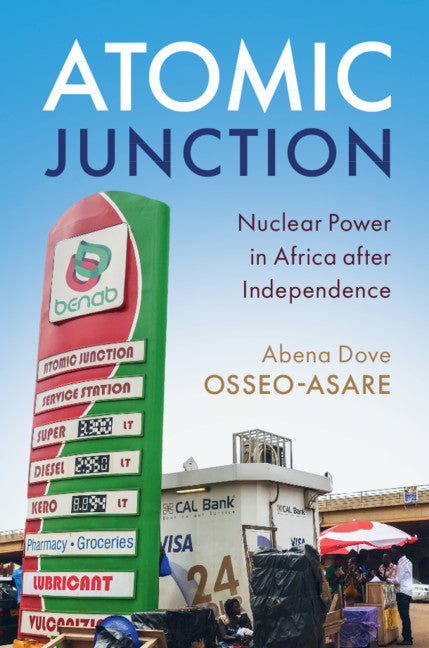
Atomic Junction
Nuclear Power in Africa after Independence
An innovative account of the first nuclear programme in independent Africa, centring on the promises and perils of atomic research in Ghana.
Abena Dove Osseo-Asare (Author)
9781108457378, Cambridge University Press
Paperback / softback, published 19 September 2019
296 pages, 28 b/w illus.
22.8 x 15.3 x 1.5 cm, 0.5 kg
'The book's contribution to the growing body of scholarship on nuclear power in Africa is difficult to overstate. Beyond this, it will interest a wide range of Africanists, historians of science, medicine and technology, and scholars of post-colonial and development studies. The book's readability makes it accessible for university curricula, and indeed it represents an indispensable addition to reading lists on the histories of the Global South in science and technology.' Chloë Mayoux, Journal of African Military History
After Atomic Junction, along the Haatso-Atomic Road there lies the Ghana Atomic Energy Commission, home to Africa's first nuclear programme after independence. Travelling along this road, Abena Dove Osseo-Asare gathers together stories of conflict and compromise on an African nuclear frontier. She speaks with a generation of African scientists who became captivated with 'the atom' and studied in the Soviet Union to make nuclear physics their own. On Pluton Lane and Gamma Avenue, these scientists displaced quiet farming villages in their bid to establish a scientific metropolis, creating an epicentre for Ghana's nuclear physics community. By placing interviews with town leaders, physicists and local entrepreneurs alongside archival records, Osseo-Asare explores the impact of scientific pursuit on areas surrounding the reactor, focusing on how residents came to interpret activities on these 'Atomic Lands'. This combination of historical research, personal and ethnographic observations shows how Ghanaians now stand at a crossroad, where some push to install more reactors, whilst others merely seek pipe-borne water.
Preface: nuclear reveries
1. Introduction: 'no country has monopoly of ability'
2. Nuclear winds: particles without boundaries
3. Scientific equity: physics from the Soviets
4. Atomic reactors: a fission facility for Ghana
5. Radiation within: monitoring particles in bodies
6. Atomic lands: risks on a nuclear frontier
Epilogue: nuclear power at the crossroads.
Subject Areas: History of science [PDX], Politics & government [JP], African history [HBJH]