Freshly Printed - allow 10 days lead
Couldn't load pickup availability
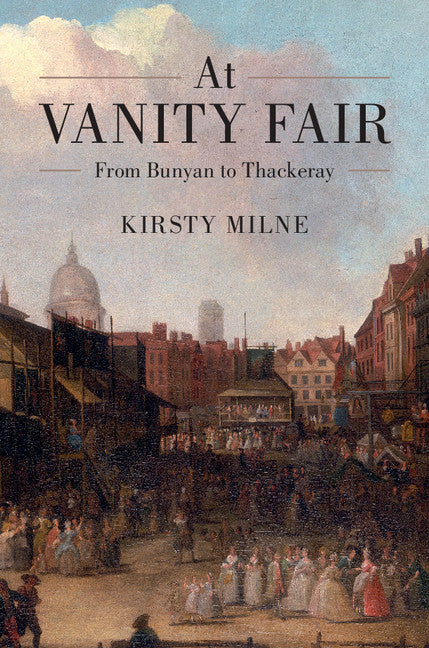
At Vanity Fair
From Bunyan to Thackeray
Explores how Vanity Fair transformed from its Puritan origins as an emblem of sin into a modern celebration of hedonism.
Kirsty Milne (Author), Sharon Achinstein (Afterword by)
9781107105850, Cambridge University Press
Hardback, published 12 May 2015
237 pages, 5 b/w illus.
23.5 x 16 x 1.7 cm, 0.47 kg
'Milne traces [Vanity Fair] as it appears in eighteenth- and nineteenth-century novels, letters, journalism and light verse. The result is a pugnacious and provocative interrogation of the ways in which 'a literary text is constructed' and of the relationship between seventeenth-century Puritanism and the modern free market.' Frances Wilson, New Statesman
At Vanity Fair tells the story of Bunyan's powerful metaphor, exploring how Vanity Fair was transformed from an emblem of sin and persecution into a showcase for celebrity, wealth and power. This literary history, focusing on reception, adaptation and influence, traces the fictional representation of Vanity Fair over three centuries from John Bunyan's masterpiece, The Pilgrim's Progress (1678), to William Makepeace Thackeray's own Vanity Fair (1847–8). It explores the influence of anonymous journalists and booksellers alongside well-known authors including Ben Jonson, Samuel Richardson and Thomas Carlyle. Over time, Bunyan's dystopian fantasy has been altered and repurposed to characterise consumer capitalism, channelling memories that inform and unsettle modern hedonism. By tracking the idea of 'Vanity Fair' against this shifting background, the book illuminates the relationship between the individual and the collective imagination, between what is culturally available and what is creatively impelled.
Introduction: the boy at the Royal Exchange
1. 'Copying from life': the literal and the literary in Bunyan's Vanity Fair
2. Reforming Bartholomew Fair: Bunyan, Jonson, and the transmission of a trope
3. 'More moderate now than formerly': re-writing Vanity Fair, 1684–1700
4. 'Gay ideas of Vanity-Fair': transforming Bunyan in the eighteenth century
5. 'Manager of the performance': Thackeray's Vanity Fair
Conclusion: the fair in vogue
Afterword Sharon Achinstein.
Subject Areas: History of ideas [JFCX], Literary studies: general [DSB]