Freshly Printed - allow 10 days lead
Couldn't load pickup availability
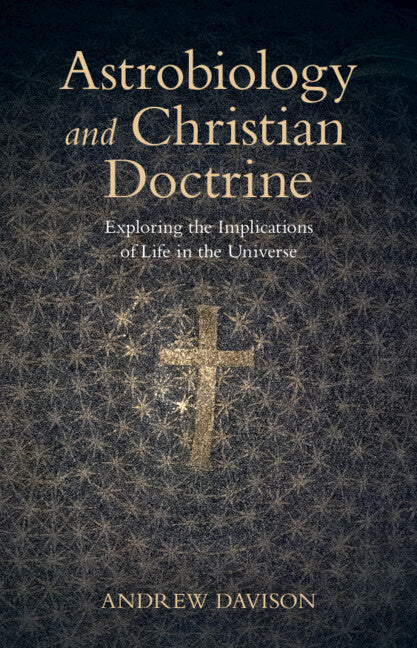
Astrobiology and Christian Doctrine
Exploring the Implications of Life in the Universe
So much now points to life beyond Earth. This book addresses the impact that would make on Christian belief.
Andrew Davison (Author)
9781009303156, Cambridge University Press
Hardback, published 6 July 2023
422 pages
22.2 x 14.9 x 2.8 cm, 0.65 kg
'This is not a book about aliens. It is mostly a book about Christology which uses aliens as a tool to pick apart theological doctrines in challenging and sometimes uncomfortable ways. Reading this book has led me to appreciate that the mere possibility of alien life provides an occasion for reassessing our theologies.' Nathan R. James, Science and Christian Belief
In recent decades, powerful telescopes have enabled astrophysicists to uncover startling new worlds and solar systems. An epochal moment came in 1995, when a planet – 51 Pegasi b – was located orbiting a star other than our own sun. Since then, thousands of new planets have followed, and the question of life beyond earth has become one of the principal topics in discussions between science and religion. Attention to this topic has a long history in Christian theology, but has rarely been pursued at any depth. Writing with both passion and precision, Andrew Davison brings his extensive knowledge of Christian thought to bear, drawing particularly on the thought of Thomas Aquinas, as well as his training as a scientist. No book to date better prepares the Christian community for responding to evidence of other life, if it is found. And yet, we do not need to wait for that to have happened before this book shows its worth. In thinking about planets, creatures, and ecosystems beyond our planet, Davison already reinvigorates our theology for the earth.
Introduction
Part I. Creation: 1. Many worlds
2. Angels
3. Life
4. Emptiness and plenitude
Part II. Revelation and Theological Knowledge: 5. Revelation
6. Knowledge of God and the language of the trinity
Part III. Imago Dei and Uniqueness: 7. A Copernican demotion? 8. Uniqueness and sharing the imago dei
9. Uniqueness, convergence and embodied cognition
Part IV. Christology, Salvation and Grace: 10. Sin and fall
11. Responses to sin: one incarnation
12. Multiple incarnations: introduction
13. Distinct incarnations: possibility and christological detail
14. The word unchanging and unchanged
15. Person assuming and natures assumed
16. Multiple incarnations: necessity and suitability
17. The dealings of God with unfallen creatures
Part V. Eschatology: 18. The final state
19. The arrival of the end.
Subject Areas: Theology [HRLB]