Freshly Printed - allow 7 days lead
Couldn't load pickup availability
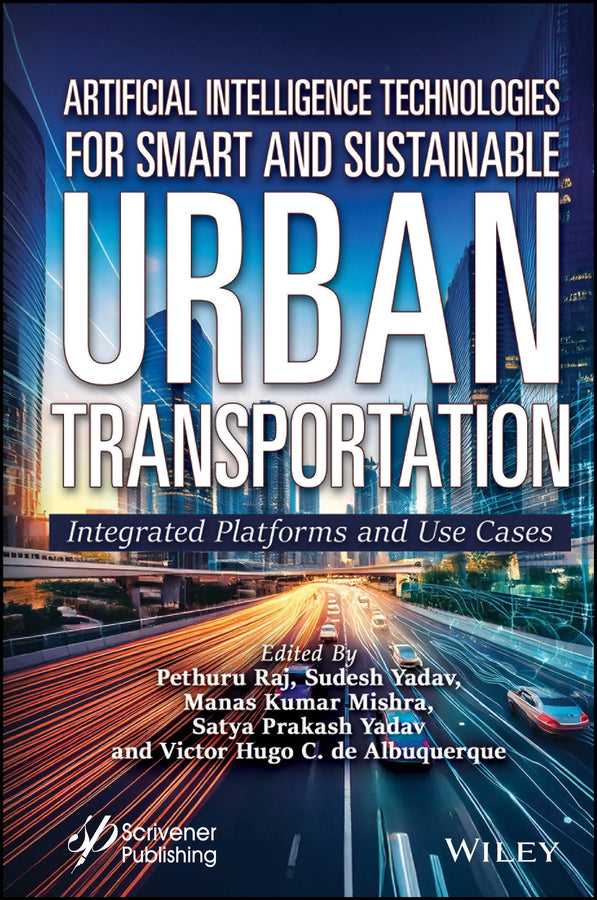
Artificial Intelligence Technologies for Smart and Sustainable Urban Transportation
Integrated Platforms and Use Cases
Pethuru Raj (Edited by), Sudesh Yadav (Edited by), Manas Kumar Mishra (Edited by), Satya Prakash Yadav (Edited by), Victor Hugo C. de Albuquerque (Edited by)
9781394346745, Wiley
Hardback, published 12 December 2025
400 pages
28 x 19 x 3 cm, 0.857 kg
Explores the future of transportation and provides a comprehensive guide to leveraging cutting-edge digital technologies and AI-powered platforms for creating smart, energy-efficient, and sustainable urban transportation systems. As urbanization accelerates globally, transportation has become a major contributor to environmental degradation and climate change. Rising greenhouse gas (GHG) emissions—including carbon dioxide (CO2), methane, ozone, nitrous oxide, and chlorofluorocarbons—pose a serious threat to air quality and environmental sustainability. To counteract these challenges, nations advocate smart, eco-friendly urban mobility solutions. This book presents the latest advancements and transformative trends in urban transportation, emphasizing emerging digital technologies that foster sustainability. The integration of artificial intelligence, 5G and 6G, cybersecurity, the Internet of Things, blockchain, edge computing, and cloud-native infrastructures enhances intelligent and energy-efficient transportation systems. Experts and environmental advocates champion innovative software platforms and solutions essential for modernizing mobility. This book examines the foundational technologies driving this transformation and explores AI-powered platforms and management solutions shaping the future of urban transportation, making it an essential resource for beginners and seasoned professionals alike.
Preface xix Part 1: Artificial Intelligence in Solving Urban Planning and Designing Challenges 1 1 Illustrating the Sustainability, Challenges, and Concerns of Urban Mobility and Smart Cities 3 1.1 Introduction 4 1.1.1 Characteristics of a Smart City 5 1.2 Smart City 6 1.2.1 An Overview of Smart Cities 6 1.2.2 Role of Digitalisation in Smart Cities 6 1.2.3 Infrastructural Impacts of Digitalisation in Smart Cities 9 1.3 Smart Mobility in Smart Cities 10 1.4 Analysis of Security Threats 13 1.4.1 Mobility Trends in Smart Cities in the Future 14 1.5 Issues and Opportunities Related to Smart Cities 15 1.5.1 Challenges for Smart Cities 15 1.5.2 Trends and Opportunities for the Future 17 1.6 Conclusions 17 References 18 2 Accentuating Climate Change Adaptation and Vulnerability (CCAV) Challenges 23 2.1 Introduction 24 2.1.1 Adapting to Climate Change Vulnerabilities 25 2.2 Related Work 26 2.2.1 Spatial Violence 26 2.2.2 Response to Climate Change 27 2.3 Key Challenges in Climate Change Adaptation and Vulnerability (CCAV) 28 2.3.1 Technical Challenges 28 2.3.2 Financial Constraints 28 2.3.3 Social and Cultural Barriers 28 2.3.4 Institutional and Governance Challenges 29 2.3.5 Multi-Level Governance (MLG) of Climate Change 29 2.4 Case Studies Highlighting Vulnerability and Adaptation Challenges 30 2.4.1 Small Island Developing States (SIDS) 30 2.4.2 Rural Farming Communities in Sub-Saharan Africa 30 2.4.3 Urban Slums in South Asia 31 2.5 Strategic Frameworks for Addressing CCAV Challenges 31 2.5.1 Through Community-Based Approaches 31 2.5.2 Mobilising Climate Finance and Reducing Funding Barriers 31 2.5.3 Strengthening Institutional Capacity and Governance Frameworks 32 2.5.4 Innovating and Leveraging Technology 32 2.5.5 Insufficient Funding and Resources 32 2.5.6 Data Gaps and Uncertainty 32 2.5.7 Insufficient Localised Solutions 33 2.5.8 Institutional and Policy Challenges 33 2.5.9 Social and Economic Inequities 33 2.5.10 Awareness and Engagement of the Public Lacking 33 2.5.11 Using Fossil Fuels as a Source of Energy 33 2.5.12 Limitations 34 2.5.13 Maintaining a Balance Between Short-Term and Long-Term Needs 34 2.5.14 Adaptation Challenges Based on Ecosystems 34 2.5.15 Efforts to Monitor and Evaluate Adaptation 34 2.5.16 Global Coordination and Climate Justice 34 2.6 Conclusion 35 References 35 3 Delineating the Solution Approaches for Sustainable Urban Mobility 39 3.1 Introduction 40 3.2 Related Work 42 3.3 Materials and Methods 44 3.3.1 Travel Demand Generation 45 3.3.2 Traffic Simulation Process 46 3.4 Results Analysis and Discussion 47 3.4.1 Amsterdam 47 3.4.2 Helsinki 49 3.5 Conclusion 51 References 51 4 About the Growing Power of Artificial Intelligence (AI) and Blockchain for Fleet Management and Sustainable Societies 55 4.1 Introduction 56 4.1.1 Artificial Intelligence and Blockchain 57 4.1.2 Sustainable Smart City Society 59 4.2 Literature Survey and Contribution 60 4.2.1 Privacy and Security Concerns 60 4.3 Blockchain to Support Smart Cities’ Operations 62 4.4 Blockchain Benefits 63 4.5 Types of Blockchain Networks 64 4.6 Blockchain Suitability 65 4.7 Conclusion 66 References 67 5 Testifying the Criticality of the Internet of Things (IoT), 5G and AI: A Perfect Combination for Battery Management 71 5.1 Introduction 72 5.1.1 Energy Management Strategy Description 74 5.2 Literature Review 74 5.2.1 Managing an EV Battery Pack 75 5.2.2 IoT in Battery Management 75 5.2.3 Wireless BMS Incentive Program 75 5.2.4 5G as a Catalyst for Rapid Data Transmission 76 5.2.5 AI and Predictive Analytics in Battery Optimization 76 5.2.6 Synergy of IoT, 5G, and AI in Battery Management 76 5.3 The Internet of Things (IoT) in Battery Management 77 5.3.1 Real-Time Monitoring and Predictive Maintenance 77 5.3.2 Data Collection and Data-Driven Insights 77 5.4 5G Connectivity: Enabling High-Speed, Low-Latency Data Exchange 77 5.4.1 Enhancing Real-Time Decision Making 78 5.4.2 Scalability of IoT Networks 78 5.5 Artificial Intelligence (AI): The Brain Behind Smart Battery Management 78 5.6 BMS’s Goals and Challenges 81 5.6.1 Optimal Charging 82 5.6.2 Fast Characterization 83 5.7 Conclusion 83 References 84 6 Using Local Knowledge and Sustainable Transport for Greener Mobility 89 6.1 Introduction 90 6.2 Related Work 92 6.3 Greening Mobility Necessities 94 6.3.1 Green Transport Standards 94 6.4 Principles of the Sustainable Mobility Paradigm 97 6.5 Conclusion 100 References 100 Part 2: Green Revolution in IoV 105 7 Expounding the Importance of Explainable AI for Greener Transportations 107 7.1 Introduction 108 7.2 Related Work 110 7.2.1 Why Explainable AI is Needed? 111 7.2.2 Evaluation of Explainable-AI (XAI) Frameworks and Results 113 7.3 The Need for Explainable AI in Transportation 115 7.4 AI’s Potential for Transforming Smart Cities and its Limitations 116 7.5 Explainable AI Supports Greener Transportation 117 7.5.1 Optimizing Traffic Flow and Reducing Emissions 117 7.5.2 Managing and Reducing Fleet Emissions 117 7.5.3 Enhancing Predictive Maintenance 118 7.5.4 Supporting Autonomous Vehicles and Green Routing 118 7.5.5 Facilitating Transparent Data Sharing 118 7.6 Benefits of Explainable AI in Greener Transportation 118 7.7 Challenges of Implementing Explainable AI in Greener Transportation 119 7.8 Conclusion 120 References 120 8 Demystifying the Aspects of Edge Computing and Edge AI for Real-Time Insights 127 8.1 Introduction 128 8.1.1 Importance of Real-Time Processing in AI 129 8.1.2 A Paradigm for Edge Computing 131 8.1.3 Mobile Edge Computing (MEC) 132 8.1.3.1 Understanding Edge Computing 132 8.1.3.2 The Architecture of Edge Computing 132 8.1.4 Advantages of Edge Computing 133 8.2 Edge AI 134 8.2.1 Decision-Making in Real-Time: Why it’s Important 135 8.2.2 Purpose and Scope of the Paper 135 8.3 Application of Edge AI in a Variety of Industries 137 8.3.1 Manufacturing 137 8.4 Edge AI Challenges and Limitations 138 8.4.1 Challenges in Technology 138 8.5 Future Directions and Trends 140 8.5.1 Federated Learning on the Edge 140 8.5.2 5G and Edge Synergy 140 8.5.3 TinyML for Edge AI 140 8.5.4 Integration with Blockchain for Security 140 8.6 Conclusion 140 References 141 9 Elucidating the Strategic Significance of Smart Grids Towards Sustainable Cities 145 9.1 Introduction 146 9.2 Related Work 149 9.3 Smart Grids as a Catalyst for Sustainability in Urban Environments 154 9.4 Smart Grid Technologies: Enabling Real-Time Decision Making 155 9.5 Challenges in Implementing Smart Grids for Sustainable Cities 156 9.6 Case Studies: Smart Grid Implementation in Sustainable Cities 156 9.7 Conclusion 157 References 157 10 Describing the Needs for Connected Electric Vehicles for Better Air Quality 161 10.1 Introduction 162 10.2 Related Work 164 10.2.1 Battery Electric Vehicles 165 10.3 Performance Aspects of CAEVs 166 10.3.1 Autonomous Vehicles 167 10.3.2 Connected Vehicles 168 10.3.3 Electric Vehicles 169 10.4 The Impact of Air Quality on Environmental Justice (EJ) 170 10.4.1 Data Collection and Setup of Air Quality Modeling Systems 170 10.5 CAV Taxonomy Based on Performance 170 10.5.1 Connected and Autonomous Electric Vehicles (CAEVs) 171 10.5.2 The Quality of Experience Framework for CAEVs 172 10.6 Conclusion 173 References 173 11 Distilling the Convergence of AI and EVs Towards Self-Driving EVs 177 11.1 Introduction 178 11.1.1 The State of Electric Vehicles (EVs) Today 181 11.2 Related Work 181 11.2.1 AI as the Backbone of Self-Driving Technology 182 11.2.2 Machine Learning and Computer Vision 182 11.2.3 Deep Reinforcement Learning 182 11.3 The Convergence of AI and EVs: Key Enablers for Self-Driving EVs 184 11.3.1 Technical Challenges in the Path Towards Self-Driving EVs 185 11.4 The Impact of Self-Driving EVs on Society and the Environment 186 11.5 The Impact of Self-Driving Vehicles on the Environment 189 11.6 Conclusion 190 References 191 12 Explaining the Distinct Functionalities of Battery Management Systems (BMS) 197 12.1 Introduction 198 12.2 Battery Management System (BMS) 199 12.3 An Overview of Components and Topologies 202 12.3.1 Software Architecture 203 12.3.2 Functionalities 204 12.4 Battery Models 205 12.4.1 Thermal Modeling 205 12.4.2 Electrical Modeling 207 12.5 Monitoring the Stack 208 12.5.1 Batteries for Grid Storage 209 12.5.2 A Modeling Approach to Lithium-Ion Batteries 209 12.5.3 Advanced Model-Based BMSs 210 12.6 State of Charge Estimation 210 12.6.1 The Need for BMS in Smart Grids and EVs 211 12.6.2 Challenges of BMS and Possible Solutions 211 12.7 Conclusion 211 References 212 13 Detailing How AI Empowers Battery Management Systems 215 13.1 Introduction 216 13.2 Systems for Managing Batteries 218 13.2.1 Structure of Elements and Arrangements 219 13.2.2 Structure of Battery-Management System 221 13.2.3 System Functions to Manage Batteries 221 13.2.4 Impacts of Battery-Management Systems 222 13.2.5 A Study of How AI Can Be Applied to Smart Grids and Renewable Energy 222 13.3 Traditionally, BMS Has Faced Many Challenges 224 13.4 AI in Business Management Systems 225 13.4.1 Calculation of State of Charge (SoC) and State of Health (SoH) 225 13.4.2 Balancing and Controlling the Temperature of Cells 225 13.4.3 Predicting and Diagnosing Faults 225 13.4.4 Optimizing Energy Efficiency and Extending the Range 226 13.5 BMS Powered by Artificial Intelligence 226 13.5.1 Machine Learning (ML) and Deep Learning (DL) 226 13.5.2 Reinforcement Learning (RL) 226 13.5.3 An Algorithm for Detecting Anomalies 227 13.5.4 Digital Twins 227 13.6 BMS with AI Enhancements: Benefits 227 13.6.1 BMS Integration with AI Offers Numerous Benefits 227 13.6.2 Future Trends and Challenges 227 13.6.3 Future Prospects 228 13.7 Conclusion 228 References 228 Part 3: Infrastructure Optimization in EV 233 14 Insisting for Electric Vehicle (EV) Charging Infrastructure Management Systems 235 14.1 Introduction 236 14.2 The Need for EV Charging Infrastructure Management Systems 238 14.2.1 User Demand for Convenience 239 14.2.2 Utility and Energy Load Management 239 14.2.3 Integration with Renewable Energy Sources 239 14.3 Overview of the Charging Infrastructure for Electric Vehicles 239 14.3.1 Equipment Specifications for Electric Vehicles 239 14.3.2 Standards for Interoperable EV Charging 241 14.4 Model Overview 242 14.4.1 Vehicle Fleet 243 14.4.2 Deployment of Electric Vehicle Charging Infrastructure 244 14.5 Hotspot-Based EVCS 246 14.6 Key Features of EV Charging Infrastructure Management Systems 246 14.6.1 Smart Charging and Load Balancing 246 14.6.2 Data Collection and Predictive Maintenance 247 14.6.3 Dynamic Pricing and User Management 247 14.6.4 Integration with Mobile Applications 247 14.6.5 Grid Interaction and Energy Storage 247 14.6.6 Scalability and Flexibility 247 14.7 Challenges in Implementing EV Charging Infrastructure Management Systems 248 14.7.1 High Initial Investment Costs 248 14.7.2 Data Security and Privacy 248 14.7.3 Interoperability and Standardization 248 14.7.4 Grid Reliability and Capacity 248 14.8 Future Directions and Innovations in EV Charging Infrastructure Management 248 14.8.1 AI and Machine Learning for Predictive Optimization 249 14.8.2 Blockchain for Secure Transactions 249 14.8.3 Ultra-Fast and Wireless Charging 249 14.9 Conclusion 249 References 250 15 Illuminating the AIs Role in Shaping Up EV Charging Infrastructures 253 15.1 Electro Mobility Charging Systems 254 15.2 Literature Review 256 15.3 Electric Vehicle Charging Infrastructure 257 15.3.1 Infrastructural Types of Charging 258 15.4 Optimizing the Charging Infrastructure Using Artificial Intelligence 259 15.4.1 Predicting Charging Demand with Data Analytics 260 15.4.2 Managing Dynamic Charges with AI 260 15.4.3 Planned Infrastructure Optimization Algorithms 261 15.5 Charging Intelligent Infrastructures 262 15.5.1 The Challenges of Developing EV Charging Infrastructure 262 15.5.2 Predicting Demand and Selecting Sites with AI 262 15.5.3 Managing and Balancing Loads in Real Time 263 15.5.4 The Integration of Renewable Energy Sources with AI 263 15.5.5 Infrastructural Challenges and Considerations in AI-Driven Charging 264 15.5.6 The Future of AI in EV Charging Infrastructure 264 15.6 Conclusion 265 References 265 16 Deciphering Smart Grid Integration and Energy Management 269 16.1 Introduction 270 16.1.1 Smart Grid Systems 271 16.1.2 Energy Management System 272 16.1.3 System for Managing Transmission Energy 273 16.2 A Smart Grid EMS Based on Communication Technologies 275 16.2.1 Gprs 275 16.2.2 WiMAX (IEEE 802.16) 276 16.2.3 Bluetooth (IEEE 802.15) 276 16.2.4 Power Line Communication (PLC) 276 16.3 Smart Grids: An Overview 277 16.3.1 An Overview of Smart Grid Components 277 16.3.2 Goals of a Smart Grid 278 16.4 Integrating Smart Grids with Existing Infrastructure 278 16.4.1 Upgrading Infrastructure 278 16.4.2 Synchronizing with Renewable Sources 279 16.4.3 Digitalizing the Grid 279 16.4.4 Cybersecurity Measures 279 16.5 Energy Management in the Smart Grid 279 16.5.1 Demand Response 279 16.5.2 Distributed Energy Resources Management (derm) 280 16.5.3 Energy Storage Solutions 280 16.5.4 Rates and Pricing for Real-Time Usage 280 16.5.5 Electric Vehicle (EV) Integration 280 16.6 Managing Energy and Integrating Smart Grids 280 16.7 Conclusion 281 References 282 17 Decoding the Aspects of Intelligent Traffic Management 287 17.1 Introduction 288 17.2 Related Work 290 17.3 Proposed Methodology 292 17.3.1 Design Objectives 292 17.3.2 Method and Materials 293 17.4 ITS Applications in Various Transport Sectors 295 17.4.1 Transportation Industry 296 17.4.2 Low CE of Urban Transportation 296 17.4.3 Road Traffic Transportation Infrastructure 296 17.5 Result and Discussion 297 17.6 Conclusion 298 References 299 18 Exploring the Impact of Computer Vision in Smart Transportation 301 18.1 Introduction 302 18.1.1 Surveillance Systems Along Roadsides: An Overview 302 18.2 Related Work 303 18.2.1 Computer Vision Functions 303 18.3 Proposed Methodology 308 18.3.1 ACF Object Detection System 309 18.3.2 Point Tracker Algorithm 309 18.3.3 Intelligent Transportation Systems: Computer Vision Applications 309 18.3.4 Intelligent Transportation Systems and Machine Learning (ML) 310 18.3.4.1 Machine Learning: The Evolution 311 18.3.4.2 Challenges 313 18.4 Result and Discussion 314 18.5 Conclusion 317 References 317 19 Exposing the Importance of Connected Lighting for Urban Sustainability 323 19.1 Introduction 324 19.2 Sustainability 326 19.3 Transdisciplinary Framework for Urban Lighting Research: Actors, Framework, and Four Steps 327 19.4 Understanding Connected Lighting Systems 330 19.5 Energy Efficiency and Reduced Carbon Emissions 330 19.6 Conclusion 332 References 333 20 Responsible and Green AI for Environment Sustainability 337 20.1 Introduction 338 20.2 AI and the Environment 339 20.2.1 Green-by AI 340 20.2.2 Green-in AI 342 20.3 Principles of Responsible AI 344 20.4 Sustainable AI for Human and Planetary Flourishing 345 20.5 AI for Environmental Sustainability 348 20.5.1 Climate Prediction and Disaster Management 348 20.5.2 Precision Agriculture 348 20.5.3 Wildlife Conservation and Biodiversity 348 20.5.4 Renewable Energy Optimisation 348 20.6 Challenges and Future Directions 349 20.7 Conclusion 349 References 349 21 Integrating AI into Mobility as a Service (MaaS): The Future of Urban Transportation 355 21.1 Introduction 356 21.1.1 The MaaS Concept 356 21.2 Mobility in Rural Areas is a Problem 359 21.3 Transportation Systems and Artificial Intelligence: A Critical Review 360 21.3.1 Artificial Intelligence-Assisted Smart Cities 360 21.3.2 AI Applications Currently in Use 363 21.3.3 Identifying Research Gaps 365 21.3.4 Sustainability Implications of Apps 365 21.3.5 The Impact of Urban Development on the Environment 366 21.4 Encounters 367 21.4.1 Challenges in Knowledge 367 21.5 Expected Early Adopter and Users 368 21.6 Conclusion 371 References 371 Index 375
Nilesh Bhosle, Amandeep Kaur, Raman Kumar, Yashwant Singh Bisht and Laith H. Alzubaidi
Adil Abbas Alwan, Amandeep Kaur, Nilesh Bhosle, Sanjeev Kumar Shah and Mohemmed Hussien
Adil Abbas Alwan, Amandeep Kaur, Nilesh Bhosle, Rajesh Singh and Mohammed Al-Farouni
Jayant Jagtap, Raman Kumar, Kunal Gagneja, Anita Gehlot and M. Muhsen Hassan
Preeti Rani, Raman Kumar, Amrita Singh, Jayant Jagtap and Muntather Almusawi
Jayant Jagtap, Amrita Singh, Sandeep Singh, Shivani Pant and Haider Mohammed Abbas
Abhilasha Jadhav, Amrita Singh, Adil Abbas Alwan, Ruby Pant and Haider Alabdeli
Abhilasha Jadhav, Heena Madan, Mohammed Y. Al-khuzaie, Ruby Pant, Nidhi Singh and Hassan M. Al-Jawahry
Abhilasha Jadhav, Heena Madan, Mohammed Y. Al-khuzaie, Sanjeev Kumar Shah and Mohammed I. Habelalmateen
Shivakrishna Dasi, Jasgurpreet Singh Chohan, Saroj Kumar Gupta, Rajesh Singh and Myasar Mundher Adnan
Shivakrishna Dasi, Heena Madan, Mohammed Y. Al-khuzaie, Anita Gehlot and Ramy Riad Al-Fatlawy
Hawraa Ali Sabah, Shivakrishna Dasi, Jaspreet Kaur, Devendra Singh and Ahmad Radee Alawadi
Umesh Chandra Garjola, Ashish Singh, Hawraa Ali Sabah, Jaspreet Kaur and Zaid Alsalami
Jasgurpreet Singh Chohan, Ashish Singh, Jaspreet Kaur, Ruby Pant and Kassem AL-Attabi
Jatinder Kumar, Ashish Singh, Hawraa Ali Sabah, Yashwant Singh Bisht and Laith H. Jasim
Jatinder Kumar, Protyay Dey, Jasgurpreet Singh Chohan, Sanjeev Kumar Shah and Laith Jasim
Preeti Rani, Jatinder Kumar, Sandeep Singh, Protyay Dey and Laith H. Jasim
Umesh Chandra Garjola, Sandeep Singh, Kamaljeet Kaur, Protyay Dey and Laith Hussein
Zainab. R. Abdulsada, Kamaljeet Kaur, Sapna Singh, Devendra Singh and Mohammed H. Al-Farouni
Kunal Gagneja, Sapna Singh, Zainab. R. Abdulsada, Shivani Pant and Rami Riad Hussien
Kunal Gagneja, Zainab. R. Abdulsada, Sapna Singh, Ruby Pant and Ramy Al-Fatlawy
Subject Areas: Computer science [UY]