Freshly Printed - allow 7 days lead
Couldn't load pickup availability
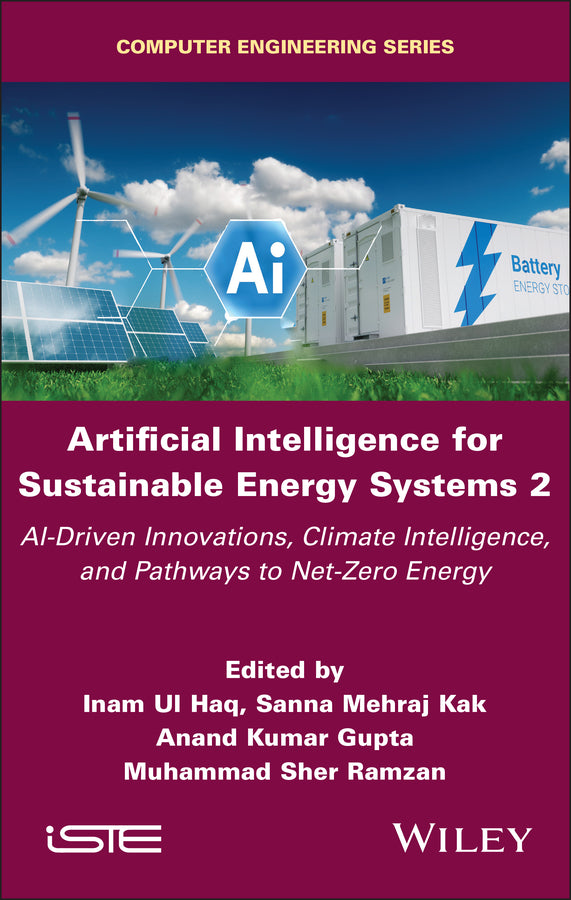
Artificial Intelligence for Sustainable Energy Systems 2
AI-Driven Innovations, Climate Intelligence, and Pathways to Net-Zero Energy
Inam Ul Haq (Edited by), Sanna Mehraj Kak (Edited by), Anand Kumar Gupta (Edited by), Muhammad Sher Ramzan (Edited by)
9781836691433, Wiley
Hardback, published 12 June 2026
288 pages
23.5 x 15.6 x 1.9 cm, 0.54 kg
Artificial Intelligence for Sustainable Energy Systems 2 presents a comprehensive exploration of how intelligent technologies are transforming modern energy infrastructures toward a more sustainable and efficient future. This book brings together the fundamental concepts of artificial intelligence (AI), machine learning, deep learning and big data analytics, with their practical integration into renewable energy systems, smart grids and digital energy management platforms. The book covers key developments such as AI-driven renewable optimization, predictive modeling for energy demand, digital twins for asset maintenance, blockchain-enabled energy trading, IoT-based smart grids and intelligent monitoring systems. By blending theoretical insights with real-world technological implementations, the book highlights how data-driven intelligence enhances reliability, security and sustainability across energy ecosystems. Designed for researchers, engineers, graduate students and policymakers, this book serves as a fundamental reference for advancing intelligent solutions in next-generation sustainable energy systems.
Preface xiii Chapter 1. AI for Solar Energy Forecasting and Optimization 1 1.1. Introduction 1 Chapter 2. Integrating ANN, SVM and GA for Optimized Wind Resource Assessment and Energy Management 25 2.1. Introduction 25 Chapter 3. Next-Generation Renewables: AI Applications in Green Hydrogen Production and Marine Energy Harvesting 43 3.1. Introduction 43 Chapter 4. Mapping the Research Landscape of AI in Electric Vehicles: A Bibliometric Analysis of Foundations and Emerging Trends 83 4.1. Introduction 83 Chapter 5. AI-Enabled Predictive and Adaptive Solutions for Environmental and Energy Challenges 107 5.1. Introduction 107 Chapter 6. Harnessing AI to Address Environmental and Energy Challenges in a Climate-Driven World 143 6.1. Introduction 144 Chapter 7. Global Policies and AI-Enabled Energy Strategies 165 7.1. Introduction 165 Chapter 8. Pathways to Net-Zero: Challenges, Risks and the Future of AI in Sustainable Energy 179 8.1. Introduction: AI and the data race to net-zero. 179 Chapter 9. The Future of AI, ML and DL in Energy and Sustainability 205 9.1. Introduction 206 Chapter 10. Hydrogen Intelligence (HyAI): A Data-Driven Approach to Transforming the Global Hydrogen Ecosystem 227 10.1. Introduction 228 List of Authors 253
Inam UL HAQ, Sanna Mehraj KAK, Anand Kumar GUPTA and Muhammad Sher RAMZAN
Sarika AGARWAL, Mamta NARWARIA, Rohit KUMAR and Savita SINGH
1.2. Fundamentals of solar energy and forecasting 3
1.3. AI techniques for forecasting 7
1.4. Predicting solar energy output using a LSTM DL model 10
1.5. Applications and case studies 14
1.6. Challenges, risks and ethical considerations 16
1.7. Future directions and research opportunities 20
1.8. Conclusion 21
1.9 References 22
Vikrant SHARMA and Salliah SHAFI
2.2. Literature review 29
2.3. Methodology 33
2.4. Result and discussion 37
2.5. Conclusion and future work 39
2.6. References 39
Pardeep KUMAR, Sanjeev KUMAR and Mohammad Badruddoza TALUKDER
3.2. Next-generation renewable energy systems: introduction 48
3.3. AI for renewable energy systems 51
3.4. Application of AI in hydrogen green production 56
3.5. AI in marine energy harvesting 59
3.6. AI-intensified systems interaction with smart grids 62
3.7. Challenges and limitations 67
3.8. Future research directions 71
3.9. Conclusions and recommendations 75
3.10. References 77Contents vii
Nivedita JHA, Rakhi ARORA and Sonal PUROHIT
4.2. Methodology 85
4.3. Analysis and discussion 87
4.4. Most relevant authors 88
4.5. Most relevant affiliations. 90
4.6. Most cited countries 92
4.7. Most relevant journals 93
4.8. Keyword analysis 95
4.9. Co-occurrence network analysis 95
4.10. Factorial analysis 97
4.11. Thematic map 100
4.12. Chronological mapping of the most influential documents 101
4.13. Conclusion 102
4.14. References 103
Inderdeep KAUR
5.2. AI technologies for environmental intelligence 109
5.3. Predictive modeling for environmental challenges 113
5.4. Adaptive AI systems for sustainable management 116
5.5. AI for renewable energy optimization 121
5.6. Case studies and practical applications 126
5.7. Challenges and ethical considerations 129
5.8. Future directions and emerging trends 133
5.9. Conclusion 137
5.10. References 138
Sahil SHARMA and Rishi KANT
6.2. AI technologies and environmental data management 146
6.3. Applications of AI in climate change mitigation 148
6.4. Challenges and ethical considerations 151
6.5. Future perspectives and integrated technologies 154
6.6. Conclusion 157
6.7. References 157
Adil Husain RATHER, Inam UL HAQ and Irfan RASOOL
7.2. International laws influencing AI use in energy systems 168
7.3. AI-powered energy techniques 171
7.4. Case studies 173
7.5. Prospects for the future 175
7.6. Conclusion 176
7.7. References 177
Mushtaq Ahmad RATHER and Vatika JALALI
8.2. The dual impact of AI on energy emissions 181
8.3. Four AI-driven transition pathways to net-zero. 184
8.4. Systemic risks in the AI-powered energy transition 189
8.5. Governance stack for responsible AI in energy 194
8.6. Conclusion: co-producing a livable climate with code 200
8.7. References 201
Mamta NARWARIA, Sarika AGARWAL, Renu MISHRA, Aman KUMAR, Avinash CHAUHAN and Ramneet
9.2. Overview of AI, ML and DL in the context of energy 207
9.3. Functions of AI, ML and DL in energy systems 209
9.4. AI and ML for sustainability goals 213
9.5. Case studies and key findings 215
9.6. Challenges and limitations in AI, ML and DL for energy and sustainability 216
9.7. Emerging trends and future directions 219
9.8. Conclusion 221
9.9. References 223
Deepak KUMAR and Shaman SHARMA
10.2. Literature review 231
10.3. Methodology: the HyAI framework 234
10.4. Results and discussion 241
10.5. Case study and model evaluation 242
10.6. Summary 245
10.7. References 247
Index 257
Subject Areas: History [HB]