In Stock - dispatch within 48 hours
Couldn't load pickup availability
Art, Knowledge, and Papal Politics in Medieval Rome
Interpreting the Aula Gotica Fresco Cycle at Santi Quattro Coronati
Shows how medieval artists developed fresco painting into a sophisticated medium for philosophical, scientific and religious speculation.
Marius B. Hauknes (Author)
9781009535762, Cambridge University Press
Hardback, published 30 January 2025
373 pages
26 x 18.7 x 2.4 cm, 0.95 kg
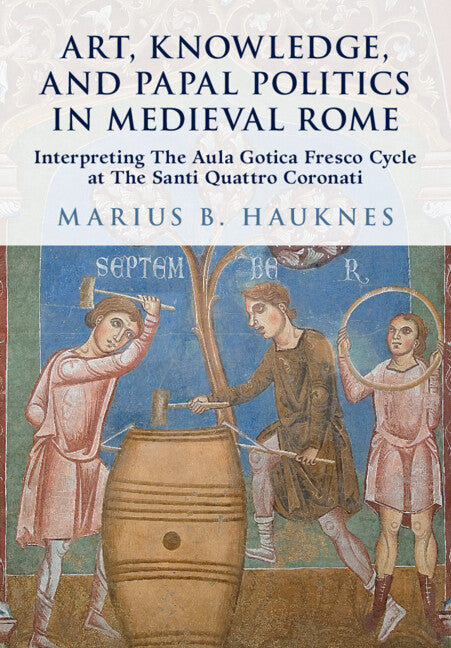
Discovered in 1995, the remarkable thirteenth-century frescoes in the great hall, or Aula Gotica, of Rome's Santi Quattro Coronati complex are among the most important vestiges of medieval Italian painting. In this volume, Marius Hauknes offers a thorough investigation of the fresco cycle, which includes allegorical representations of the liberal arts, the virtues and vices, the seasons, the signs of the zodiac, and the months of the year. Hauknes relates these subjects to the papacy's growing interest in fields of worldly knowledge, such as music, time, astrology, and medicine. He argues that the Santi Quattro Coronati frescoes function as a large-scale, interactive encyclopedia that not only represented secular knowledge but also produced philosophical speculation, stimulating beholders to draw connections between pictorial motifs across architectural space. Integrating medieval intellectual history with close attention to multi-sensory and architectural conditions of fresco Hauknes' study offers new insights into religion, art, science, and spectatorship in medieval Italy.
Introduction
1. The Santi Quattro Coronati frescoes in context
2. Art, learning and reflective viewing: the liberal arts at Santi Quattro Coronati
3. Emblems of time and political power: the labors of the months at Santi Quattro Coronati
4. Allegory, history and political eschatology: the virtues and vices at Santi Quattro Coronati
5. Visual and material entanglement in the Anagni crypt
Conclusion
Appendix
Bibliography.
Subject Areas: The arts: general issues [AB]