Freshly Printed - allow 10 days lead
Couldn't load pickup availability
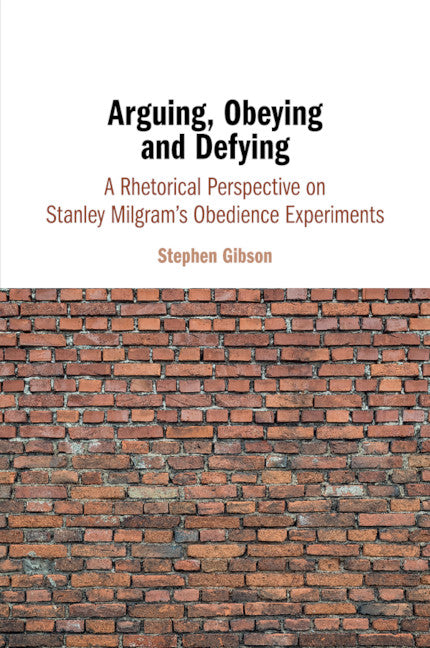
Arguing, Obeying and Defying
A Rhetorical Perspective on Stanley Milgram's Obedience Experiments
Presents an extensive qualitative analysis of the transcripts of Stanley Milgram's (in)famous obedience experiments.
Stephen Gibson (Author)
9781108431811, Cambridge University Press
Paperback / softback, published 29 October 2020
244 pages
23 x 15 x 1.5 cm, 0.36 kg
'If you thought there was nothing more to be learned from Milgram's obedience experiments conducted over fifty years ago, Stephen Gibson's rigorous forensic analysis of the archived audio recordings of these infamous experiments challenges how we should view them. Using theoretical principles from discursive and rhetorical psychology, Gibson details the rhetorical and argumentative interactions that test the standard story told in textbooks. Invoking Protagoras's maxim that there are always two sides to every story, Gibson also warns us not to summarily dismiss Milgram's findings either. A must-read for all social psychologists and their students.' Martha Augoustinos, University of Adelaide, Australia
Stanley Milgram's obedience experiments are among the most influential and controversial scientific studies ever conducted. The experiments are commonly understood to have shown how easily people can be led into harming another person, simply as a result of following orders. Recently, however, Milgram's studies have been subjected to a sustained critique and re-evaluation. This book draws on the vast stock of audio recordings from Milgram's experiments to reveal how these experiments can be understood as occasions for argumentation and rhetoric, rather than showing how passive subjects can be led into simply doing as they are told. In doing so, it reconsiders what we understand by 'obedience' and extends how social psychologists have understood rhetoric itself.
1. Introduction
2. The obedience experiments
3. Re-evaluating Milgram
4. A rhetorical perspective
5. From standardised procedure to flexible rhetoric
6. From proximity to argumentation
7. From passive agents to active rhetoricians
8. From a physical to a rhetorical metaphor
9. Conclusion.
Subject Areas: Social, group or collective psychology [JMH], Psychology [JM]