Freshly Printed - allow 7 days lead
Couldn't load pickup availability
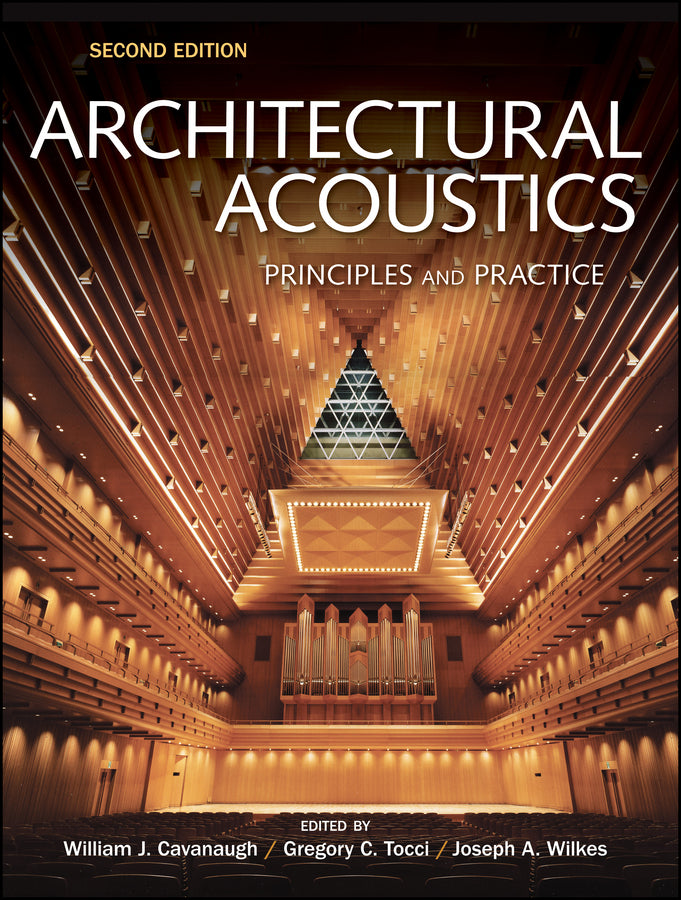
Architectural Acoustics
Principles and Practice
William J. Cavanaugh (Author), Gregory C. Tocci (Author), Joseph A. Wilkes (Author)
9780470190524, Wiley
Hardback, published 12 January 2010
352 pages, Photos: 75 B&W, 0 Color; Drawings: 175 B&W, 0 Color
28.5 x 22.4 x 2.5 cm, 1.071 kg
Get the leading guide to acoustics for architects, engineers, and interior designers. A widely recognized, comprehensive reference to acoustic principles for all concerned with the built environment, Architectural Acoustics, Second Edition provides design professionals with up-to-date information on basic concepts, acoustical materials, and technologies for controlling wanted or unwanted sound within and around buildings. Written by a team of internationally recognized experts and experienced consultants, this Second Edition covers fundamental acoustic principles, design criteria, acoustical materials, control strategies, and methods for a wide variety of building types, including educational, healthcare, recreational, residential, commercial, industrial, and transportation facilities. Particular attention is given to places for listening and performance such as theaters, churches, concert and recital halls, outdoor arenas, classrooms, multiuse auditoria, libraries, music practice and rehearsal rooms, recording and broadcast studios, sports venues, home theaters, and other spaces that people meet to communicate and enjoy performance. Updated throughout, this edition features: With fundamental conceptual understanding of basic acoustical principles provided by Architectural Acoustics, Second Edition, building designers can confidently create aesthetically and aurally pleasing spaces, while avoiding problems that could be very costly, if not impossible, to solve later.
Preface xi About the Authors xv Acknowledgments xix Chapter 1 Introduction to Architectural Acoustics and Basic Principles 1 1.1 Introduction 1 1.2 Basic Concepts 2 1.3 Design Criteria 23 1.4 Selected Standards in Building Acoustics 31 Further Reading 31 CASE STUDY: Fogg Art Museum Lecture Hall, Harvard University (1895–1973) 33 Chapter 2 Acoustical Materials and Methods 41 2.1 Introduction 41 2.2 Sound Attenuation 41 2.3 Sound Absorption 44 2.4 Common Building Materials 47 2.5 Acoustical Materials 50 2.6 Special Devices 54 2.7 Performance Tables 58 References 69 Further Reading 70 Selected Web Resources 70 CASE STUDY: Duke University Chapel: A Lesson on Acoustical Materials 71 CASE STUDY: Boston Waterfront Development Under a Flight Path: Sound-Isolating Façade Constructions to Reduce Intrusive Noise 75 CASE STUDY: Berklee College of Music: Sound-Isolating Constructions Between Percussion Studios 79 Chapter 3 Building Noise Control Applications 83 3.1 Introduction 83 3.2 Acoustical Analysis 84 3.3 Standards Organizations for the Building Industry 85 3.4 Overview of Building Noise Control Design 86 3.5 Heating, Ventilating, and Air-Conditioning System Noise Control 111 References 120 Further Reading 120 CASE STUDY: Mechanics Hall, Worcester, Massachusetts: Cooling Tower Sound Isolation 121 CASE STUDY: Field Impact Insulation Class Rating Measurements of Condominium Floor/Ceiling Construction 123 CASE STUDY: Noise Insulation Class Rating Measurements of a Hotel Guestroom Door 125 CASE STUDY: 500 Atlantic Avenue Hotel/Condominium Building Vibration Isolation 126 Chapter 4 Acoustical Design: Places for Listening 133 4.1 Introduction 133 4.2 Sound Outdoors and Transition to Indoor Acoustics 133 4.3 Concert Halls and Recital Halls 136 4.4 Opera Houses, Theaters, General-Purpose Auditoriums, and Worship Spaces 145 4.5 Other Places for Speech and Music Activities 155 References 158 Further Reading 159 CASE STUDY: Holy Cross Church, Dewitt, New York 160 CASE STUDY: Mitchell Hall at the University of Delaware, Newark, Delaware—Historic Renovation 162 CASE STUDY: The New Hitchcock Presbyterian Church, Scarsdale, New York 164 CASE STUDY: Katherine M. Elfers Concert Hall at the Esther Eastman Music Center, Hotchkiss School, Lakeville, Connecticut 165 CASE STUDY: Ozawa Hall, Tanglewood Music Center, Lenox, Massachusetts 167 CASE STUDY: Hollywood Bowl Stage Redesign, Los Angeles, California 169 Chapter 5 Sound Systems 175 5.1 Introduction 175 5.2 Loudspeaker Systems 178 5.3 Equipment 181 5.4 Examples of Sound Reinforcement and Reproduction Systems 186 5.5 Special Sound System Installations 190 Further Reading 191 CASE STUDY: Hanover Theatre, Worcester, Massachusetts 192 CASE STUDY: Agganis Arena and Boston University Fitness and Recreation Center, Boston, Massachusetts 194 CASE STUDY: Ave Maria University Oratory, Ave Maria, Florida 197 CASE STUDY: University of Connecticut Student Union, Storrs, Connecticut 199 CASE STUDY: Rhode Island Senate Chamber, Providence, Rhode Island 201 CASE STUDY: Rhodes Arts Center, Northfield Mount Hermon School, Gill, Massachusetts 202 CASE STUDY: Tufts University Granoff Music Center, Medford, Massachusetts 205 CASE STUDY: Jay Pritzker Music Pavilion, Chicago, Illinois 206 Chapter 6 Recent Innovations in Acoustical Design and Research 209 6.1 Introduction 209 6.2 Understanding and Measuring Room Acoustic Qualities 211 6.3 Acoustical Modeling and Aural Simulation 231 6.4 Other Directions in Architectural Acoustics Research 233 6.5 Conclusions 238 References 239 Further Reading 240 CASE STUDY: Recent Halls for the Performing Arts and Acoustical Model Studies 241 CASE STUDY: Segerstrom Hall, Orange County Performing Arts Center, Orange County, California 242 CASE STUDY: McDermott Concert Hall, Morton H. Meyerson Symphony Center, Dallas, Texas 245 CASE STUDY: Evangeline Atwood Concert Hall, Alaska Center for the Performing Arts, Anchorage, Alaska 249 CASE STUDY: Bass Performance Hall, Fort Worth, Texas 253 CASE STUDY: The Esplanade Concert Hall, Theaters on the Bay, Singapore 255 CASE STUDY: Tokyo Opera City Concert Hall, Takemitsu Memorial, Tokyo, Japan 257 CASE STUDY: Walt Disney Concert Hall, Los Angeles, California 260 CASE STUDY: Computer Model Tests 264 Chapter 7 Sustainable Design and Acoustics 273 7.1 Introduction 273 7.2 Organizations Leading the Green Building Movement 274 7.3 Acoustical Challenges of Green Design 277 7.4 Postoccupancy Evaluations of Green Buildings 281 7.5 Examples of Building Types Designed for Green Ratings 281 7.6 Conclusion 285 References 285 Further Reading 286 Internet and Web Resources 286 CASE STUDY: Global Ecology Research Center at Stanford University, Palo Alto, California 287 CASE STUDY: Dougherty Valley High School, San Ramon, California 289 CASE STUDY: Charles Salter Associates Tenant Improvement Office, San Francisco, California 291 Appendixes 295 Appendix A: Conversion Factors, Abbreviations, and Unit Symbols 295 Appendix B: Acoustical Societies Throughout the World 297 Appendix C: Selection of an Acoustical Consultant 303 Appendix D: Self-Study Guide for Using this Book 305 Glossary 311 Index 317
William J. Cavanaugh
Rein Pirn and Jeffrey L. Fullerton
Gregory C. Tocci
L. Gerald Marshall
Matthew J. Moore
Gary W. Siebein and Bertram Y. Kinzey, Jr.
Ethan Salter, Leed Ap
Subject Areas: Architecture [AM]