Freshly Printed - allow 10 days lead
Couldn't load pickup availability
Applied Science
Knowledge, Modernity, and Britain's Public Realm
Bud explores the rise and fall of 'applied science' as a category of thought shaped by scientists and laity alike.
Robert Bud (Author)
9781009365239, Cambridge University Press
Hardback, published 28 March 2024
342 pages
23.5 x 15.8 x 2.4 cm, 0.64 kg
'Bud has delivered an ambitious, erudite and now acutely timely biography of a concept - applied science. It is an important subject, one which, given Bud's prominence in the history of science, will no doubt receive a great deal of scholarly attention.' Paul Lucier, The British Journal for the History of Science
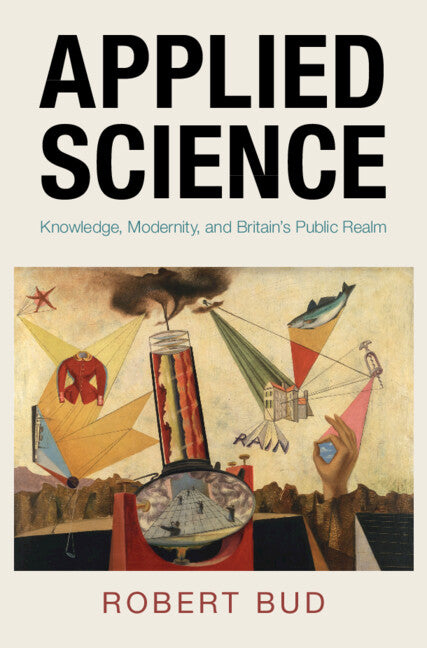
For almost two centuries, the category of 'applied science' was widely taken to be both real and important. Then, its use faded. How could an entire category of science appear and disappear? By taking a longue durée approach to British attitudes across the nineteenth and twentieth centuries, Robert Bud explores the scientific and cultural trends that led to such a dramatic rise and fall. He traces the prospects and consequences that gave the term meaning, from its origins to its heyday as an elixir to cure many of the economic, cultural, and political ills of the UK, eventually overtaken by its competitor, 'technology'. Bud examines how 'applied science' was shaped by educational and research institutions, sociotechnical imaginaries, and political ideologies and explores the extent to which non-scientific lay opinion, mediated by politicians and newspapers, could become a driver in the classification of science.
Introduction: the biography of a concept
Stage 1. Origins and Pedagogy in the Nineteenth Century
1. Applied science conceived: the early nineteenth century
2. Applied science Institutionalised: the Liberal Science College
3. Competing concepts of applied science and technology
Stage 2. Research in the Early Twentieth Century
4. The dawn of the twentieth century
5. From the magi to industrial function
6. 'Western civilisation' and applied science
Stage 3. After World War Two
7. Co-existence through growth
8. From applied science to technological innovation
Conclusion.
Subject Areas: History of engineering & technology [TBX]