Freshly Printed - allow 7 days lead
Couldn't load pickup availability
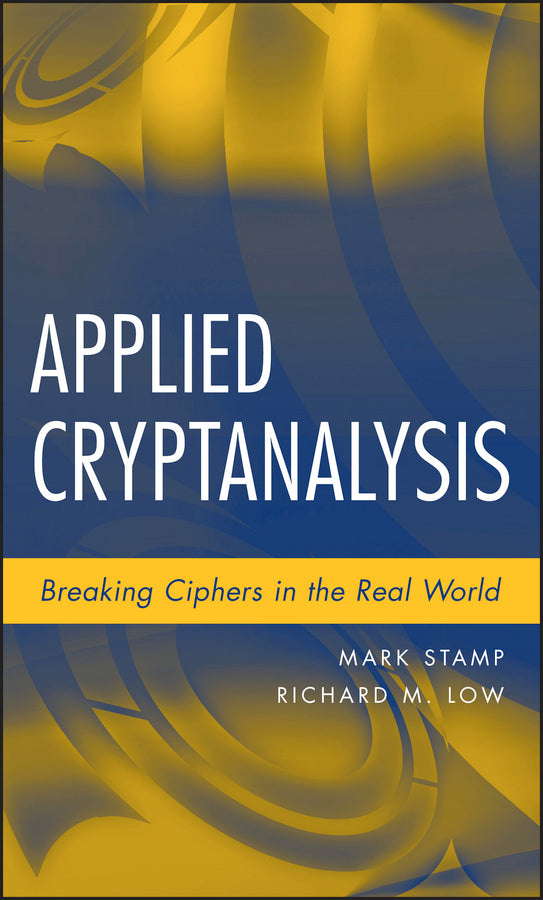
Applied Cryptanalysis
Breaking Ciphers in the Real World
Mark Stamp (Author), Richard M. Low (Author)
9780470114865, Wiley
Hardback, published 18 May 2007
424 pages, Photos: 4 B&W, 0 Color; Drawings: 65 B&W, 0 Color; Tables: 75 B&W, 0 Color
23.9 x 15.8 x 2.8 cm, 0.748 kg
"…a very good book for students and people who want to learn some real cryptanalysis…" (Computing Reviews.com, October 1, 2007) "…this is not a book to be merely read or studied, but a field manual to be followed." (Computing Reviews.com, August 14, 2007)
The book is designed to be accessible to motivated IT professionals who want to learn more about the specific attacks covered. In particular, every effort has been made to keep the chapters independent, so if someone is interested in has function cryptanalysis or RSA timing attacks, they do not necessarily need to study all of the previous material in the text. This would be particularly valuable to working professionals who might want to use the book as a way to quickly gain some depth on one specific topic.
Preface. About The Authors . Acknowledgments. 1. Classic Ciphers. 1.1 Introduction . 1.2 Good Guys and Bad Guys. 1.3 Terminology . 1.4 Selected Classic Crypto Topics. 1.4.1 Transposition Ciphers . 1.4.2 Substitution Ciphers. 1.4.3 One-Time Pad . 1.4.4 Codebook Ciphers . 1.5 Summary. 1.6 Problems . 2. World War II Ciphers. 2.1 Introduction . 2.2 Enigma . 2.2.1 Enigma Cipher Machine . 2.2.2 Enigma Keyspace . 2.2.3 Rotors . 2.2.4 Enigma Attack . 2.2.5 More Secure Enigma. 2.3 Purple. 2.3.1 Purple Cipher Machine . 2.3.2 Purple Keyspace . 2.3.3 Purple Diagnosis . 2.3.4 Decrypting Purple. 2.3.5 Purple versus Enigma . 2.4 Sigaba . 2.4.1 Sigaba Cipher Machine. 2.4.2 Sigaba Keyspace . 2.4.3 Sigaba Attack . 2.4.4 Sigaba Conclusion . 2.5 Summary . 2.6 Problems . 3. Stream Ciphers. 3.1 Introduction . 3.2 Shift Registers . 3.2.1 Berlekamp-Massey Algorithm . 3.2.2 Cryptographically Strong Sequences . 3.2.3 Shift Register-Based Stream Ciphers. 3.2.4 Correlation Attack. 3.3 ORYX . 3.3.1 ORYX Cipher. 3.3.2 ORYX Attack. 3.3.3 Secure ORYX. 3.4 RC4. 3.4.1 RC4 Algorithm . 3.4.2 RC4 Attack . 3.4.3 Preventing the RC4 Attack. 3.5 PKZIP. 3.5.1 PKZIP Cipher. 3.5.2 PKZIP Attack. 3.5.3 Improved PKZIP. 3.6 Summary. 3.7 Problems. 4. Block Ciphers. 4.1 Introduction . 4.2 Block Cipher Modes . 4.3 Feistel Cipher. 4.4 Hellman’s Time-Memory Trade-Off. 4.4.1 Cryptanalytic TMTO. 4.4.2 Bad Chains. 4.4.3 Success Probability. 4.4.4 Distributed TMTO. 4.4.5 TMTO Conclusions. 4.5 CMEA. 4.5.1 CMEA Cipher. 4.5.2 SCMEA Cipher. 4.5.3 SCMEA
Subject Areas: Computer science [UY]