Freshly Printed - allow 10 days lead
Couldn't load pickup availability
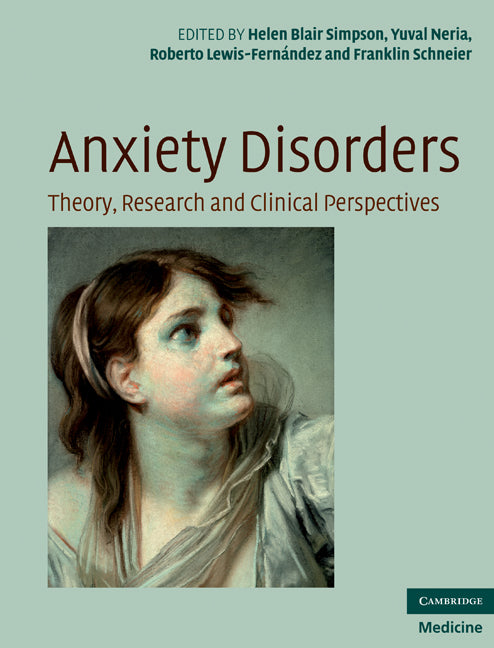
Anxiety Disorders
Theory, Research and Clinical Perspectives
Illustrates the enormous advances occurring in research and describes the multi-disciplinary efforts that will shape the future of the field.
Helen Blair Simpson (Edited by), Yuval Neria (Edited by), Roberto Lewis-Fernández (Edited by), Franklin Schneier (Edited by)
9780521515573, Cambridge University Press
Hardback, published 26 August 2010
394 pages, 23 b/w illus. 2 colour illus. 34 tables
25.3 x 19.3 x 2.3 cm, 1.02 kg
'It is uncommon to read a good book on anxiety disorders. This one, however, is unusually fine. Anxiety Disorders: Theory, Research and Clinical Perspectives is highly descriptive and clinically useful. It is well researched and a pleasure to read … It is written in a compelling style, which is a benefit to the student, clinician, or educated layman. The references are excellent and the index is helpful. This is a good book for any clinician interested in anxiety. It covers theory, diagnoses, treatment, and future directions … I highly recommend it.' James Allen Wilcox, Annals of Clinical Psychiatry
Anxiety disorders are amongst the most common of all mental health problems. Research in this field has exploded over recent years, yielding a wealth of new information in domains ranging from neurobiology to cultural anthropology to evidence-based treatment of specific disorders. This book offers a variety of perspectives on new developments and important controversies relevant to the theory, research, and clinical treatment of this class of disorders. Clinicians will find reviews of state-of-the-art treatments for panic disorder, social anxiety disorder, phobias, obsessive-compulsive disorder, generalized anxiety disorder, and post-traumatic stress disorder, as well as controversies over diagnostic and treatment issues. Researchers will find in-depth consideration of important selected topics, including genetics, neuroimaging, animal models, contemporary psychoanalytic theory, and the impact of stressors. This book illustrates the enormous advances that have occurred in anxiety research and describes the evolving multi-disciplinary efforts that will shape the future of the field.
Foreword Jeffrey Lieberman
1. Introduction: the need for an interdisciplinary approach Helen Blair Simpson, Yuval Neria, Roberto Lewis-Fernández and Franklin R. Schneier
Part I. Evolving Concepts of Anxiety: 2. The epidemiology of anxiety disorders Jonathan S. Comer and Mark Olfson
3. Development of the nosology of anxiety disorders Michael B. First, Desiree K. Caban and Roberto Lewis-Fernández
4. The emergence of social phobia as a major medical condition Michael R. Liebowitz
5. Anxiety as signal, symptom and syndrome Robert A. Glick and Steven P. Roose
6. New concepts in the evolution and development of anxiety Myron A. Hofer
Part II. Challenges in Diagnosing Pathological Anxiety: 7. Challenges in OCD research: overcoming heterogeneity Anthony Pinto, Marco A. Grados and Helen Blair Simpson
8. Is there a spectrum of social anxiety disorder? Franklin R. Schneier and Jami Socha
9. Co-occurring anxiety and depression: concepts, significance, and treatment implications Patrick J. McGrath and Jeffrey M. Miller
10. Understanding health anxiety Kelli Jane K. Harding, Natalia Skritskaya, Emily R. Doherty and Brian A. Fallon
11. Axis II and anxiety disorders Matthew J. Kaplowitz and John C. Markowitz
12. 'Idioms of distress' (culturally salient indicators of distress) and anxiety disorders Devon E. Hinton and Roberto Lewis-Fernández
Part III. Understanding the Causes of Anxiety: 13. Current status of research in the genetics of anxiety disorders Nicole R. Nugent, Myrna Weissman, Abby Fyer and Karestan C. Koenen
14. Animal models of anxiety disorders: behavioral and genetic approaches Jesse W. Richardson-Jones, E. David Leonardo, Rene Hen and Susanne E. Ahmari
15. Role of the cortex in the regulation of anxiety states Noelia V. Weisstaub, Caitlin McOmish, James Hanks and Jay A. Gingrich
16. Learned fear and innate anxiety in rodents and their relevance to human anxiety disorders Joshua A. Gordon and Avishek Adhikari
17. Brain systems underlying anxiety disorders: a view from neuroimaging Amit Etkin and Tor D. Wager
18. Cognitive-behavioral treatment of anxiety disorders: model and current issues James P. Hambrick, Jonathan S. Comer and Anne Marie Albano
19. The stressor Criterion A in post-traumatic stress disorder: issues, evidence, and implications Bruce Dohrenwend
20. Attachment, separation, and anxiety disorders Elizabeth Sagurton Mulhare, Angela Ghesquiere and M. Katherine Shear
21. Non-human primate models in understanding anxiety Navin A. Natarajan, Ranjeeb Shrestha and Jeremy D. Coplan
Part IV. Treatment of Anxiety: Current Status and Controversial Issues: 22. Evidence-based treatment for patients with obsessive-compulsive disorder: questions and controversies Carolyn Rodriguez and Helen Blair Simpson
23. Treatment of social anxiety disorder Franklin R. Schneier, Kristin Pontoski and Richard G. Heimberg
24. Treatment of post-traumatic stress disorder Gregory M. Sullivan, Eun Jung Suh and Yuval Neria
25. Panic disorder Smit S. Sinha and Donald F. Klein
26. Treatment of late-life generalized anxiety disorder Laszlo A. Papp, Ethan E. Gorenstein and Jan Mohlman
27. Childhood anxiety disorders: best treatment options and practice Hilary B. Vidair and Moira A. Rynn
28. Brain stimulation in the treatment of anxiety disorders Antonio Mantovani and Sarah H. Lisanby
29. Complementary and alternative medicine approaches to the treatment of anxiety Sapana R. Patel, Anthony J. Tranguch and Philip R. Muskin
30. The treatment of anxiety disorders in primary care Mayumi Okuda, Sharaf S. Khan, Ana Alicia de la Cruz and Carlos Blanco
31. Future directions Helen Blair Simpson, Yuval Neria, Roberto Lewis-Fernández and Franklin R. Schneier
Index.