Freshly Printed - allow 7 days lead
Couldn't load pickup availability
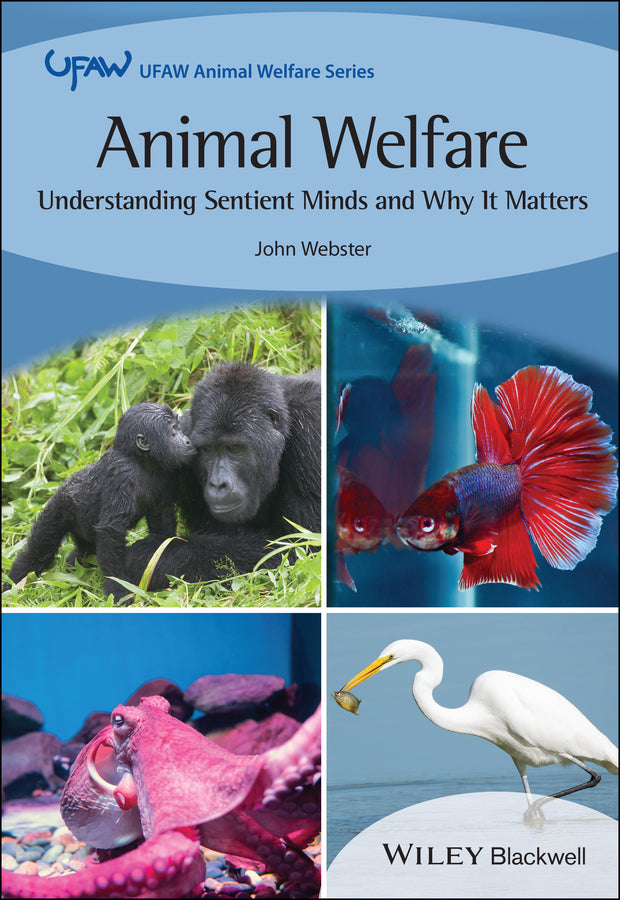
Animal Welfare
Understanding Sentient Minds and Why It Matters
John Webster (Author)
9781119857068, Wiley
Paperback / softback, published 5 May 2022
176 pages
24.4 x 17 x 1 cm, 0.285 kg
Animal Welfare An Accessible Overview of the Concept of Sentience Throughout the Animal Kingdom and Why It Matters to Humans Animal Welfare explores the concept of sentience and the development of sentient minds throughout the animal kingdom. The work provides improved definitions and analysis of the ideas of sentience, cognition, and consciousness, along with evidence of advanced mental formulation in birds, fish, and invertebrates. Considerations between humans and animals are also discussed, such as outcome-based ethics in relation to humans’ duties of care and the rights and wrongs of domestication. The work is divided into three parts and covers key topics such as: Animal Welfare serves as an invaluable analysis of animal sentience for students, teachers, and professionals directly involved in the study, teaching, and applications of animal behavior, motivation, and welfare. Thanks to the wide-ranging implications of animal sentience, the work will also appeal to everyone with a broader interest in animal behavior and human/animal interactions.
About the Author xi Preface xiii Acknowledgements and Apologies xv Part 1 The Sentient Mind: Skills and Strategies 1 1 Setting the Scene 3 Human Attitudes to Animals 5 Animal Behaviour Science 7 Rules of Engagement 9 2 Sentience and the Sentient Mind 13 Sentience, Consciousness and the Mind 14 The Five Skandhas of Sentience 14 Understanding the Sentient Mind 17 Pain and Suffering 21 Fear and Dread 23 Coping with Challenge: Stress and Boredom 24 Social Life 26 Comfort and Joy 28 Hope and Despair 29 Sex and Love 29 Summary 30 3 Special Senses and Their Interpretation 32 Vision 33 Hearing 35 Smell and Taste 36 Cutaneous Sensation, Touch 37 Magnetoreception 38 Interpreting the Special Senses 38 Theory of Mind, or Metarepresentation 40 Summary 41 4 Survival Strategies 42 Foraging 43 Hunting Behaviour: The Predator and the Prey 48 Spatial Awareness and Navigation 50 Breeding Behaviour and Parental Care 52 5 Social Strategies 55 Sentient Social Life 57 Social Hierarchies: The Pecking Order 58 Communication 59 Cooperation and Empathy 60 Social Learning, Education and Culture 61 Territorial Behaviour and Tribalism 62 Part 2 Shaping Sentient Minds: Adaptation to the Environment 65 6 Animals of the Waters 67 Pain and Fear 69 Survival Skills: Hunting, Hiding and Problem Solving 71 Migration 72 Communication and Social Behaviour 74 7 Animals of the Air 77 Feeding Strategies 78 Migration 80 Sentience and Breeding Behaviour 82 Social Behaviour, Culture and Education 83 Bats 84 8 Animals of the Savannah and Plains 86 Environmental Challenges 87 Animals of the Open Plains 88 Sheep 88 Goats 90 Cattle 91 Wild Bovidae 92 Feral Horses 93 Elephants 93 Predators 96 9 Animals of the Forest 97 The Boreal Forest 97 Cervidae 98 Beavers 100 Bears 101 The Tropical Rain Forests 102 Snakes 103 Primates 104 10 Close Neighbours 106 History of Domestication 107 Artificial Selection and Unnatural Breeding 108 Domestication, Sentience and Wellbeing 109 Pigs 110 Dogs 113 Cats 114 Dairy Cows 115 Horses and Donkeys 118 Chickens 121 Opportunist Neighbours: Rats and Urban Foxes 123 Coda 124 Part 3 Why it matters: Nature’s Social Union 125 11 Our Duty of Care 127 Sentience Revisited 128 Outcome-based Ethics 131 Death and Killing 133 Farms, Farmed Animals and Food 135 Animals in Laboratories 136 Wild Animals in Captivity 138 Animals in Sport and Entertainment 140 Pets 143 What can We Learn from the Animals? 144 Further Reading 147 General Reading 151 Index 152
Subject Areas: Veterinary medicine [MZ]