Freshly Printed - allow 7 days lead
Couldn't load pickup availability
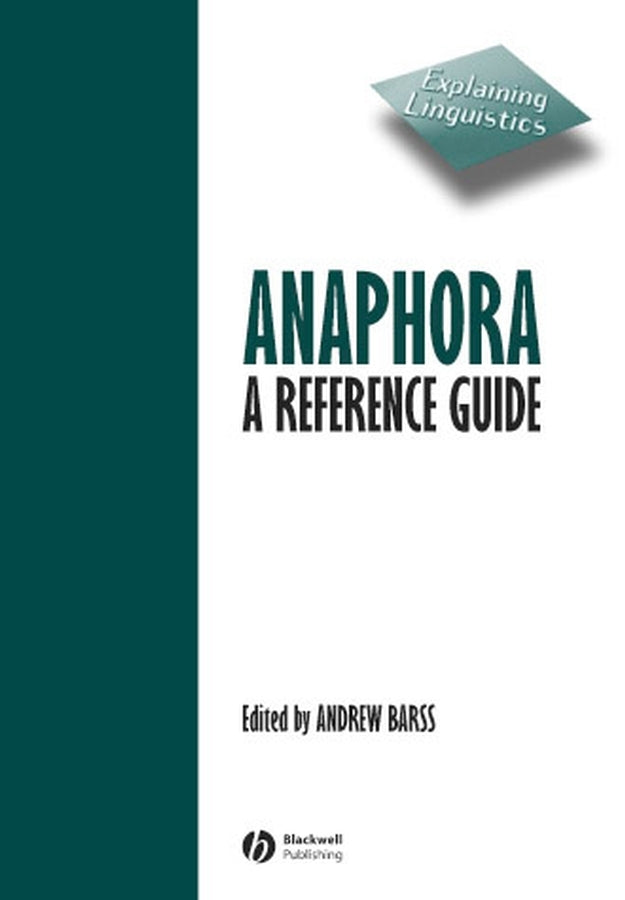
Anaphora
A Reference Guide
Andrew Barss (Edited by)
9780631211181, Wiley
Paperback / softback, published 12 December 2002
304 pages
24.8 x 17.3 x 2.5 cm, 0.553 kg
‘Andrew Barss's Anaphora is a dynamic contribution, full of interesting and insightful essays. I recommend it in the highest possible terms.’ David Lebeaux, NEC Research Institute ‘This is an outstanding book. Relating linguistics to other cognitive domains in a non-trivial way, it clearly addresses an impressive number of issues important for our understanding of the design and nature of language.’ Pierre Pica, Centre National de la Recherche Scientifique, Paris, France "Andrew Narss has done Linguistics and its related fields a good service by putting together a collection of papers that address a number of important issues in the study of anaphora. The major selling point of the book under considersation is two fold. First the articles contained in the volume are of high quality ... Secondly, the book represents a welcome attempt to relate linguistics to cognitive science, thus helping to shed new light on our quest to attain a better understanding of human cognition ... the book deserves to be read by anyone who is seriously interested in the study of anaphora." Linguistics, volume 42 2006, Cambridge University Press
Anaphora: A Reference Guide is a collection of essays that report on the major results of recent research in anaphora and set the stage for further inquiry.
Notes on Contributors. Preface. Acknowledgments. 1. Timing Puzzles in Anaphora and Interpretation (Andrew Barss). 2. Two Types o0f Scrambling Constructions in Japanese (Ayumi Ueyama). 3. The Psycholinguistics of Anaphora (Janet L. Nicol and David A. Swinney). 4. Two Pronominal Mysteries in the Acquisition of Binding and Control (Dana McDaniel). 5. Reference Transfers and the Giorgione Problem (Mario Montalbetti). 6. Tense and Anaphora: Is There a Tense-Specific Theory of Coreference (Karen Zagona). 7. Surface and Deep Anaphora, Sloppy Identity, and Experiments in Syntax (Hajime Hoji). 8. The Logic of Reflexivity and Reciprocity (D. Terence Langendoen and Joel Magloire). References. Index.
Subject Areas: Language teaching & learning [other than ELT CJ]