Special Order - allow 2+ weeks lead
Couldn't load pickup availability
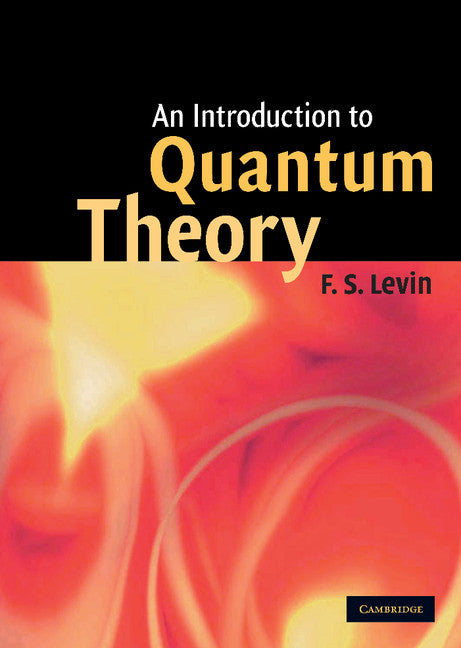
An Introduction to Quantum Theory
An undergraduate introductory quantum mechanics textbook with a large number of figures and exercises.
F. S. Levin (Author)
9780521591614, Cambridge University Press
Hardback, published 10 December 2001
808 pages, 163 b/w illus. 20 tables
26.2 x 18.7 x 3.6 cm, 1.526 kg
'… [a] sound reliable text, suitable for students with the appropriate abilities and background.' Alastair Rae, The Times Higher Education Supplement
Underpinning the axiomatic formulation of quantum theory presented in this undergraduate textbook is a review of early experiments, a comparison of classical and quantal terminology, a Schroedinger-equation treatment of the one-dimensional quantum box, and a survey of relevant mathematics. Among the many concepts comprehensively discussed are: operators; state vectors and wave functions; experimental observables; classical/quantal connections; and symmetry properties. The theory is applied to a wide variety of systems including the non-relativistic H-atom, external electromagnetic fields, and spin1/2. Collisions are described using wave packets. Various time-dependent and time-independent approximations are discussed; applications include electromagnetic transition rates and corrections to the H-atom energies. The final chapter deals with identical-particle symmetries and their application to the He atom, the Periodic Table and diatomic molecules. There are also brief treatments of advanced subjects such as gauge invariance and hidden variables.
Preface
Part I. Introductory: 1. The need for a non-classical description of microscopic phenomena
2. Classical concepts and quantal inequivalencies
3. Introducing quantum mechanics: a comparison of the classical stretched string and the quantal box
4. Mathematical background
Part II. The Central Concepts: 5. The postulates of quantum mechanics
6. Applications of the postulates: bound states in one dimension
7. Applications of the postulates: continuum states in one dimension
8. Quantal/classical connections
9. Commuting operators, quantum numbers, symmetry properties
Part III. Systems with Few Degrees of Freedom: 10. Orbital angular momentum
11. Two-particle systems, potential-well bound state problems
12. Electromagnetic fields
13. Intrinsic spin, two-state systems
14. Generalized angular momentum and the coupling of angular momenta
15. Three-dimensional continuum states/scattering
Part IV. Complex Systems: 16. Time-dependent approximation methods
17. Time-independent approximation methods
18. Many degrees of freedom: atoms and molecules
Appendix A. Elements of probability theory
Appendix B. Fourier series and integrals
Appendix C. Solution of Legendre's equation
Appendix D. Fundamental and derived quantities, conversion factors
References.
Subject Areas: Quantum physics [quantum mechanics & quantum field theory PHQ], Physics [PH]