Freshly Printed - allow 10 days lead
Couldn't load pickup availability
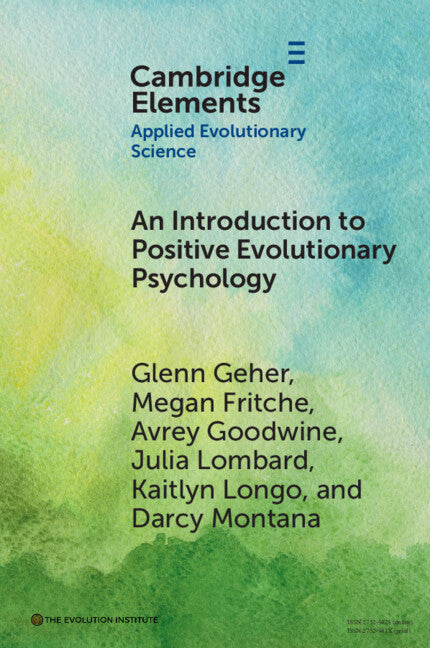
An Introduction to Positive Evolutionary Psychology
The intersection of evolutionary and positive psychology allows us to understand and improve the overall wellbeing of one's life.
Glenn Geher (Author), Megan Fritche (Author), Avrey Goodwine (Author), Julia Lombard (Author), Kaitlyn Longo (Author), Darcy Montana (Author)
9781009286855, Cambridge University Press
Paperback / softback, published 18 May 2023
56 pages
22.8 x 15.2 x 0.4 cm, 0.1 kg
Over the past few decades, evolutionary psychology has shed light on such features of the human experience as mating, love, religion, aggression, warfare, physical health, mental health, and more. The field of positive psychology has progressed along a parallel trajectory, using behavioral science techniques to help our understanding of human thriving at the individual and community levels. Positive Evolutionary Psychology is dedicated to the integration of positive and evolutionary psychology, with an eye toward using Darwinian-inspired concepts to help advance our understanding of human thriving. This Element describes the basic ideas of this new approach to behavioral science as well as examples that dip into various aspects of the human experience, including such topics as health, education, friendships, love, and more–all with an eye toward providing a roadmap for the application of Darwinian principles to better understanding human thriving and the good life.
1. What is Positive Evolutionary Psychology?
2. Why Do We Need Positive Evolutionary Psychology?
3. Evolutionary Mismatch as a Foundational Concept in Positive Evolutionary Psychology
4. Understanding Family Through an Evolutionary Lens
5. Evolutionary Psychology Applied to Education
6. Evolutionary Psychology, Happiness, and Mental Health
7. Evolutionary Psychology and the Cultivation of Community
8. The Evolution of Social and Moral Emotions
9. Evolutionary Psychology and Physical Health
10. Future Directions in Positive Evolutionary Psychology
11. Bottom Line.
Subject Areas: Physiological & neuro-psychology, biopsychology [JMM]