Freshly Printed - allow 7 days lead
Couldn't load pickup availability
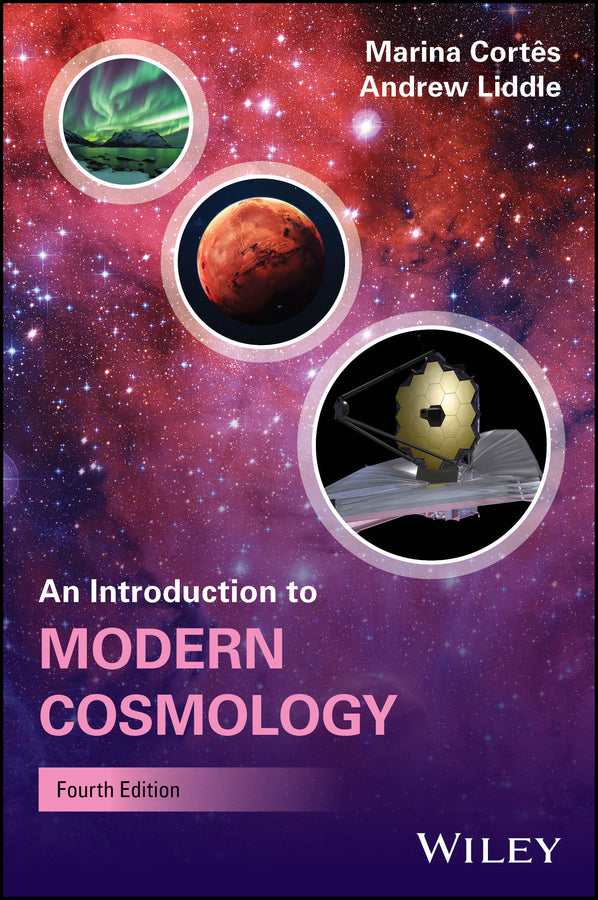
An Introduction to Modern Cosmology
Marina V. Cortês (Author), Andrew Liddle (Author)
9781394278435, Wiley
Paperback / softback, published 23 April 2026
224 pages
22.6 x 15.2 x 1.8 cm, 0.363 kg
Updated edition of a popular introduction to cosmology, now with new observational data, supporting web material, and problems with solutions An Introduction to Modern Cosmology is an accessible account of modern cosmological ideas that enables readers to understand cosmology without resorting to the mathematical apparatus of general relativity. This fully revised Fourth Edition of the bestseller takes an approach which is grounded in physics with a logical flow of chapters, leading the reader from basic ideas of the expansion described by the Friedman equations to some of the more advanced ideas about the early universe. The Advanced Topic sections present subjects with more detailed mathematical approaches to give greater depth to discussions. Student problems with hints for solving them and numerical answers are embedded in the chapters to facilitate the readers’ understanding and learning. The new edition contains updated observational data, more detailed explanations and examples of the central-to-cosmology Friedman equations, and references to extensive online supporting material. It also incorporates up-to-date results from the Planck mission, which imaged the anisotropies of cosmic microwave background radiation over the whole sky. Sample topics explored in An Introduction to Modern Cosmology include: Written in a clear, concise format with short, accessible chapters, An Introduction to Modern Cosmology is an essential textbook resource on the subject for advanced undergraduate and graduate students of astronomy, astrophysics, and physics.
Preface xi About the Companion Website xv 1 A Brief History of Cosmological Ideas 1 2 Observational Overview 3 2.1 In visible light 4 2.2 In other wavebands 8 2.3 Homogeneity and isotropy 11 2.4 The expansion of the Universe 11 2.5 Particles in the Universe 14 2.5.1 What particles are there? 14 2.5.2 Thermal distributions and the blackbody spectrum 16 3 Newtonian Gravity 21 3.1 The Friedmann equation 22 3.2 On the meaning of the expansion 25 3.3 Things that go faster than light 25 3.4 The fluid equation 26 3.5 The acceleration equation 27 3.6 On mass, energy, and vanishing factors of c 2 28 4 The Geometry of the Universe 31 4.1 Flat geometry 31 4.2 Spherical geometry 32 4.3 Hyperbolic geometry 35 4.4 Infinite and observable universes 36 4.5 Where did the Big Bang happen? 36 4.6 Three values of k 37 5 Simple Cosmological Models 39 5.1 Hubble’s law 39 5.2 Expansion and redshift 40 5.3 Solving the equations 41 5.3.1 Matter 42 5.3.2 Radiation 43 5.3.3 Mixtures 44 5.4 Particle number densities 46 5.5 Evolution including curvature 47 6 Observational Parameters 51 6.1 The expansion rate H 0 51 6.2 The density parameter Ω 0 53 6.3 The deceleration parameter q0 55 7 The Cosmological Constant 57 7.1 Introducing Λ 57 7.2 Fluid description of Λ 58 7.3 Cosmological models with Λ 60 8 The Age of the Universe 63 9 The Density of the Universe and Dark Matter 69 9.1 Weighing the Universe 69 9.1.1 Counting stars 69 9.1.2 Nucleosynthesis foreshadowed 70 9.1.3 Galaxy rotation curves 71 9.1.4 Galaxy cluster composition 72 9.1.5 The formation of structure 74 9.1.6 The geometry of the Universe and the brightness of supernovae 74 9.2 What might the dark matter be? 76 9.2.1 Fundamental particles 76 9.2.2 Compact objects 78 9.3 Dark matter searches 78 10 The Cosmic Microwave Background 81 10.1 Properties of the microwave background 81 10.2 The photon to baryon ratio 83 10.3 The origin of the microwave background 84 10.4 The origin of the microwave background (optional advanced treatment) 87 11 The Early Universe 91 12 Nucleosynthesis: The Origin of the Light Elements 99 12.1 Hydrogen and helium 100 12.2 Comparing with observations 103 12.3 Contrasting decoupling and nucleosynthesis 105 13 The Inflationary Universe 107 13.1 Problems with the Hot Big Bang 107 13.1.1 The flatness problem 107 13.1.2 The horizon problem 109 13.1.3 Relic particle abundances 111 13.2 Inflationary expansion 111 13.3 Solving the Big Bang problems 113 13.3.1 The flatness problem 113 13.3.2 The horizon problem 114 13.3.3 Relic particle abundances 114 13.4 How much inflation? 115 13.5 Inflation and particle physics 116 14 The Initial Singularity 121 15 Overview: The Standard Cosmological Model 125 15.1 Expansion 126 15.2 Geometry 126 15.3 Age 126 15.4 Fate 126 15.5 127 15.6 Early history 128 15.7 Outlook 128 Advanced Topic 1 General Relativistic Cosmology 129 A. 1 The metric of space–time 129 A1.2 The Einstein equations 131 A1.3 Aside: Topology of the Universe 132 Advanced Topic 2 Classic Cosmology: Distances and Luminosities 135 A2.1 Light propagation and redshift 135 A2.2 The observable Universe 138 A2.3 Luminosity distance 138 A2.4 Angular diameter distance 143 A2.5 Source counts 145 Advanced Topic 3 Neutrino Cosmology 149 A3.1 The massless case 149 A3.2 Massive neutrinos 151 A3.2.1 Light neutrinos 152 A3.2.2 Heavy neutrinos 153 A.3 Neutrinos and structure formation 153 Advanced Topic 4 Baryogenesis 157 Advanced Topic 5 Structures in the Universe 161 A5.1 The observed structures 161 A5.2 Gravitational instability 163 A5.3 The clustering of galaxies 165 A5.4 Cosmic microwave background anisotropies 167 A5.4.1 Statistical description of anisotropies 167 A5.4.2 computing the c l 169 A5.4.3 Microwave background observations 171 A5.4.4 Spatial geometry 172 A5.5 The origin of structure 173 Advanced Topic 6 Constraining Cosmological Models 177 A6.1 Cosmological models and parameters 177 A6.2 Key cosmological observations 178 A6.3 Cosmological data analysis 179 A6.4 The Standard Cosmological Model: 2025 edition 181 A6.5 Tensions and hints of new physics 184 A6.6 The future 185 Bibliography 187 Numerical Answers and Hints to Problems 191 Index 197
Subject Areas: Physics [PH]