Freshly Printed - allow 10 days lead
Couldn't load pickup availability
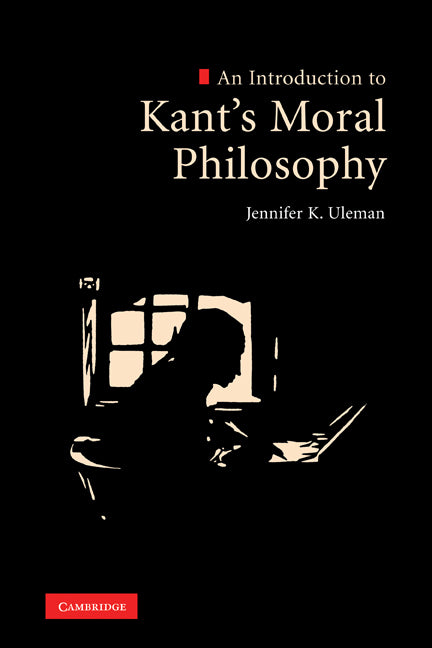
An Introduction to Kant's Moral Philosophy
Explores the basis of Kant's anti-naturalist, secular, humanist vision of human flourishing, presented in an accessible and engaging way.
Jennifer K. Uleman (Author)
9780521199629, Cambridge University Press
Hardback, published 21 January 2010
200 pages
23.5 x 15.5 x 1.5 cm, 0.44 kg
'This engaging book is a wonderful introduction to Kant's moral philosophy. It explains many of Kant's central concepts, such as those of will, freedom, maxims, and imperatives, clearly and succinctly. But the book also makes an argument that must be taken seriously by every scholar as well as student of Kant: that Kant's formulations of the categorical imperative collectively analyze what it is to make the realization of freedom the ultimate goal of human action. The book also beautifully shows how Kant unfolds the value of realizing our freedom without reducing his argument to the kind of empirical, psychological morality that Kant rejects. This is a wise, insightful work.' Paul Guyer, University of Pennsylvania
Immanuel Kant's moral philosophy is one of the most distinctive achievements of the European Enlightenment. At its heart lies what Kant called the 'strange thing': the free, rational, human will. This introduction explores the basis of Kant's anti-naturalist, secular, humanist vision of the human good. Moving from a sketch of the Kantian will, with all its component parts and attributes, to Kant's canonical arguments for his categorical imperative, this introduction shows why Kant thought his moral law the best summary expression of both his own philosophical work on morality and his readers' deepest shared convictions about the good. Kant's central tenets, key arguments, and core values are presented in an accessible and engaging way, making this book ideal for anyone eager to explore the fundamentals of Kant's moral philosophy.
1. Introduction: the strange thing
2. A sketch of Kantian will: desire and the human subject
3. A sketch continued: the structure of practical reason
4. A sketch completed: freedom
5. Against nature: Kant's argumentative strategy
6. The categorical imperative: free will willing itself
7. What's so good about the good Kantian will? The appeals of the strange thing
8. Conclusion: Kant and the good free rational will
Bibliography.
Subject Areas: History of Western philosophy [HPC]