Freshly Printed - allow 10 days lead
Couldn't load pickup availability
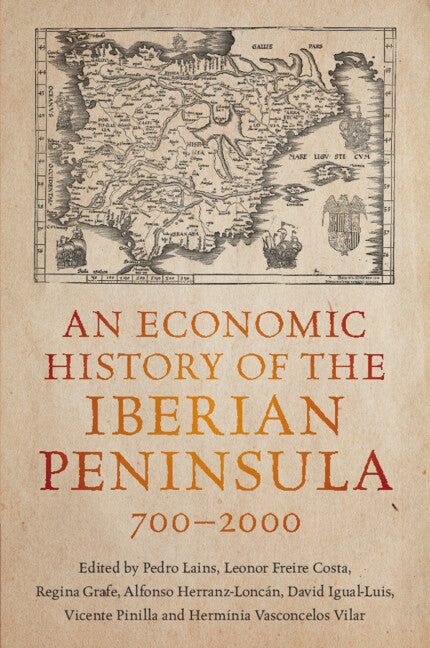
An Economic History of the Iberian Peninsula, 700–2000
This is a comprehensive long-run history of economic and political change in the Iberian Peninsula.
Pedro Lains (General editor), Leonor Freire Costa (Edited by), Regina Grafe (Edited by), Alfonso Herranz-Loncán (Edited by), David Igual-Luis (Edited by), Vicente Pinilla (Edited by), Hermínia Vasconcelos Vilar (Edited by)
9781108726221, Cambridge University Press
Paperback / softback, published 3 July 2025
808 pages
22.9 x 15.2 x 4.1 cm, 1.146 kg
'This massive volume of Iberian economic history draws together for the first time a vast array of the latest research by the most significant scholars. A rich tapestry of national perspectives, from the early middle ages to current times, is enriched by thematic cross-country analyses and tempered by broader European perspectives.' Jaime Reis, Universidade de Lisboa
This is a comprehensive long-run history of economic and political change in the Iberian Peninsula. Beginning with the development of the old medieval kingdoms, it goes on to explore two countries, Portugal and Spain, which during the early modern period possessed vast empires and played an essential role in the global economic and political developments. It traces how and why both countries began to fall behind during the first stages of industrialization and modern economic growth only to achieve remarkable economic development during the second half of the twentieth century. Written by a team of leading historians, the book sheds new light on all aspects of economic history from population, agriculture, manufacturing and international trade to government, finance and welfare. The book includes extensive new data and will be an essential work of reference for scholars of Portugal and Spain and also of comparative European economic development.
Preface: By way of presentation Pedro Lains
Introduction Leonor Freire Costa, Regina Grafe, Alfonso Herranz-Loncán, David Igual Luis, Vicente Pinilla and Herminia Vasconcelos Vilar
Part I. The Making of Iberia, 700–1500 David Igual Luis and Hermínia Vasconcelos Vilar
Section I. The Early Middle Ages, 700–1200: 1. Muslim and Christian polities, 700–1200 Hermenegildo Fernandes and Flocel Sabaté
Section II. The Medieval Economy, 1000–1500: 2. Production, 1000–1500 María Asenjo-González and Antoni Furió
3. Population, 1000–1500 Luís Miguel Duarte, Ignacio Álvarez Borge and Mario Lafuente Gómez
4. The polity, 1000–1500 Maria Helena Coelho, Francisco Franco-Sánchez, Jesús Ángel Solórzano Telechea and Hermínia Vasconcelos Vilar
5. Money, credit and banking, 1000–1500 David Carvajal, António Henriques and Pere Verdés
6. Technology, 1000–1500 Arnaldo Sousa Melo, Germán Navarro Espinach and Ricardo Córdoba de la Llave
7. Living standards, 1000–1500 Hipolito Rafael Oliva Herrer, Pere Benito i Monclús and Isabel dos Guimarães Sá
8. International trade and commerce, 1000–1500 Hilario Casado Alonso, David Igual Luis, Flaìvio Miranda and Joana Sequeira
9. The Iberian economy in global perspective, 700–1500 Jeff Fynn-Paul
Part II. Globalization and Enlightenment (1500–1800): 10. Patterns of Iberian economic growth in the early modern period Nuno Palma and Carlos Santiago-Caballero
11. Population of Iberian peninsula in the early modern period: a comparative and regional perspective Andreia Durães and Vicente Pérez Moreda
12. Institutions and policy (1500–1800) Mafalda Soares da Cunha, Francisco Gil Montes and Ana Sofia Ribeiro
13. Early modern financial development in the Iberian Peninsula Leonor Freire Costa, Susana Münch Miranda and Pilar Nogues Marco
14. Science, knowledge and technology, 1500-1800 Carlos Alvarez-Nogal, Alejandro García-Montón, and Pedro Lains
15. Living standards, inequality, and consumption (1500–1800) Esteban Nicolini, Fernanda Olival and Fernando Ramos-Palencia
16. Trade and the colonial economies, 1500–1828 Cátia Antunes, Regina Grafe and Xabier Lamikiz
17. The economic history of Iberia in a wider context, 1500–1800 Bartolomé Yun-Casalilla
Part III. Industrialization and Catching-Up, 1800–2000 Alfonso Herranz-Loncán and Vicente Pinilla: 18. Economic growth and the spatial distribution of income, 1800–2000 Alfonso Herranz-Loncán, M. Teresa Sanchis-Llopis and Daniel A. Tirado-Fabregat
19. Population growth, composition, and educational levels Amélia Branco and Fernando Collantes
20. Economic policies and institutions José Luís Cardoso and Francisco Comín
21. Iberian financial system, 1800–2000 Pablo Martín-Aceña and Rita Martins de Sousa
22. Economic growth and structural change in the Iberian economies, 1800–2000 Luciano Amaral, Concha Betrán and Vicente Pinilla
23. Living standards in Iberia, 1800–2010 Alfonso Díez-Minguela, Jordi Guilera and Julio Martinez-Galarraga
24. Iberian globalization and catching up in the poor South European periphery. 1830–2010 Antonio Tena-Junguito, Giovanni Federico and Ester G. Silva
25. The Iberian economy in comparative perspective, 1800–2000 Stephen Broadberry and Rui Pedro Esteves.
Subject Areas: Economic history [KCZ]