Freshly Printed - allow 10 days lead
Couldn't load pickup availability
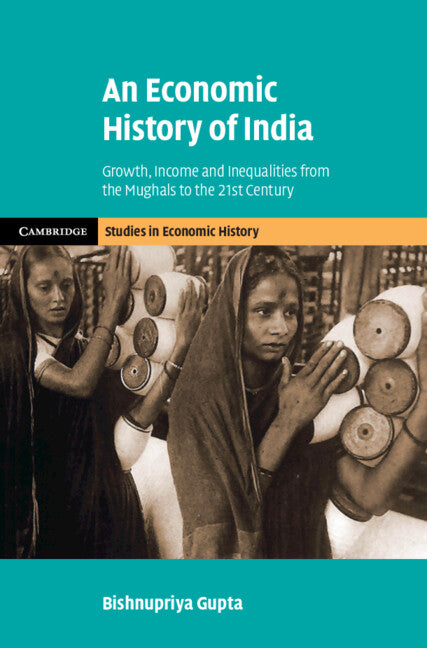
An Economic History of India
Growth, Income and Inequalities from the Mughals to the 21st Century
A new overview of India's long-run economic history, revealing how colonialism shaped growth and development before and after independence.
Bishnupriya Gupta (Author)
9781108491624, Cambridge University Press
Hardback, published 13 February 2025
234 pages
22.9 x 15.2 x 1.4 cm, 0.495 kg
'The publication of this book marks a milestone in the field of the economic history of India … It extends beyond Indian history and makes a significant contribution to the Great Divergence debate, which has motivated this project. India has not been absent from the discussion but has been a marginal player at best. The book, while placing India at the center, also approaches the subject with scholarly rigor as empirical economists would understand it by asking how we know what we claim to know. The book broadens the comparative historical context beyond the Indo-European axis to include East Asia. For all these reasons, it should be a great aid to teaching global and comparative economic history.' Tirthankar Roy, The Developing Economies
This book offers a major new economic history of India from the reign of Akbar in the sixteenth century to India's post-independence integration into the global economy. Using concepts and theories from economics and economic history alongside extensive new data, Bishnupriya Gupta builds a new framework for understanding the economic impacts and legacies of British rule. She charts India's transition from precolonial economy to colonial rule and evaluates its economic performance from a comparative perspective, particularly in the context of the Great Divergence between Europe and Asia. Finally, she examines India's post-independence economy and the evolution of social and economic inequality through to the turn of the twenty-first century. By taking a long view, the book sheds new light on the persistent effects of historical institutions as well as the impacts of policy-driven changes. It will be essential reading for anyone seeking to understand the long-run evolution of the Indian economy.
Introduction
1. The decline and the rise of the Indian economy
2. Agriculture as the engine of growth
3. From handlooms to modern industry and the emergence of a planned economy
4. Origins of India's service sector advantage
5. Region, income, caste, and gender: continuity and change
6. Colonial development in a comparative perspective
Conclusion: the myths and the realities of India's long run development.
Subject Areas: Economic history [KCZ]