Freshly Printed - allow 10 days lead
Couldn't load pickup availability
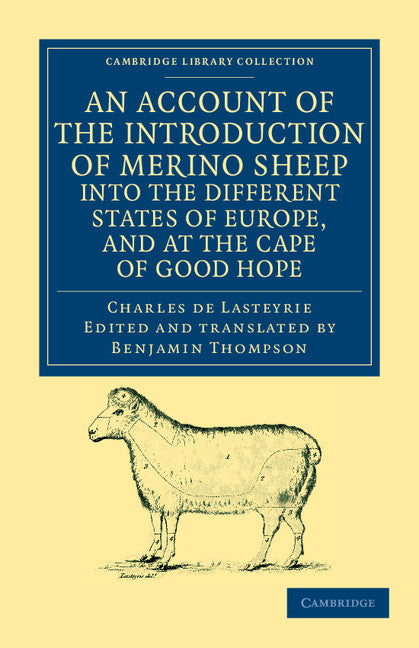
An Account of the Introduction of Merino Sheep into the Different States of Europe, and at the Cape of Good Hope
1810 translation of an 1802 French work describing breeding and husbandry practices, yields and prices of superfine wool around Europe.
Charles de Lasteyrie (Author), Benjamin Thompson (Edited and translated by)
9781108039154, Cambridge University Press
Paperback / softback, published 20 October 2011
260 pages, 1 b/w illus.
21.6 x 14 x 1.5 cm, 0.34 kg
During the eighteenth century, Spain relaxed its stringent export restrictions on Merino sheep, whose notably fine fleeces had long ensured the reputation of the Spanish woollen industry. Merinos were introduced around Europe and in 1792 Sir Joseph Banks, President of the Royal Society, established the first British flock in George III's gardens at Kew. This book, describing the qualities and adaptability of the Merino, was originally published in Paris in 1802 by the French agriculturalist and aristocrat C. P. Lasteyrie (1759–1849). It appeared in 1810 in this English translation by Benjamin Thompson (1775/6–1816), a professional playwright and translator, who was also an unsuccessful agricultural speculator and, briefly, secretary to the Merino Society. Documenting the spread of the Merino, regional variations in breeding regulations and husbandry practices, and wool yields, prices and taxation, this promotional treatise sheds light on the history of both agriculture and commodity trading.
Dedication
Part I: 1. General remarks
2. Sweden
3. The Danish states
4. Saxony
5. The Prussian states
6. The Austrian states
7. France
8. Holland
9. The Cape of Good Hope
10. Italy
11. Great-Britain
Part II: 1. Sweden
2. The Danish states
3. Saxony
4. The Prussian states
5. The Austrian states
6. France
7. Holland
8. Italy
9. Explanation of the frontispiece.
Subject Areas: History of science [PDX]