Freshly Printed - allow 10 days lead
Couldn't load pickup availability
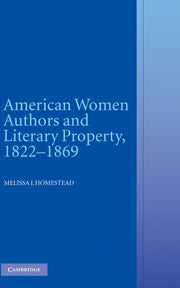
American Women Authors and Literary Property, 1822–1869
Explores the relationship between copyright laws and women's writing in nineteenth-century America.
Melissa J. Homestead (Author)
9780521154758, Cambridge University Press
Paperback / softback, published 24 June 2010
286 pages
22.9 x 15.2 x 1.6 cm, 0.42 kg
Review of the hardback: 'Although a self-styled act of 'literary recovery,'Melissa Homestead's American Women Authors and Literary Property, 1822–1869 seems to me actually nothing less than a revisionary literary history of the heyday of women's writing - and the conditions underlying and regulating its composition and circulation - in the United States. Based on a perspective reading of nineteenth-century copyright as a central agency in the formation of the field of letters, it adroitly explains how the terms and structures of copyright, especially in a society fast moving toward the commercialization of its culture, not only regulated the circulation of texts but defined the parameters of authorship - in particular, the possibilities available to the emergent category of women authors.' Ezra Greenspan, Kahn Chair in the Humanities, Southern Methodist University
Through an exploration of women authors' engagements with copyright and married women's property laws, American Women Authors and Literary Property, 1822–1869, revises nineteenth-century American literary history, making women's authorship and copyright law central. Using case studies of five popular fiction writers - Catharine Sedgwick, Harriet Beecher Stowe, Fanny Fern, Augusta Evans, and Mary Virginia Terhune - Homestead shows how the convergence of copyright and coverture both fostered and constrained white women's agency as authors. Women authors exploited their status as nonproprietary subjects to advantage by adapting themselves to a copyright law that privileged readers'access to literature over authors' property rights. Homestead's inclusion of the Confederacy in this work sheds light on the centrality of copyright to nineteenth-century American nationalisms and on the strikingly different construction of author reader relations under U.S. and Confederate copyright laws.
Introduction: 'lady-writers' and 'copyright, authors, and authorship' in nineteenth-century America
1. Authors, wives, slaves: coverture, copyright, and authorial dispossession, 1831–1869
2. Suited to the market: Catharine Sedgwick, female authorship, and the literary property debates, 1822–1842
3. When I can read my title clear: Harriet Beecher Stowe and the Stowe v. Thomas Copyright Infringement case (1853)
4. Every body sees the theft: Fanny Fern and periodical reprinting in the 1850s
5. A 'rank rebel' lady and her literary property: Augusta Jane Evans and copyright, the Civil War and after, 1861–1868
Epilogue. Belford v. Scriber (1892) and the ghost of Mary Virginia Terhune's Phemie's Temptation (1869)
or, the lessons of the 'lady-writers' of the 1820's through the 1860s for literary history and twenty-first-century copyright law.
Subject Areas: Literary studies: general [DSB]