Freshly Printed - allow 10 days lead
Couldn't load pickup availability
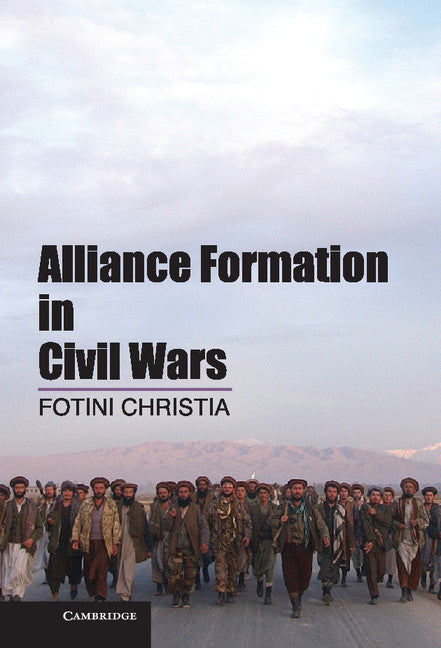
Alliance Formation in Civil Wars
This book argues power balances, rather than shared identities, explain why warring Afghan groups aligned with and double-crossed each other.
Fotini Christia (Author)
9781107023024, Cambridge University Press
Hardback, published 12 November 2012
360 pages, 19 b/w illus. 11 maps 15 tables
22.9 x 15.2 x 2.4 cm, 0.64 kg
'Although some may argue that Christia's neo-realist framework is not comprehensive because it undervalues the ideological and psychological dimensions of civil wars, the author's argument is both persuasive and fundamental to understanding alliance formation and disintegration. The author's observation in the book's conclusion that the alliance shifts in Iraq's Anbar province in favour of the Iraqi government (and then against it) have been driven by relative power considerations seems to be borne out by events since the book's publication. Anyone interested in or responsible for policies aimed at resolving multi-party civil wars stands to gain from close consideration of Christia's argument.' H. R. McMaster, Survival
Some of the most brutal and long-lasting civil wars of our time involve the rapid formation and disintegration of alliances among warring groups, as well as fractionalization within them. It would be natural to suppose that warring groups form alliances based on shared identity considerations - such as Christian groups allying with Christian groups - but this is not what we see. Two groups that identify themselves as bitter foes one day, on the basis of some identity narrative, might be allies the next day and vice versa. Nor is any group, however homogeneous, safe from internal fractionalization. Rather, looking closely at the civil wars in Afghanistan and Bosnia and testing against the broader universe of fifty-three cases of multiparty civil wars, Fotini Christia finds that the relative power distribution between and within various warring groups is the primary driving force behind alliance formation, alliance changes, group splits and internal group takeovers.
Part I. Context and Theory: 1. Literature and research design
2. A theory of warring group alliances and fractionalization in multi-party civil wars
Part II. Afghanistan: 3. The Afghan Intra-Mujahedin War, 1992–8
4. The Afghan Communist-Mujahedin War, 1978–89
5. The theory at the commander level in Afghanistan, 1978–98
Part III. Bosnia and Herzegovina: 6. The Bosnian Civil War, 1992–5
7. The Bosnian Civil War, 1941–5
Part IV. Further Extensions: 8. Quantitative testing on the universe of cases of multi-party civil wars.
Subject Areas: International relations [JPS], Comparative politics [JPB]