Freshly Printed - allow 7 days lead
Couldn't load pickup availability
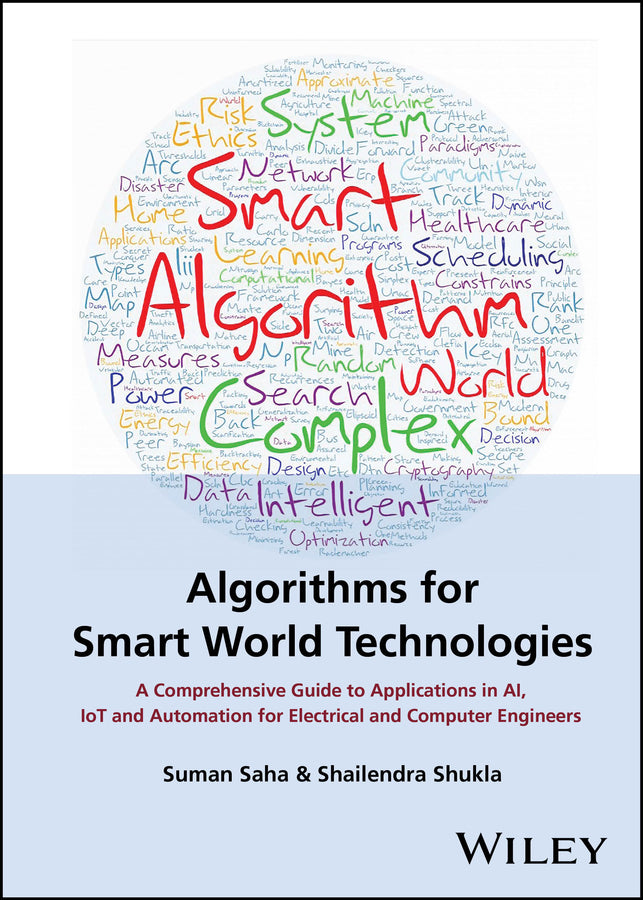
Algorithms for Smart World Technologies
A Comprehensive Guide to Applications in AI, IoT and Automation for Electrical and Computer Engineers
Suman Saha (Author), Shailendra Shukla (Author)
9781119823612, Wiley
Hardback, published 17 March 2026
272 pages
25.9 x 18.5 x 2 cm, 0.703 kg
Enables readers to learn how to design and implement algorithms for efficient and secure smart technologies Algorithms for Smart World Technologies explains the fundamentals of key algorithms and their application in a variety of use cases, covering the factors, assumptions, and models essential for the design of a real-world algorithm and discussing the importance of advanced algorithms in the use of modern world technologies such as AI, IoT, and Blockchain. Each chapter is written to provide a self-contained treatment of one major topic. Collectively, the chapters have been designed and carefully integrated to be entirely complementary with respect to definitions, terminology, and notation. Chapters are divided into three parts—complexities, paradigms, and recent applications—and at the beginning of each part, a detailed introduction explaining each subject area is provided. The foundational subjects are supported by end-of-chapter exercises and case studies, while the application-focused chapters are supported by projects to give worked experience. Written by two highly qualified authors in academia, sample topics covered in Algorithms for Smart World Technologies include: Written for developers and domain experts who want to explore the opportunities and challenges of designing and developing algorithms and protocols for Smart-world problems, Algorithms for Smart World Technologies is an authoritative resource on the topic that provides both foundational knowledge and guidance on practical applications.
Foreword xv Preface xvii Acknowledgments xix Acronyms xxi Introduction xxv Part I Complexities of Smart Algorithms 1 1 Introduction to Complexities 3 1.1 Complex Systems and Algorithms 4 1.2 Complex Systems 4 1.2.1 Key Features of Complex Systems 4 1.2.2 Examples of Complex Systems 5 1.2.3 The Role of Algorithms in Complex Systems 5 1.2.4 Modeling and Simulation 5 1.2.5 Data Analysis 5 1.2.6 Optimization 5 1.2.7 Machine Learning 5 1.2.8 Challenges and Opportunities in Algorithmic Design 5 1.2.9 Future Directions 5 1.3 Efficiency Metrics for Complex Systems 6 1.3.1 Challenges in Measuring Efficiency 6 1.3.2 Techniques for Measuring Efficiency 7 1.3.3 Defining Efficiency in Complex Systems: A Holistic Approach 7 1.3.4 The Path Forward: Toward a Unified Framework 8 1.4 Applications of Complexity 8 1.4.1 Complexity in Practice 8 1.4.2 Complexity Management 8 1.4.3 Complexity Economics 8 1.4.4 Complexity and Education 9 1.4.5 Complexity and Modeling 9 1.4.6 Complexity and Chaos Theory 9 1.4.7 Complexity and Network Science 9 1.4.8 Complexity and Future Research Directions 10 1.5 Types of Complexities 10 1.6 Exercises 11 2 Computational Complexity 13 2.1 Computability 13 2.2 Computational Models 15 2.3 Complexity Classes 16 2.4 Probabilistic Complexity 17 2.4.1 The BPP Complexity Class 17 2.4.2 Examples of Probabilistic Complexity 17 2.4.3 BPP: Efficient Probabilistic Computation 17 2.4.4 Future Directions in Probabilistic Complexity 18 2.5 Quantum Complexity 18 2.5.1 BQP: Power and Intrigue 18 2.5.2 The P, NP, and BQP 19 2.5.3 BQP: Efficient Quantum Computation 19 2.5.4 Future Directions in Quantum Complexity 19 2.6 Exercises 20 3 Communication Complexity 23 3.1 Deterministic Communication 24 3.2 Deterministic Communication Complexity 24 3.3 Nondeterministic Communication 26 3.4 Nondeterministic Communication Complexity 26 3.5 Randomized Communication Complexity 27 3.5.1 Approximate Rank 28 3.6 Exercises 28 4 Data Complexity 31 4.1 Algorithmic Information Theory 32 4.1.1 Philosophy of Mathematics: Randomness Within Mathematics 32 4.1.2 Philosophy of Probability: Understanding Randomness of Individual Sequences 32 4.2 Occam’s Razor and Inductive Inference 33 4.3 Philosophy of Information 33 4.4 Lessons for the Philosophy of Information 34 4.5 Kolmogorov Complexity: Measuring Randomness 35 4.5.1 Defining Descriptions and Complexity 35 4.5.2 Compression and Invariance 35 4.5.3 Randomness and Compressibility 36 4.5.4 Connection to Gödel’s Theorem 36 4.6 VC Dimension: Measuring Model Complexity 36 4.6.1 VC Dimension of Set Families 36 4.6.2 VC Dimension of Classification Models 36 4.7 Rademacher Complexity 37 4.7.1 Rademacher Complexity of a Set 37 4.7.2 Rademacher Complexity of a Function Class 37 4.7.3 Example 37 4.7.4 Generalization Bound 38 4.7.5 Using Rademacher Complexity 38 4.7.6 Representativeness of a Sample 38 4.8 Exercises 38 5 Risk Measures 41 5.1 Addressing Algorithmic Bias 41 5.2 Risk Measures 42 5.3 Algorithmic Fairness Measures 43 5.4 Risks in Algorithmic Monoculture 44 5.5 Green Efficiency 45 5.5.1 Green Internet Technologies 46 5.5.2 Green RFID Tags 46 5.5.3 Green Wireless Sensor Networks 47 5.5.4 Green Cloud Computing 47 5.5.5 Green Data Centers 47 5.6 Conclusion 47 5.7 Exercises 47 6 Ethics and Algorithmic Boundaries 49 6.1 Introduction 49 6.2 Objectives 50 6.3 Algorithmic Decision-making 50 6.3.1 Background 50 6.3.2 Algorithmic Decision-making in Public Discourse 51 6.3.3 Ethical Challenges in Algorithmic Decision-making 51 6.3.4 ml and Autonomous Decision-making 51 6.4 Algorithmic Morality 52 6.4.1 Artificial Life and Emerging Ethical Behavior 52 6.4.2 Unbiased Learning Machines 52 6.4.3 Associative Learning and Moral Training 53 6.4.4 Ethical Risks of Learning Systems 53 6.5 Ethics as a Service 53 6.5.1 Service Model Analogies for Ethical Governance 53 6.5.2 Implementing the Ethics-as-a-Service Model 54 6.5.3 Case Study: Digital Catapult Pilot 54 6.5.4 Future Research Directions 54 6.6 Current Discussions and Future Research Directions 54 6.7 Conclusion 55 6.8 Exercises 55 Part II Algorithmic Paradigms for Smart World Technologies 57 7 Introduction to Paradigms of Smart Algorithms 59 7.1 Introduction to Smart Paradigms 60 7.2 Important Algorithms in Smart Paradigms 60 7.2.1 ML Algorithms 60 7.2.2 Optimization Algorithms 60 7.2.3 IoT and Distributed Algorithms 61 7.3 Roadmap for Future Advancements 61 7.3.1 Enhancing Scalability 61 7.3.2 Data Privacy and Security 61 7.3.3 Autonomous and Intelligent Decision-making 61 7.3.4 Green Computing and Energy Efficiency 61 7.4 Conclusion 62 8 Optimization Algorithms 63 8.1 Constrained Optimization: Optimization with Limitations 63 8.2 Convex Optimization: Finding the Global Minimum 64 8.3 Solving Linear Equations 65 8.3.1 Steepest Descent: Gradient-based Minimization 66 8.3.2 Improving Convergence 66 8.3.3 Preconditioning with Trees 67 8.4 Linear Programming Duality 67 8.4.1 Complementary Slackness 68 8.4.2 Congestion Minimization 69 8.4.3 Maximum Weight Matching 69 8.4.4 Games and Strategic Solutions 69 8.4.5 The Minimax Theorem 70 8.5 Network Problems 72 8.5.1 Key Definitions 72 8.5.2 The Minimum-cost Flow Problem 72 8.5.3 The Transportation Problem 73 8.5.4 The Maximum Flow Problem 79 8.6 Exercises 82 9 Decision-making Algorithms 85 9.1 Markov Decision Process 85 9.1.1 Discrete MDPs 86 9.1.2 Nondiscrete MDPs: General Constructions 90 9.1.3 Discrete State MDPs 92 9.1.4 Classical Borel MDPs 92 9.1.5 Assumptions for Borel MDPs 93 9.1.6 Universally Measurable Borel MDPs 94 9.1.7 Assumptions for Universally Measurable MDPs 94 9.2 Reinforcement Learning 95 9.3 Value Iteration 96 9.4 Q-learning 97 9.5 TD Learning 98 9.6 Exercises 99 10 Prediction Algorithms 101 10.1 Regression 101 10.1.1 Least Squares and Nearest-neighbor Methods 101 10.1.2 Prediction Theory 102 10.1.3 Curse of Dimensionality 102 10.1.4 Learning as Function Approximation 102 10.1.5 Key Formulas 102 10.1.6 Linear Regression and Least Squares 103 10.1.7 Variable Selection 104 10.1.8 Best Subset Selection and Forward and Backward Stepwise Selection 104 10.1.9 Smoothly Clipped Absolute Deviation 106 10.1.10 Consistency and Oracle Property 106 10.1.11 Selecting a Group of Variables 107 10.1.12 Least Squares, Penalized Likelihood, and Bayesian Inference 107 10.2 Classifications 108 10.2.1 Issues with Linear Regression Approach 108 10.2.2 Linear Discriminant Analysis 108 10.2.3 Reduced-rank LDA 109 10.2.4 Comparison Between Logistic Regression and LDA 110 10.2.5 Piecewise Polynomial Functions 111 10.2.6 Smoothing Splines 111 10.2.7 Choosing Smoothing Parameters 112 10.2 8 Hilbert Space 113 10.2.9 Generalized Additive Models 114 10.2.10 Fitting GAMs 115 10.2.11 Illustration: Predicting Email Spam 115 10.2.12 Tree-based Regression and Classification 116 10.2.13 Regression Trees 116 10.2.14 Classification Trees 116 10.2.15 Challenges in Tree-based Methods 117 10.2.16 Illustrative Example: Spam Prediction 117 10.2.17 Hierarchical Mixtures of Experts and Missing Values 118 10.2.18 One-dimensional Kernel Smoothers 118 10.2.19 Considerations in Kernel Smoothing 119 10.2.20 Local Regression and Local Likelihood Method 119 10.2.21 Selecting the Width of the Kernel 120 10.2.22 Structured Kernels and Local Likelihood Methods 120 10.2.23 Kernel Density Estimation 120 10.2.24 Application to Classification 121 10.2.25 Mixture Models 122 10.3 Model Complexity 122 10.3.1 Bia-variance Decomposition 123 10.3.2 Estimate the Errors 124 10.3.3 Cross-validation 125 10.3.4 Bootstrap 126 10.3.5 The EM Algorithm 126 10.3.6 Two Other Interpretations of EM Algorithm 127 10.4 Bayesian Algorithms 129 10.4.1 Variational Bayes 129 10.4.2 The Key Identity 129 10.4.3 Variational Inference 130 10.4.4 Improvements and Variants 131 10.4.5 Approximate Bayesian Computation 131 10.4.6 The Discrete Version 131 10.4.7 The Continuous Version 131 10.4.8 Issues 132 10.5 Neural Networks 132 10.5.1 Fitting Neural Networks 132 10.5.2 Some Issues with Neural Networks 133 10.6 Support Vector Machines 134 10.6.1 Separating Hyperplane 134 10.6.2 Support Vectors 134 10.7 Cluster Analysis 135 10.7.1 Clustering Algorithms: Combinatorial 136 10.7.2 Clustering Algorithms: k-means 136 10.7.3 Clustering Algorithms: Hierarchical Clustering 136 10.7.4 Principal Components, Curves, and Surfaces 137 10.7.5 Procrustes Transform and Shape Averaging 138 10.7.6 Factor Model and Independent Component Analysis 139 10.7.7 Independent Component Analysis 139 10.7.8 Principal Curve and Multidimensional Scaling 139 10.8 Graphical Models 140 10.8.1 False Discovery Rate 140 10.8.2 Markov Graphs and Gaussian Graphical Models 141 10.8.3 Undirected Graphs for Discrete Variables 142 10.8.4 Exponential Random Graphs 143 10.8.5 Eigen-statistics of Sample Covariance Matrices 143 10.8.6 Bulk Universality: Marchenko–Pastur Law (or Quartercircle Law) 143 10.8.7 Edge Universality: Tracy–Widom Law 144 10.9 Exercises 144 11 Secure Algorithms 147 11.1 Low-power Cryptography 148 11.2 Secret-key Cryptography 148 11.3 Public-key Cryptography 148 11.3.1 Key Exchange Protocol 149 11.3.2 Trapdoor Functions 150 11.3.3 md 5 154 11.3.4 Secure Sockets Layer 155 11.3.5 Blockchain 156 11.3.6 Digital Signature 157 11.4 Exercises 158 Part III Smart World Applications 161 12 Introduction to Smart World Applications 163 12.1 Interesting Applications 164 13 Smart Education 167 13.1 Examples of Smart Education Tools 167 13.2 Personalized Learning 168 13.2.1 Key Algorithms 168 13.2.2 Application Example 169 13.3 Intelligent Content Delivery 169 13.3.1 Key Algorithms 169 13.3.2 Application Example 170 13.4 Learning Analytics and Insights 170 13.4.1 Key Algorithms 170 13.4.2 Application Example 170 13.5 Data Analytics in Education 170 13.5.1 Key Algorithms 170 13.5.2 Application Example 171 13.6 AI Tutors and Assistants in Education 171 13.6.1 Key Algorithms 171 13.6.2 Application Example 171 13.7 Assessment and Feedback in Education 171 13.7.1 Key Algorithms 172 13.7.2 Application Example 172 13.8 Assessment and Feedback in Education 172 13.8.1 Key Algorithms 172 13.8.2 Application Example 172 13.9 Collaborative Learning 173 13.9.1 Key Algorithms 173 13.9.2 Application Example 173 13.10 Exercises 174 14 Smart World Algorithms in Healthcare 175 14.1 Patient Flow Scheduling and Capacity Planning 175 14.1.1 Queueing Theory 176 14.1.2 Simulation Algorithms 176 14.1.3 Linear Programming 176 14.2 Drug Packaging in the Healthcare Industry 177 14.2.1 Robotic Process Automation 177 14.2.2 Optical Character Recognition 177 14.2.3 Predictive Analytics 177 14.3 Data Security of Smart Healthcare 178 14.3.1 Encryption Algorithms 178 14.3.2 Blockchain Technology 178 14.3.3 Machine Learning for Anomaly Detection 178 14.4 Automated Nutrition Monitoring System 178 14.4.1 Dietary Assessment Algorithms 179 14.4.2 Recommendation Systems 179 14.4.3 Image Recognition 179 14.5 Exercises 179 15 Modern Approach Algorithms in Environmental and Energy I nfrastructure 181 15.1 Crowdsensing for Urban Air Pollution Monitoring 181 15.1.1 Algorithms 181 15.1.2 Application Example 182 15.2 Green Energy Scheduling for Demand Side Management 182 15.2.1 Algorithms 182 15.2.2 Application Example 183 15.3 Smart Grid 183 15.3.1 Application Example 184 15.4 Smart Waste Management Systems 184 15.4.1 Application Example 185 15.5 Drone Monitoring 185 15.5.1 Application Example 186 15.6 Exercises 187 16 Smart Agriculture 189 16.1 Precision Farming 189 16.1.1 Key Algorithms 190 16.1.2 Application Example 190 16.2 Soil Health Monitoring 191 16.2.1 Key Algorithms 191 16.2.2 Application Example 192 16.3 Irrigation Management 192 16.3.1 Application Example 193 16.4 Crop Yield Prediction 193 16.4.1 Key Algorithms 193 16.4.2 Application Example 194 16.5 Exercises 194 17 Smart Transportation 197 17.1 Smart Traffic Management 198 17.1.1 Key Algorithms and Applications 198 17.2 Intelligent Transportation Systems 199 17.2.1 Key Algorithms and Applications 199 17.3 Public Transportation 200 17.3.1 Key Algorithms and Applications 200 17.4 Smart Parking 201 17.4.1 Key Algorithms and Applications 201 17.5 Autonomous Vehicles 202 17.5.1 Key Algorithms and Applications 202 17.6 Infrastructure Monitoring and Maintenance 202 17.6.1 Key Algorithms 202 17.7 Electric and Connected Vehicles 203 17.7.1 Key Algorithms and Applications 203 17.8 Emergency Response 204 17.8.1 Key Algorithms and Applications 204 17.9 Exercises 204 18 Information Technology and Society 207 18.1 Introduction 207 18.2 Missing Person Identification 207 18.2.1 Key Algorithms 207 18.2.2 Applications 208 18.3 Social Contagions 208 18.3.1 Key Algorithms 208 18.3.2 Applications 208 18.4 Disease Propagation 208 18.4.1 Key Algorithms 208 18.4.2 Applications 208 18.5 Crime Monitoring 209 18.5.1 Key Algorithms 209 18.5.2 Applications 209 18.6 Exercises 209 19 Smart Government 211 19.1 E-government Services 211 19.1.1 Key Algorithms 211 19.1.2 Applications 212 19.2 Smart Utilities 212 19.2.1 Key Algorithms 212 19.2.2 Applications 213 19.3 Public Safety Enhancements 214 19.3.1 Key Algorithms 214 19.3.2 Applications 214 19.4 Environmental Monitoring 214 19.4.1 Key Algorithms 214 19.4.2 Applications 215 19.5 Exercises 215 20 Disaster Management 217 20.1 Introduction 218 20.2 Postaccident Mine Communications and Tracking Systems 219 20.2.1 Leaky-feeder System 219 20.3 Data Mining for Disaster Information Management 220 20.4 Algorithms for Smart Sensor Networks in Disaster Management 221 20.4.1 RSSI-based Localization with Mobile Anchors 222 20.5 Exercises 223 21 Communication Algorithms 225 21.1 Communication Algorithms for WSN 225 21.1.1 Key Algorithms 226 21.1.2 Applications 226 21.2 Store-carry-forward Based Communication Algorithm for DTN 226 21.2.1 Key Algorithms 227 21.2.2 Applications 227 21.3 Low Power-based Communication Algorithms for LLN 227 21.3.1 Key Algorithms 227 21.3.2 Applications 227 21.4 Software-defined Networking Algorithms 227 21.4.1 Key Algorithms 228 21.4.2 Applications 228 21.5 Peer-to-peer Network Algorithm 228 21.5.1 Key Algorithms 228 21.5.2 Applications 228 21.6 Exercises 228 References 231 Index 243
Subject Areas: Mathematics [PB]