Freshly Printed - allow 7 days lead
Couldn't load pickup availability
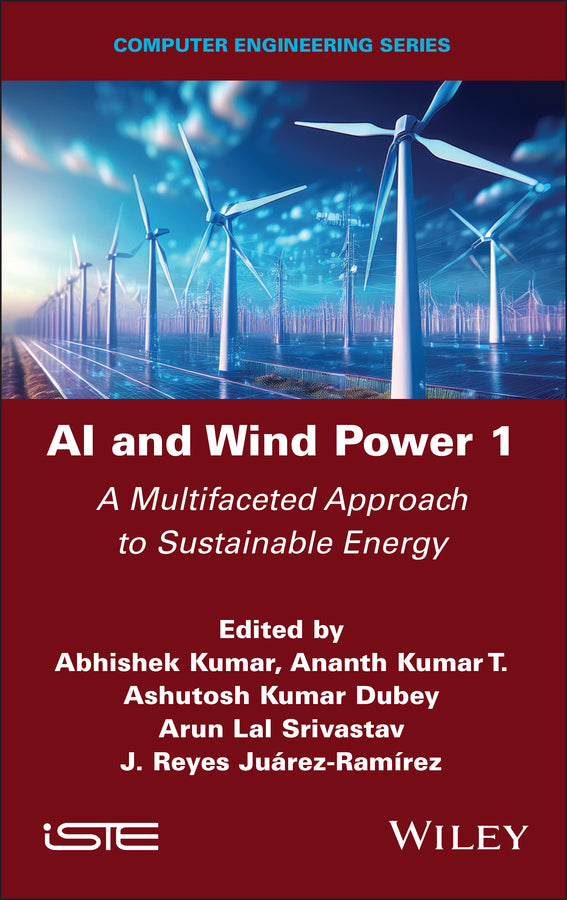
AI and Wind Power 1
A Multifaceted Approach to Sustainable Energy
Abhishek Kumar (Edited by), Ananth Kumar T. (Edited by), Ashutosh Kumar Dubey (Edited by), Arun Lal Srivastav (Edited by), J. Reyes Juarez-Ramirez (Edited by)
9781836690610, Wiley
Hardback, published 12 June 2026
368 pages
23.5 x 15.6 x 2.3 cm, 0.659 kg
In the critical global transition to sustainable energy, the integration of artificial intelligence (AI) with wind power stands as a pivotal technological frontier. AI and Wind Power 1 provides a comprehensive, practical guide to this transformative synergy. This volume delves deep into the core applications of AI, from leveraging deep learning for precise wind resource assessment and sophisticated farm design to deploying advanced algorithms for predictive maintenance and fault diagnosis. The book presents detailed examinations of cutting-edge frameworks, including digital twins, IoT-enabled smart farms and adaptive AI controllers, all aimed at maximizing energy yield, reducing operational costs and enhancing system reliability. By combining rigorous technical analysis with real-world case studies, this book equips engineers, data scientists and energy professionals with the knowledge to implement intelligent solutions, which make wind energy more efficient, resilient and integral to a smarter grid. It is an indispensable resource for anyone dedicated to advancing the technical frontier of renewable energy.
Preface xv Chapter 1. Harnessing the Power of the Wind: A Detailed Exploration of Wind Energy Fundamentals and the Pivotal Role of Emerging AI Techniques 1 1.1. Introduction to wind energy 2 Chapter 2. A Terrain-Fused Spatio-Temporal Deep Learning Framework for Accurate Wind Resource Assessment and Forecasting Using TFS-TWF 35 2.1. Introduction 36 Chapter 3. Deep Fuzzy-Optimized CLSTM–BERT Algorithm with Adaptive Learning for Efficient Wind Farm Design and Energy Management 57 3.1. Introduction 58 Chapter 4. Optimizing Wind Energy with AI 83 4.1. Introduction 83 Chapter 5. Integration of Artificial Intelligence and Wind Power: An Orientation Technique. 109 5.1. Introduction 109 Chapter 6. Predictive Maintenance and Fault Diagnosis of Wind Turbines Using AI 139 6.1. Introduction 139 Chapter 7. A Comprehensive Review of Digital Twin-Enabled AI Models for Interpretable and Scalable Fault Diagnosis in Wind Turbines. 159 7.1. Introduction 159 Chapter 8. A Hybrid AI-Driven Digital Twin Technology for Predictive Maintenance and Fault Diagnosis in Wind Turbines under Variable Environmental Conditions using EcoHyTwin Framework 187 8.1. Introduction 188 Chapter 9. An AI-Driven Framework for Predictive Maintenance and Adaptive Control in Hybrid Wind Farms Using BreezeSenseAI Algorithm 209 9.1. Introduction 210 Chapter 10. AI-Powered Predictive Maintenance for Wind Energy. 227 10.1. Introduction 227 Chapter 11. Integrating AI and IoT Technologies in Smart Wind Farms: Leveraging Predictive Maintenance and Performance Optimization. 245 11.1. Introduction to smart wind farms 245 Chapter 12. AI and IoT for Smart Wind Farms 271 12.1. Introduction 271 Chapter 13. Intelligent Wind Power Forecasting and Demand-Responsive Power Scheduling Using LSTMs 293 13.1. Introduction 293 List of Authors 317
Abhishek KUMAR, Ananth Kumar T., Ashutosh Kumar DUBEY, Arun Lal SRIVASTAV and J. Reyes JUÁREZ-RAMÍREZ
R. VENKATESH and D. VETRITHANGAM
1.2. Fundamentals of wind energy generation 6
1.3. Wind energy systems and grid integration 12
1.4. Emerging AI techniques in wind energy 14
1.5. Predictive maintenance and performance monitoring 17
1.6. AI in wind farm design and layout optimization 21
1.7. Energy forecasting and demand response with AI 24
1.8. Future trends and innovations in wind energy and AI 26
1.9. Conclusion 30
1.10. References 32
Suresh Kumar K., Kirubha Sagar T., Arun Prakash P. and Praveen Kumar M.
2.2. Literature survey 38
2.3. Proposed work 42
2.4. TFS-TWF proposed architecture 43
2.5. Implementation and methodology 45
2.6. Results and discussion 47
2.7. Performance in Region C's hilly terrain 49
2.8. Projected horizon performance 49
2.9. Study of ablation 50
2.10. Estimating uncertainty and dependability 51
2.11. Summary of comparative performance 52
2.12. Prospects and remarks 52
2.13. Conclusion 53
2.14. References 54
Prabbu Sankar P., Yaashuwanth C., Prathibanandhi K. and S. RAMESH
3.2. Literature review 61
3.3. Proposed methodology 66
3.4. Results and discussion 73
3.5. Conclusion 79
3.6. References 80
Harshvardhan KUNWAR, Shruti ROY, Ahanya BANERJI and Sayantika MUKHERJEE
4.2. Literature review 85
4.3. Methodology 88
4.5. Case studies and real-world applications 94
4.6. AI versus traditional methods: what is the difference? 97
4.7. Challenges and limitations of using AI in wind energy 98
4.8. Future outlook and recommendations 100
4.9. Scalability in developing countries 102
4.10. Conclusion 104
4.11. References 105
Johncy Bai J., T.S. SIVARANI, S. JAISIVA, Srividhya J.P. and Gayathri A.R.
5.2. Introduction to wind power 110
5.3. Overview of AI in renewable energy 123
5.4. AI applications in wind power 124
5.5. Popular AI techniques in wind power 127
5.6. Challenges of AI in wind power 128
5.7. Future trends and directions for research 129
5.8. Conclusion 135
5.9. References 136
Karthick Manoj R. and Aasha Nandhini S.
6.2. Related work 142
6.3. Methodology 145
6.4. Results and discussion 150
6.5. Conclusion and future work 155
6.6. References 156
N.C. DESAI and Priyanka P. SHINDE
7.2. Overview of wind turbine fault diagnosis 160
7.3. Digital twin technology: concept and role in wind turbines 162
7.4. AI techniques in fault diagnosis 164
7.5. Integration of digital twin and AI: synergies and architectures 166
7.6. Explainable AI for interpretability 169
7.7. Sensor fusion and multimodal data integration 170
7.8. Uncertainty quantification in AI models 172
7.9. Validation strategies and simulation frameworks 175
7.10. Scalability considerations for large wind farms 177
7.11. Open challenges and future directions 179
7.12. Conclusion 181
7.13. References 182
Mahesh Kumar S., Suresh Kumar K., Arun Prakash P. and Karthick Raja M.
8.2. Literature survey 191
8.3. Proposed work 195
8.4. Algorithm, implementation and expected outcomes 198
8.5. Dataset and experimental setup 199
8.6. Fault detection accuracy 199
8.7. RUL prediction 200
8.8. Environmental adaptability performance 201
8.9. Fault-type classification performance 201
8.10. Energy efficiency and maintenance cost reduction 202
8.11. Hybrid AI learning efficiency 202
8.12. Comparative analysis with existing approaches 203
8.13. Discussion 204
8.14. Conclusion 204
8.15. References 205
Suresh Kumar K., Karthikesh N., Anandaraj A. and Yuvaraj S.
9.2. Overview of the BreezeSenseAI framework 216
9.3. Methodology and system architecture 217
9.4. Implementation, evaluation and novel contributions 218
9.5. Adaptive control optimization 221
9.6. Turbine health index (THI) evaluation 222
9.7. Energy efficiency and cost reduction 222
9.8. Real-time adaptability evaluation 223
9.9. Comparative analysis with existing models 223
9.10. Conclusion 224
9.11. References 224
Anurag WAZARKAR, Pratik GUNJALKAR, Tanmay SAWANT, Sanket BABAR, Bhushan S. YELURE and Priyanka P. SHINDE
10.2. Fundamentals of wind turbine systems and failure modes 228
10.3. Predictive maintenance (PdM) techniques for wind turbines 230
10.4. AI for predictive maintenance and fault diagnosis 234
10.5. Challenges and future directions 238
10.6. Conclusion 240
10.7. References 241
Sathish Kumar D., Vanitha U., Saravanan G. and Ramya G.
11.2. Challenges in traditional wind farm operations 248
11.3. Role of smart technologies in the energy sector 250
11.4. Overview of smart wind farms 251
11.5. Components of smart wind farms 251
11.6. Internet of Things (IoT) in wind farms 253
11.7. Cloud-centric IoT architecture 254
11.8. Edge-centric IoT architecture 255
11.9. Hybrid IoT architecture 257
11.10. Sensor deployment for real-time monitoring in wind farms 258
11.11. Data acquisition and wireless communication in wind farms 260
11.12. Cloud and edge computing for data processing in smart farms 261
11.13. AI applications in smart wind farms 262
11.14. Performance prediction and optimization algorithms 264
11.15. Case studies and real-world implementations 266
11.16. Conclusion 269
11.17. References 269
Mantena SIREESHA and Mantena Siva Pavan Kumar RAJU
12.2. Fundamentals of AI and IoT in wind farm operations 273
12.3. IoT for data acquisition and real-time monitoring 275
12.4. AI for predictive maintenance and fault detection 277
12.5. Performance optimization and energy production forecasting 280
12.6. Challenges and barriers to implementation 282
12.7. Future trends and innovations in smart wind farms 284
12.8. Conclusion 285
12.9. References 287xiv AI and Wind Power 1
Pranav Raja K.R., Ritik and Karthika S.K.
13.2. Literature review 295
13.3. Methodology 300
13.4. Results and analysis 310
13.5. Conclusion and future work 312
13.6. References 313
Index 323
Subject Areas: Electronics & communications engineering [TJ]