Freshly Printed - allow 10 days lead
Couldn't load pickup availability
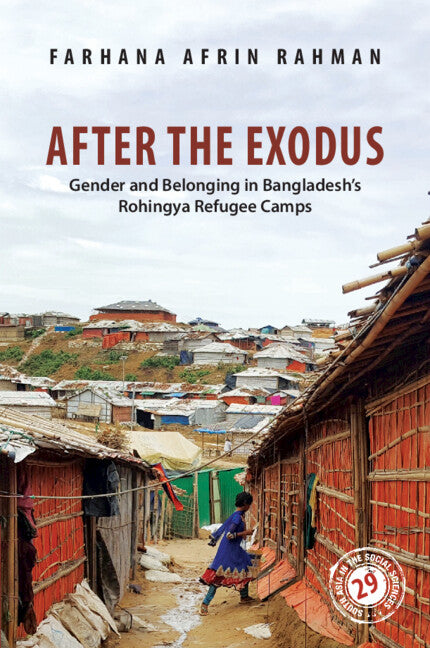
After the Exodus
Gender and Belonging in Bangladesh's Rohingya Refugee Camps
Examines how forced migration transforms the gendered subjectivities and everyday lived experiences of Rohingya refugee women in Bangladesh.
Farhana Afrin Rahman (Author)
9781009414821, Cambridge University Press
Hardback, published 23 January 2025
176 pages
23.5 x 15.8 x 1.7 cm, 0.42 kg
'This book provides a much-needed in-depth and poignant examination of the experiences of Rohingya women in the refugee camps of Bangladesh, exploring the complex interplay of gender identity, relations, and roles amid the harsh realities of forced displacement. Rahman restores women as resilient social agents navigating and negotiating patriarchal structures, rather than writing off their experiences as being those of victims unable to attend to their own wellbeing. Her unique approach instead emphasizes the resilience and creative strategies deployed by the Rohingya women to reconstruct their lives and communities, chief among them being the 'Majhee' system. This refreshing focus on the quotidian aspects of life in the camps provides an insightful and much-needed contribution to our understanding of refugee experiences more broadly and of refugee women specifically. Overall, a brilliantly researched and compelling book that offers a crucial perspective on the world's most marginalized individuals, making it a highly relevant and significant read.' Azeem Ibrahim OBE, author of The Rohingyas: Inside Myanmar's Hidden Genocide (2016)
After the Exodus examines how forced migration of the Rohingya from Myanmar to Bangladesh has affected the gendered subjectivities and lived experiences of Rohingya refugee women, and transformed gender relations and roles in displacement. Based on 14 months of feminist ethnographic fieldwork in Bangladesh's Kutupalong-Balukhali refugee camp in 2017 and 2018, the book uncovers the everyday strategies employed by refugee women to create a sense of belonging and to make a life for themselves after forced migration. Rohingya women adapt to camp life by negotiating marriage and intimate experiences, adjusting to changing gender divisions of labour, and navigating encounters with humanitarian aid agencies and male camp leaders. These women strategically bargain shifting power relations to reconstruct their lives in displacement, thereby reclaiming agency and asserting their identity through the spaces they create, inhabit, and reshape; the coping mechanisms they employ; and the bonds of kinship and community they forge.
Acknowledgements
Glossary of Terms
Prologue
1. Introduction
2. Stories and Silences: On Entering and Writing Women's Worlds
3. Life Under Siege: On Violence and Displacement
4. At Journey's End: On Home and Belonging
5. Beyond Brides: On Marriage and Moral Panics
6. Broken Breadwinners: On Womanhood and Gender Divisions of Labour
7. The Price of Development: On NGOs and Gender Programming
8. Conclusion
Epilogue
Bibliography.
Subject Areas: Sociology [JHB]