Freshly Printed - allow 10 days lead
Couldn't load pickup availability
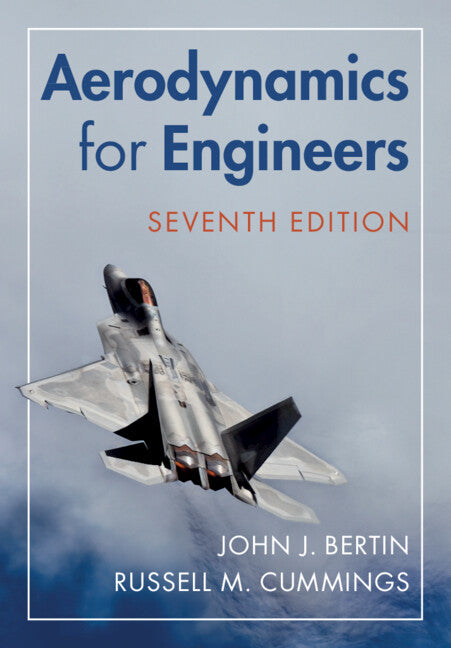
Aerodynamics for Engineers
The seventh edition of this classic textbook, now revised, expanded, and packed with new learning features.
John J. Bertin (Author), Russell M. Cummings (Author)
9781009501309, Cambridge University Press
Hardback, published 12 June 2025
960 pages
25.9 x 18.6 x 4.8 cm, 2.03 kg
'Aerodynamics is such a vast field, incorporating physics, mathematics, design and operational experience, as to be bewildering; however, this book provides a logical narrative through the subject. The content and exercises are representative of professional practice and supplementing traditional theory and analysis.' Chris Atkin, University of East Anglia, UK
Revised and expanded to reflect cutting-edge innovation in aerodynamics, and packed with new features to support learning, the seventh edition of this classic textbook introduces the fundamentals of aerodynamics using clear explanations and real-world examples. Structured around clear learning objectives, this is the ideal textbook for undergraduate students in aerospace engineering, and for graduate students and professional engineers seeking a readable and accessible reference. Over 10 new Aerodynamics Computation boxes that bring students up to speed on modern computational approaches for performing aerodynamic analysis, including various Matlab® programs, OpenVSP, XFOIL, CBAero, Kestrel, and other analysis tools. New end-of-chapter team projects show students how to work together to solve larger, more important aerodynamic problems, in many cases using the computational approaches listed above. New and expanded coverage of propellers, UAVs, transonic wings, wingtip devices, drones, hypersonic aircraft, and aircraft design. New pedagogical features including Look Ahead navigation, expanded use of SI units in new homework problems, and many new Aerodynamics Concepts boxes featuring advanced experimental aircraft concepts. Additional references in each chapter that bring current advancements in aerodynamics into each part of the book.
1. Why study aerodynamics?
2. Fundamentals of fluid mechanics
3. Dynamics of an incompressible, inviscid flow field
4. Viscous boundary layers
5. Characteristic parameters for airfoil and wing aerodynamics
6. Incompressible flows around airfoils of infinite span
7. Incompressible flow about wings of finite span
8. Dynamics of a compressible flow field
9. Compressible, subsonic flows and transonic flows
10. Two-dimensional supersonic flows around thin airfoils
11. Supersonic flows over wings and airplane configurations
12. Hypersonic flows
13. Aerodynamic design considerations
14. Tools for defining the aerodynamic environment
Appendices
Answers to selected problems
Index
Conversion factors.
Subject Areas: Aerospace & aviation technology [TRP]