Freshly Printed - allow 10 days lead
Couldn't load pickup availability
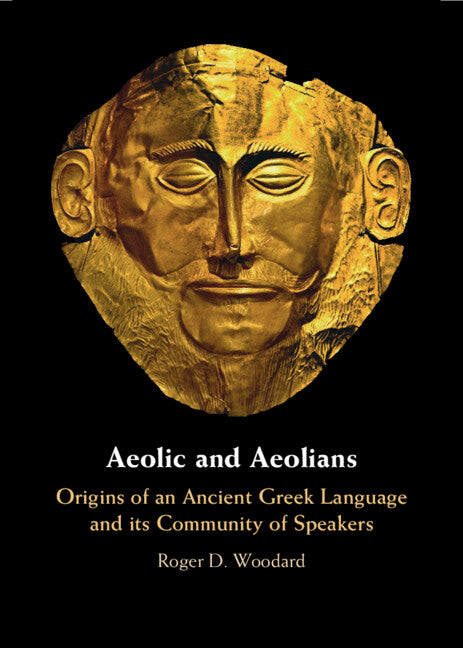
Aeolic and Aeolians
Origins of an Ancient Greek Language and its Community of Speakers
Explores the origin of an ancient Greek language and the beginnings and evolution of the community of its speakers – the Aeolians.
Roger D. Woodard (Author)
9781009424400, Cambridge University Press
Hardback, published 21 November 2024
648 pages
26.2 x 18.5 x 4 cm, 1.34 kg
Aeolic and Aeolians explores the origin of an ancient Greek language and the beginnings and evolution of the community of its speakers – the Aeolians. Roger Woodard argues that the starting point for both is situated in Asia Minor during the period of the Late Bronze Age, and that the ancestral Aeolic speech community can be identified with the Mycenaean peoples of Anatolia called the Ahhiyawans in Hittite records. These Bronze-Age Asian Greeks would intermarry with local Luvian peoples of western Anatolia, and the Aeolian language and identity – an identity encoded in myth-emerged from the intermixing of the two societies. Aeolian myths are central to Woodard's ground-breaking investigations presented in this volume. He demonstrates how assemblages of mythic components, what Lévi-Strauss called bricolage, enabled early Aeolians to give intellectual expression to their distinctive Greek identity. With the collapse of Bronze-Age societies in Mycenaean Greece, some of the early Aeolians of Anatolia would migrate to Europe, introducing their language and myths into Hellas.
Introduction
Part I. Aeolian and Aeolic: 1. Archaeology, language, and an Aeolian migration
2. The Aeolic dialects
3. More linguistic matters: Aeolic phonology and morphology as language complexification
4. Mycenaean dialects and Despótēs
5. Aeolian patronymics and the Mycenaean Hekwetai
6. Mycenaean Epíkouros
Part II. Aeolian Origins in Myth: 7. Aeolian self-identity and metapontium
8. Magnesia on the Maeander: Cretans, Aeolians, and a white-horse man
9. Metapontium: night and day
black and white
10. Boeotian foundation Mûthoi: from Dioscuri to Cabiri
Part III. Anatolian and Aeolian Myth and Cult: 11. Asian goddesses and bees
12. Ephesian Artemis' 'breasts' and the Hittite Kurša
13. Aia and Argonauts
14. Parnassian divining bee nymphs and lot-divination
15. Honey and Theogonies: the west face of Sipylus
16. Bee and bird, Linear B Du-ma/Da-ma, Luvo-Hittite Dammara-, and Artemis/Artimis/Artamis
17. Conclusion.
Subject Areas: Classical history / classical civilisation [HBLA1]