Freshly Printed - allow 7 days lead
Couldn't load pickup availability
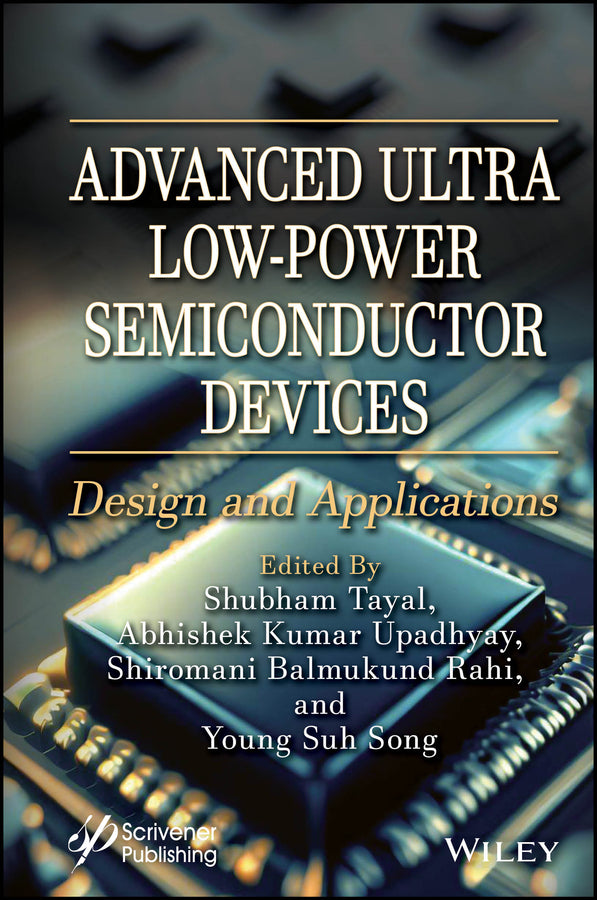
Advanced Ultra Low-Power Semiconductor Devices
Design and Applications
Shubham Tayal (Edited by), Abhishek Kumar Upadhyay (Edited by), Shiromani Balmukund Rahi (Edited by), Young Suh Song (Edited by)
9781394166411, Wiley
Hardback, published 7 November 2023
320 pages
22.9 x 15.2 x 2 cm, 0.68 kg
ADVANCED ULTRA LOW-POWER SEMICONDUCTOR DEVICES Written and edited by a team of experts in the field, this important new volume broadly covers the design and applications of metal oxide semiconductor field effect transistors. This outstanding new volume offers a comprehensive overview of cutting-edge semiconductor components tailored for ultra-low power applications. These components, pivotal to the foundation of electronic devices, play a central role in shaping the landscape of electronics. With a focus on emerging low-power electronic devices and their application across domains like wireless communication, biosensing, and circuits, this book presents an invaluable resource for understanding this dynamic field. Bringing together experts and researchers from various facets of the VLSI domain, the book addresses the challenges posed by advanced low-power devices. This collaborative effort aims to propel engineering innovations and refine the practical implementation of these technologies. Specific chapters delve into intricate topics such as Tunnel FET, negative capacitance FET device circuits, and advanced FETs tailored for diverse circuit applications. Beyond device-centric discussions, the book delves into the design intricacies of low-power memory systems, the fascinating realm of neuromorphic computing, and the pivotal issue of thermal reliability. Authors provide a robust foundation in device physics and circuitry while also exploring novel materials and architectures like transistors built on pioneering channel/dielectric materials. This exploration is driven by the need to achieve both minimal power consumption and ultra-fast switching speeds, meeting the relentless demands of the semiconductor industry. The book’s scope encompasses concepts like MOSFET, FinFET, GAA MOSFET, the 5-nm and 7-nm technology nodes, NCFET, ferroelectric materials, subthreshold swing, high-k materials, as well as advanced and emerging materials pivotal for the semiconductor industry’s future.
Preface xi 1 Subthreshold Transistors: Concept and Technology 1 1.1 Introduction 2 1.2 Major Sources of Leakage and Possible Methods of Prevention 2 1.3 Possibilities and Challenges 12 1.4 Conclusions 21 2 Introduction to Conventional MOSFET and Advanced Transistor TFET 29 2.1 Introduction 30 2.2 Device Structure 30 2.3 TFET Principle of Operation 31 2.4 Material Characterization 33 2.5 Characteristics of TFET 35 2.6 Comparison of OFF-State Characteristics 37 2.7 Phonon Scattering's Impact 39 2.8 ON-State Performance Comparison 40 2.9 Performance Analysis Based on Intrinsic Delay 40 2.10 Bandgap's Effect on Device Performance 41 2.11 MOSFET and TFET Scaling Behaviour 43 2.12 Surface Potential of an N-TFET and N-MOSFET 45 2.13 Professional Advantages of TFET over MOSFET 46 2.14 Conclusion 46 3 Operation Principle and Fabrication of TFET 51 3.1 Introduction 52 3.2 Planar MOSFET's Limitations 54 3.3 Demand for Low Power Operation 55 3.4 TFET: Operation Principle of TFET 56 3.5 TFET: Recent Design Issues in TFET 63 3.6 TFET: Modeling and Application 65 3.7 TFET: Fabrication Perspective 68 3.8 TFET: Applications and Future of Low-Power Electronics 70 3.9 Expected Challenges in Replacing MOSFET with TFET 70 3.10 Conclusion 71 4 Mathematical Modeling of TFET and Its Future Applications: Ultra Low-Power SRAM Circuit and III-IV TFET 77 4.1 Introduction 78 4.2 Modeling Approaches 78 4.3 Structure 81 4.4 Applications of Tunnel Field-Effect Transistor 83 4.5 Road Ahead for Tunnel Field Effect Transistors 87 5 Analysis of Channel Doping Variation on Transfer Characteristics to High Frequency Performance of F-TFET 91 5.1 Introduction 92 5.2 Simulated Device Structure and Parameters 93 5.3 DC Characteristics 93 5.4 Analysis of Analog/RF FOMs 98 5.5 Conclusion 101 6 Comparative Study of Gate Engineered TFETs and Optimization of Ferroelectric Heterogate TFET Structure 105 6.1 Introduction 106 6.2 Study of Different TFET Structures 106 6.3 Proposed Structure 109 6.4 Results and Discussion 110 6.5 Conclusion 127 6.6 Future Scope 128 7 State of the Art Tunnel FETs for Low Power Memory Applications 131 7.1 Static Random Access Memory 131 7.2 Performance Parameters of SRAM Cell 134 7.3 TFET-Based SRAM Cell Design 135 7.4 Conclusion 159 8 Epitaxial Layer-Based Si/SiGe Hetero-Junction Line Tunnel FETs: A Physical Insight 165 8.1 Fundamental Limitation of CMOS: Tunnel FETs 165 8.2 Working Principle of Tunnel FET 168 8.3 Point and Line TFETs: Tunneling Direction 169 8.4 Perspective of Line TFETs 170 8.5 Analytical Models of Line TFETs 176 8.6 Line TFETs for Analog & Digital Circuits Design 178 8.7 Other Steep Slope Devices 179 8.8 Conclusion 181 9 Investigation of Thermal Performance on Conventional and Junctionless Nanosheet Field Effect Transistors 187 9.1 Introduction 188 9.2 Device Simulation Details 190 9.3 Results and Discussion 192 9.4 Conclusion 201 10 Introduction to Newly Adopted NCFET and Ferroelectrics for Low-Power Application 207 10.1 Introduction 208 10.2 NCFET and Its Design Constraints 209 10.3 NCFET for Low-Power Applications 216 10.4 Summary 226 11 Application of Ferroelectrics: Monolithic-3D Inference Engine with IGZO Based Ferroelectric Thin Film Transistor Synapses 235 11.1 Introduction 236 11.2 Ferroelectricity in Hafnium Oxide 241x Contents 11.3 IGZO Based Ferroelectric Thin Film Transistor 245 11.4 Applications in Neural Networks 249 11.5 Conclusion 250 12 Radiation Effects and Their Impact on SRAM Design: A Comprehensive Survey with Contemporary Challenges 261 12.1 Introduction 261 12.2 Literature Survey 263 12.3 Impact of Radiation Effects on Sram Cells 266 12.4 Results and Discussion 267 12.5 Conclusion 274 13 Final Summary and Future of Advanced Ultra Low Power Metal Oxide Semiconductor Field Effect Transistors 279 13.1 Introduction 280 13.2 Challenges in Future Ultra-Low Power Semiconductors 282 13.3 Conclusion 286 References 288 Index 293
Ball Mukund Mani Tripathi
M. Saravanan, K. Ramkumar, Eswaran Parthasarathy, J. Ajayan and S. Sreejith
Mekonnen Getnet Yirak and Rishu Chaujar
Nayana G H and P. Vimala
Prabhat Singh and Dharmendra Singh Yadav
Susmitha Kothapalli, Zohmingliana and Brinda Bhowmick
Arun A. V., Sreelekshmi P. S. and Jobymol Jacob
Abhishek Acharya, Sourabh Panwar, Shobhit Srivastava and Shashidhara M.
Sresta Valasa, Shubham Tayal and Laxman Raju Thoutam
Shelja Kaushal
Sourav De, Maximilian Lederer, Yannick Raffel, David Lehninger, Sunanda Thunder, Michael P.M. Jank, Tarek Ali and Thomas Kämpfe
Y. Alekhya, Umakanta Nanda and Chandan Kumar Pandey
Young Suh Song, Shiromani Balmukund Rahi, Shahnaz Kossar, Abhishek Kumar Upadhyay, Shubham Tayal, Chandan Kumar Pandey and Biswajit Jena
Subject Areas: Electronics & communications engineering [TJ]