Freshly Printed - allow 7 days lead
Couldn't load pickup availability
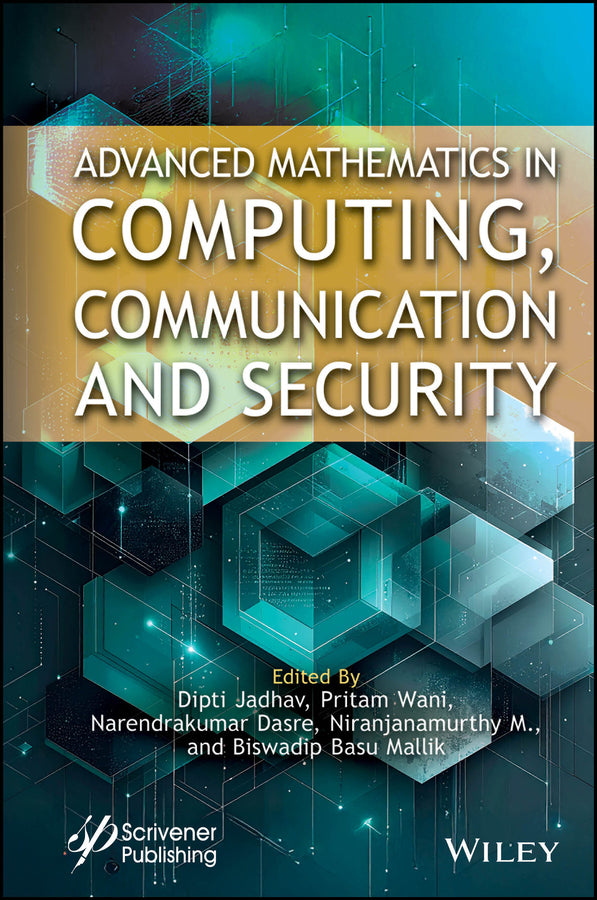
Advanced Mathematics in Computing, Communication and Security
Dipti Jadhav (Edited by), Pritam Wani (Edited by), Narendrakumar Dasre (Edited by), M. Niranjanamurthy (Edited by), Biswadip Basu Mallik (Edited by)
9781394307272, Wiley
Hardback, published 10 December 2025
576 pages
22.9 x 15.2 x 3.4 cm, 0.975 kg
Explore the cutting edge of scientific computing with this volume, which provides a comprehensive look at the interdependency between mathematics and computer science. Within the evolving landscape of computer science, mathematics is increasingly playing a pivotal role. Disciplines like linear algebra, statistics, calculus, and discrete mathematics serve as the cornerstone for comprehension and innovation within various computer science domains. This book underscores the deep-seated interdependency between the realms of mathematics and scientific computing, exploring how each discipline mutually reinforces and advances the other. With its rich theoretical framework and analytical rigor, mathematics provides the bedrock upon which many computational concepts and methodologies are built. In turn, computer science offers a practical avenue for applying mathematical abstractions to tackle real-world problems efficiently and effectively. Cutting-edge technologies, such as scientific computing, deep learning, and computer vision, require not only a mastery of foundational mathematics, but a diverse interdisciplinary approach. This book sheds light on the burgeoning frontiers of computer science, bringing together researchers with expertise across multiple industries, making it an essential resource for beginners and experienced practitioners alike.
Preface xxi 1 Comparative Analysis of Secure Multi-Party Techniques in the Cloud 1 1.1 Introduction 2 2 Exploring the Role of Mathematics in Artificial Intelligence (AI), Machine Learning (ML) and Deep Learning (DL) Applications 21 2.1 Introduction to Mathematics in Artificial Intelligence 23 3 ChatGPT as Rough Set Model Bridging Conversation Gap and Uncertainty 57 3.1 Introduction 58 4 Simulating M/G/1 Queuing Network with Time-Varying Arrival Rates and Server Failure Using Python Programming 81 4.1 Introduction 82 5 A Technique of Watermarking Using DGT and DCT 91 5.1 Introduction 91 6 Performance and Economic Study of an Impatient Consumer Queue with Working Vacations, Secondary Service and Server Failures 117 6.1 Introduction 118 7 Optimal Strategies for Multi-Item Stochastic Inventory Model for Convertible Items 139 7.1 Introduction 139 8 Sampling Statistics-Based Predictive Machine Learning Model for Large Scale Data Set 165 8.1 Introduction 166 9 Correlation of Family History with Tumor Grade and Lymph Node Involvement in Breast Cancer Patients 195 9.1 Introduction 196 10 Unlocking AI, ML, and DL Innovations: "The Essential Role of Mathematics" 211 10.1 Introduction for the Mathematical Concepts in AI, ML and DL 212 11 Optimization and Metaheuristics: Mathematical Approaches in AI, Machine Learning, and Deep Learning 247 11.1 Introduction to Metaheuristics and Optimization 248 12 A Survey on Mathematics for Edge Detection Algorithms in Image Processing 275 12.1 Introduction 275 13 PUF Inspired AES Cryptosystem for Securing Information 289 13.1 Introduction 290 14 Leveraging Honeypots and Stochastic Gradient Descent for Advanced Cybersecurity 305 14.1 Introduction 306 15 Review of "Optimizing Peer Review Workflows with AI: A Queuing Model Approach" 321 15.1 Introduction 322 16 To Analyze the Success of Prostate Cancer Prediction Using Machine Learning 329 16.1 Introduction 330 17 Statistics in Data Science 357 17.1 Introduction to Statistics 358 18 Frames for Applications in Engineering 381 18.1 Introduction 382 19 Development and Optimization of an ADRC-Controlled IPMC Actuator for Enhanced Disturbance Rejection and Creep Compensation 415 19.1 Introduction 416 20 Industry 4.0: Revolutionizing Production through Cyber-Physical Systems 437 20.1 Introduction 438 21 Safeguarding Security and Privacy in the Business Sector: The Role of AI and ML 459 21.1 Introduction 460 22 Advancing Women Health: Detecting Polycystic Ovary Syndrome through Machine Learning 485 22.1 Introduction 486 23 Personalized Hotel Recommendation System Using Similarity Measures and Heuristic Analysis 501 23.1 Introduction 502 24 Predictive Structural Equation Modeling for Multi-Dimensional Skill-Development Among Higher Education Learners in Formal Learning Environment 521 24.1 Introduction 522 References 542
Janak Dhokrat, Namita Pulgam, Tabassum Maktum and Vanita Mane
1.2 Related Work 5
1.3 Comparative Analysis 9
1.4 Summary 11
1.5 Conclusion 16
1.6 Compliance with Ethical Standards 17
R. Venkatesh
2.2 Mathematical Foundations of AI 29
2.3 Advanced Mathematical Techniques in Machine Learning 33
2.4 Applications of Mathematics in Deep Learning 41
2.5 Future Directions and Challenges 47
2.6 Conclusion 53
Anshit Mukerjee, Biswadip Basu Mallik and Sudeshna Das
3.2 Literature Review 58
3.3 Methodology 62
3.4 Results 68
3.5 Discussions 76
3.6 Conclusion and Future Works 77
Sreelekha Menon, Surya K.A. and Reshma R.
4.2 Methodology 84
4.3 Numerical Example 86
4.4 Python Code 89
4.5 Negative Arrivals 89
4.6 Conclusion 89
Narendrakumar R. Dasre and Pritam Gujarathi
5.2 Proposed Algorithm Using DGT and DCT 93
5.3 Experimental Results 95
5.4 Statistical Analysis 99
5.5 Conclusion 113
K. Jyothsna, P. Vijaya Kumar and P. Vijaya Laxmi
6.2 Model Overview 121
6.3 Steady-State Analysis 122
6.4 Performance Characteristics 125
6.5 Sensitivity Analysis 128
6.6 Conclusion 135
Mamta Keswani and Uttam Kumar Khedlekar
7.2 Literature Survey 142
7.3 Problem Statement 144
7.4 Assumptions 145
7.5 Notations 146
7.6 Model Formulation 147
7.7 Optimization by Using Dynamic Programming 148
7.8 Numerical Validations 158
7.9 Conclusion 163
Kamlesh Kumar Pandey, Anurag Singh and Sudeep Kumar Verma
8.2 Challenging Issues of Big Data for Machine Learning 168
8.3 Big Data Strategies for Machine Learning 170
8.4 Sampling 172
8.5 Sampling Model for Machine Learning 180
8.6 Experimental Analysis 184
8.7 Conclusion 188
Suganthi P. and Ebenesar Anna Bagyam J.
9.2 Literature Review 197
9.3 Methodology 201
9.4 Data Collection and Analysis of Parameters 201
9.5 Analysis of Parameters Using Statistical Tool 206
9.6 Conclusion 209
R. Roselinkiruba, Vasumathy M., C.P. Koushik, C. Saranya Jothi, S. Divya and A. Keerthika
10.2 Linear Algebra 215
10.3 Calculus: Foundations for Optimization and Training Algorithms 221
10.4 Probability and Statistics: Analyzing and Validating Models 225
10.5 Optimization: Refining Models and Resource Allocation 230
10.6 Discrete Mathematics: Graph Theory and Combinatorics in AI 235
10.7 Information Theory: Guiding Feature Selection and Model Evaluation 240
10.8 Applications in Various Domains 243
10.9 Conclusion 245
C. Saranya Jothi, J.P. Shritharanyaa, E. Surya, R. Roselinkiruba, P. Jeevanasree and B. Lalitha
11.2 Metaheuristics Algorithms and Their Mathematical Foundations 252
11.3 Applications in Artificial Intelligence 263
11.4 Metaheuristics in Machine Learning Applications 266
11.5 Metaheuristics in Deep Learning Applications 268
11.6 Challenges and Future Directions 271
11.7 Conclusions 272
Maheshkumar D. Kudre, Narendrakumar R. Dasre and Pritam Wani
12.2 Literature Review 276
12.3 Conclusion 286
Sivasankari Narasimhan, Sumathy Raju, Kavya Sri and Anitha N.
13.2 Related Works 291
13.3 Proposed PUF with AES Approach 292
13.4 Simulation Results and Discussion 296
13.5 AES-PUF Against Machine Learning Attacks 302
13.6 Conclusion 303
J. Esther, Regi Anbumozhi and S. Subbulakshmi
14.2 Literature Review 308
14.3 Methodology 309
14.4 Result & Discussion 315
14.5 Conclusion 319
Sreelekha Menon, Reshma R. and Surya K.A.
15.2 Queuing Models to Analyze the Impact of AI Peer Review Process 323
15.3 Methodology 324
15.3.4 Challenges and Drawbacks 326
15.4 Conclusion 327
Bhaskar Nandi, Soumit Chowdhury, Subrata Jana, Biswadip Basu Mallik, Krishna Pada Das and Sudipta Banerjee
16.2 Literature Review 331
16.3 Objectives 334
16.4 Hypothesis 334
16.5 Attributes 335
16.6 Flow Chart and Data Description 336
16.7 Data Analysis 337
16.8 Model Evaluation 344
16.9 Result Analysis 350
16.10 Conclusions 352
Nishant Wanjari, Aashka Gupta, Reshma Gulwani and Aditi Chhabria
17.2 Relationships between Data Science and Statistics 360
17.3 Correlation and Covariance 363
17.4 Regression Analysis 364
17.5 Probability and Probability Functions 365
17.6 Bayesian Statistics 368
17.7 Hypothesis Testing 368
17.8 Statistics in Predictive Modeling 371
17.9 Statistics Meets Computation to Form Data Science 373
17.10 Statistics Applications in Data Science 375
17.11 Statistical Software and Packages in Data Science 377
Jamkhongam Touthang
18.2 Finite Frames 384
18.3 Frames in Infinite-Dimensional Settings 390
18.4 Applications 400
18.5 Challenges in Signal Processing 407
Mohammed Mohaideen M., Seenivasan S., Ravivarman G., Rangarajan R. V., Naveenkumar P., Sekar G., Balachandar K., Girimurugan R. and Biswadip Basu Mallik
19.2 Ionic Polymer Metal Composites Creep Model 417
19.3 Design of the ADRC Controller 419
19.4 ADRC Controller Parameters Can Be Changed Using the Particle Swarm Optimization Method 424
19.5 Conclusions 432
Girisha L., Meinathan S., Ravivarman G., Girimurugan R., Irudhayamary Premkumar, Catherene Julie Aarthy C. and Biswadip Basu Mallik
20.2 A Case Study 440
20.3 Infrastructure Requirements 442
20.4 Legal Issues and Cyber-Security 445
20.5 Development of New Business Models 448
20.6 Challenges to Achieve Sustainable Development 451
20.7 Conclusions 453
Joshua Bapu J., Saranya N., Chacko Jose P., Suresh Kumar K., Jayachandran T., Girimurugan R. and Biswadip Basu Mallik
21.2 An Ethical Investigation into Cyber Security 462
21.3 Literature Review 463
21.4 Artificial Intelligence Cybersecurity as a Business Ethics Duty 466
21.5 Using AI and Big Language Models in Business Settings: Falling for the Marketing Hype 470
21.6 Risk Considerations for Cyber Security in Generative AI and Huge Language Models 471
21.7 Ethical Implications of Generative AI Risk 474
21.8 Ethical Implementations of Generative AI 479
21.9 Conclusions 480
K. DeviPriya, K. V. V. S. Trinadh Naidu, V. Chandra Kumar, Subrata Jana, Biswadip Basu Mallik, K. Bhanu Rajesh Naidu and M. V. Rajesh
22.2 Related Works 488
22.3 Proposed Work 489
22.4 Dataset 491
22.5 Experimental Setup 494
22.6 Results & Discussion 494
22.7 Conclusions 498
Prapti Sinha, Rajashree Shedge and Dipti Jadhav
23.2 Background 503
23.3 Literature Survey 505
23.4 Dataset 508
23.5 Proposed Framework 508
23.6 Result 519
23.7 Conclusion 519
S. Bhuma Devi, Preeti Jain and Gargi Tyagi
24.2 Related Work 523
24.3 Research Methodology 526
24.4 Results and Discussion 535
24.5 Conclusion 541
Index 545
Subject Areas: Mathematics [PB]