Freshly Printed - allow 7 days lead
Couldn't load pickup availability
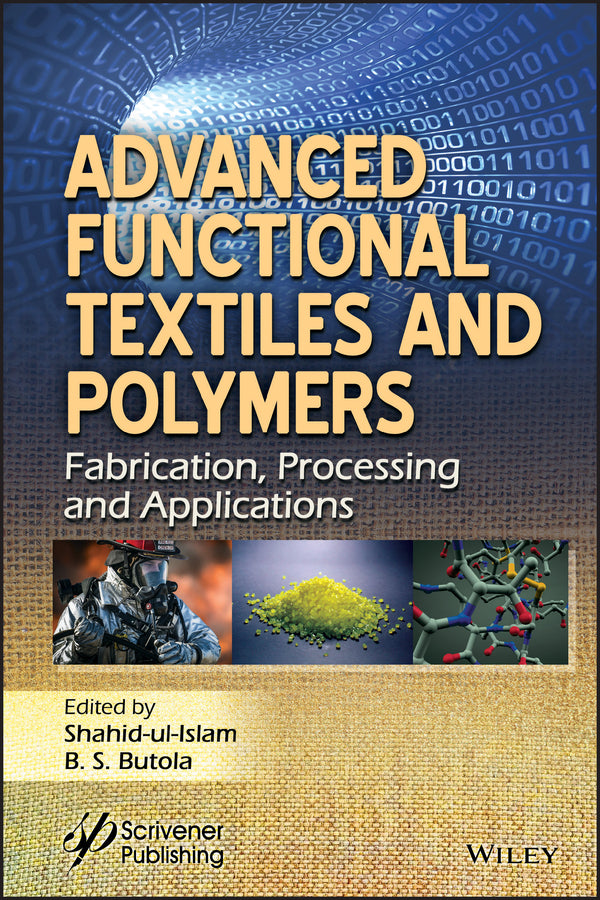
Advanced Functional Textiles and Polymers
Fabrication, Processing and Applications
Shahid Ul Islam (Edited by), B. S. Butola (Edited by)
9781119605799, Wiley
Hardback, published 25 October 2019
464 pages
1 x 1 x 1 cm, 0.454 kg
This book on advanced functional textiles and polymers will offer a comprehensive view of cutting-edge research in newly discovered areas such as flame retardant textiles, antimicrobial textiles, insect repellent textiles, aroma textiles, medical-textiles, smart textiles, and nano-textiles etc. The second part the book provides innovative fabrication strategies, unique methodologies and overview of latest novel agents employed in the research and development of functional polymers.
Preface xvii 1 Flame Retarded Cotton Fabrics: Current Achievements, Open Challenges, and Future Perspectives 1 1.1 Introduction 2 2 UV Protective Clothing 33 2.1 Introduction 33 3 Potential of Textile Structure Reinforced Composites for Automotive Applications 65 3.1 Introduction 66 4 Biotechnology Applications in Textiles 99 4.1 Introduction 100 5 Environmental Issues in Textiles 129 5.1 Introduction 130 6 Water Saving Technologies for Textile Chemical Processing 153 6.1 Introduction 154 7 Photocatalytic Dye Degradation Using Modified Titania 171 7.1 Introduction 172 8 Advanced Approaches for Remediation of Textile Wastewater: A Comparative Study 201 8.1 Introduction 202 9 Polymer-Supported Nanocomposite-Based Nanomaterials for Removal and Recovery of Pollutants and Their Application in Bio-Electrochemical System 265 9.1 Introduction 266 10 Reactive and Functional Polymers 291 10.1 Introduction 291 11 Fabrication and Biomedical Applications of Polyvinyl-Alcohol-Based Nanocomposites with Special Emphasis on the Anti-Bacterial Applications of Metal/Metal Oxide Polymer Nanocomposites 309 11.1 Introduction 310 12 Preparation, Classification, and Applications of Smart Hydrogels 337 12.1 Introduction 337 13 Potential Applications of Chitosan Nanocomposites: Recent Trends and Challenges 365 13.1 Introduction 366 14 Use of Polymer Nanocomposites in Asphalt Binder Modification 405 14.1 Introduction 405 References 428
Giulio Malucelli
1.2 Textile Finishing with Sol–Gel Treatments 8
1.3 Textile Finishing with Layer-by-Layer Assemblies 17
1.4 Current Limitations of Sol–Gel and Layer-by-Layer Treatments 25
1.5 Conclusions and Future Perspectives 26
Anu Mishra and Bhupendra Singh Butola
2.2 Harmful Effects of UV Radiations on Skin 34
2.3 Environmental Factors Influencing UV Level on Earth 39
2.4 Effect of Physical and Chemical Characteristics of Textile Materials on UV Protection 42
2.5 Type of UV Finishes, Their Working Mechanism, and Limitations 46
2.6 Application Methods of UV Finish in Textiles 50
2.7 Test Methods for Quantitative Assessment of UV Protection of Textiles 54
2.8 Summary 57
Vikas Khatkar, R. N. Manjunath, Sandeep Olhan and B. K. Behera
3.2 Materials for Automotive 68
3.3 Textile Materials for Automotive 80
3.4 Potential Automotive Parts to be Replaced with Textile Structural Composites 85
3.5 Lightweight Solution for Electric Car 93
3.6 Conclusion 93
Lalit Jajpura
4.2 Adverse Effects of Industrial Farm Practices in Cotton Cultivation 101
4.3 Application of Biotechnology in Cotton Cultivation 103
4.4 Wet Processing of Cotton and Its Environmental Impact 105
4.5 Enzyme and Its Properties 106
4.6 Classification of Enzymes 107
4.7 Enzymatic Bioprocessing of Cotton 108
4.8 Enzymatic Hydrogen Peroxide Removal by Catalase 113
4.9 Biopolishing of Cotton 114
4.10 Enzymatic Fading of Denim 114
4.11 Application of Biotechnology in Wool Production and its Wet Processing 115
4.12 Enzymatic Bioprocessing of Wool 115
4.13 Application of Biotechnology in Sericulture and Wet Processing of Silk 117
4.14 Enzymatic Bioprocessing of Silk 117
4.15 Application of Biotechnology in Sustainable Finishing 118
4.16 Application of Enzyme Immobilization Techniques in Reuse of Enzymes 119
4.17 Conclusion 119
Rishabh Kumar Saran, Raj Kumar and Shashikant Yadav
5.2 Textile Fiber 130
5.3 Processes in the Textile Industry 131
5.4 Key Environmental Issues 134
5.5 Environmental Impact of Textile Industry Wastewater 144
5.6 Environmental Legislation 146
Nagender Singh
6.2 Technologies for Water Saving in Textile Chemical Processing 158
6.3 Conclusion 166
Waseem Raza and Mohd Faraz
7.2 Photocatalytic Application 180
7.3 Factors Affecting the Degradation of Organic Pollutants 190
7.4 Conclusions 195
Shumaila Kiran, Sofia Nosheen, Shazia Abrar, Fozia Anjum, Tahsin Gulzar and Saba Naz
8.2 Treatment Methods for Textile Effluent 207
8.3 Sequential Method for Textile Effluent Treatment 240
8.4 Conclusion 247
Abdul Hakeem Anwer, Nishat Khan, Mohammad Shahadat, Mohammad Zain Khan, Ziauddin Ahammad Shaikh and Syed Wazed Ali
9.2 Conclusion 282
Tanvir Arfin
10.2 Types of Textiles 293
10.3 Location of Textile Industries in India 293
10.4 Role of Polymer 294
10.5 Conclusion 301
Shahnawaz Ahmad Bhat, Fahmina Zafar, Azar Ullah Mirza, Abdulrahman Mohammad, Paramjit Singh and Nahid Nishat
11.2 Scope of the Chapter 312
11.3 Metal/Metal Oxide Nanoparticles 313
11.4 Nanocomposite 316
11.5 Biomedical Applications of Nanocomposite 319
11.6 Conclusions 325
Ali Akbar Merati, Nahid Hemmatinejad, Mina Shakeri and Azadeh Bashari
12.2 Preparation and Characterization of Smart Hydrogels 339
12.3 Classifications of Smart Hydrogels 344
12.4 Applications of Smart Hydrogels 348
12.5 Smart Hydrogel-Functionalized Textile Systems 353
12.6 Electrospinning of Smart Hydrogels 355
12.7 Future Trends of Smart Hydrogels 356
12.8 Conclusions 357
Tara Chand Yadav, Pallavi Saxena, Amit Kumar Srivastava, Amit Kumar Singh, Ravi Kumar Yadav, Harish, R. Prasad and Vikas Pruthi
13.2 Synthetic Routes for the Preparation of Nanocomposites of Chitosan 368
13.3 Applications of Chitosan Nanocomposites 373
13.4 Biomedical Application 380
13.5 Future Prospects 388
Saqib Gulzar and Shane Underwood
14.2 Background 407
14.3 Polymer Nanocomposites 415
14.4 Rheological Impacts 418
14.5 Suggested Evaluation Method for PNC Modified Asphalt Binders 427
14.6 Summary 428
Index 433
Subject Areas: Mechanical engineering & materials [TG]