Freshly Printed - allow 7 days lead
Couldn't load pickup availability
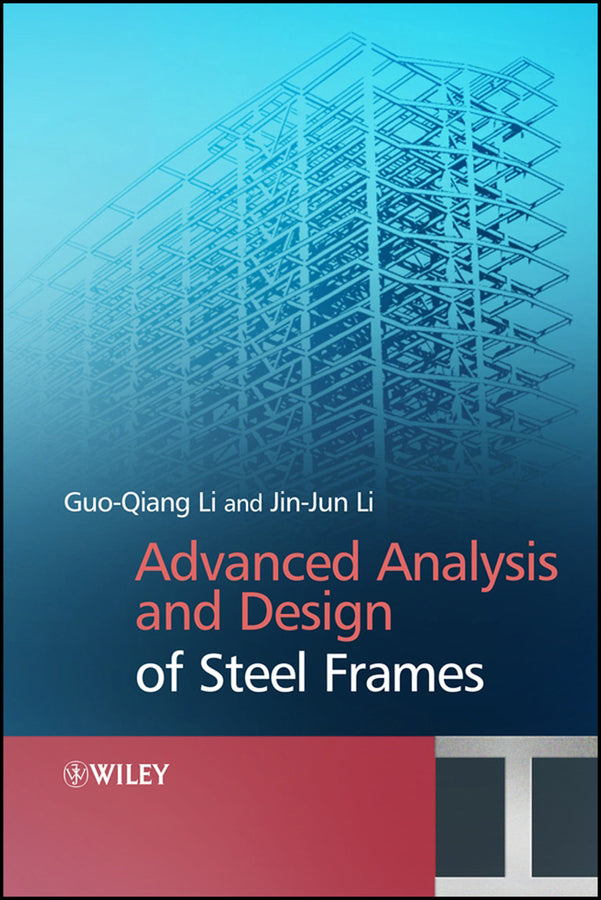
Advanced Analysis and Design of Steel Frames
Gou-Qiang Li (Author), Jin-Jin Li (Author)
9780470030615, Wiley
Hardback, published 20 April 2007
384 pages
25.2 x 17.7 x 2.7 cm, 0.879 kg
Steel frames are used in many commercial high-rise buildings, as well as industrial structures, such as ore mines and oilrigs. Enabling construction of ever lighter and safer structures, steel frames have become an important topic for engineers. This book, split into two parts covering advanced analysis and advanced design of steel frames, guides the reader from a broad array of frame elements through to advanced design methods such as deterministic, reliability, and system reliability design approaches. This book connects reliability evaluation of structural systems to advanced analysis of steel frames, and ensures that the steel frame design described is founded on system reliability. Important features of the this book include: Advanced Design and Analysis of Steel Frames provides students, researchers, and engineers with an integrated examination of this core civil and structural engineering topic. The logical treatment of both advanced analysis followed by advanced design makes this an invaluable reference tool, comprising of reviews, methods, procedures, examples, and applications of steel frames in one complete volume.
Preface xi Symbols xiii Part One Advanced Analysis of Steel Frames 1 Chapter 1 Introduction 3 1.1 Type of Steel Frames 3 1.2 Type of Components for Steel Frames 3 1.3 Type of Beam–Column Connections 7 1.4 Deformation of Joint Panel 7 1.5 Analysis Tasks and Method for Steel Frame Design 8 1.6 Definition of Elements in Steel Frames 9 Chapter 2 Elastic Stiffness Equation of Prismatic Beam Element 11 2.1 General Form of Equation 11 2.1.1 Beam Element in Tension 11 2.1.2 Beam Element in Compression 16 2.1.3 Series Expansion of Stiffness Equations 16 2.1.4 Beam Element with Initial Geometric Imperfection 17 2.2 Special Forms of Elemental Equations 19 2.2.1 Neglecting Effect of Shear Deformation 19 2.2.2 Neglecting Effect of Axial Force 21 2.2.3 Neglecting Effects of Shear Deformation and Axial Force 22 2.3 Examples 22 2.3.1 Bent Frame 22 2.3.2 Simply Supported Beam 24 Chapter 3 Elastic Stiffness Equation of Tapered Beam Element 25 3.1 Tapered Beam Element 25 3.1.1 Differential Equilibrium Equation 25 3.1.2 Stiffness Equation 27 3.2 Numerical Verification 29 3.2.1 Symmetry of Stiffness Matrix 29 3.2.2 Static Deflection 30 3.2.3 Elastic Critical Load 30 3.2.4 Frequency of Free Vibration 30 3.2.5 Effect of Term Number Truncated in Polynomial Series 31 3.2.6 Steel Portal Frame 31 3.3 Appendix 33 3.3.1 Chebyshev Polynomial Approach (Rice, 1992) 33 3.3.2 Expression of Elements in Equation (3.23) 34 Chapter 4 Elastic Stiffness Equation of Composite Beam Element 35 4.1 Characteristics and Classification of Composite Beam 35 4.2 Effects of Composite Action on Elastic Stiffness of Composite Beam 37 4.2.1 Beam without Composite Action 37 4.2.2 Beam with Full Composite Action 38 4.2.3 Beam with Partial Composite Action 39 4.3 Elastic Stiffness Equation of Steel–Concrete Composite Beam Element 40 4.3.1 Basic Assumptions 40 4.3.2 Differential Equilibrium Equation of Partially Composite Beam 41 4.3.3 Stiffness Equation of Composite Beam Element 42 4.3.4 Equivalent Nodal Load Vector 46 4.4 Example 49 4.5 Problems in Present Work 51 Chapter 5 Sectional Yielding and Hysteretic Model of Steel Beam Columns 53 5.1 Yielding of Beam Section Subjected to Uniaxial Bending 53 5.2 Yielding of Column Section Subjected to Uniaxial Bending 53 5.3 Yielding of Column Section Subjected to Biaxial Bending 56 5.3.1 Equation of Initial Yielding Surface 56 5.3.2 Equation of Ultimate Yielding Surface 56 5.3.3 Approximate Expression of Ultimate Yielding Surface 61 5.3.4 Effects of Torsion Moment 62 5.4 Hysteretic Model 64 5.4.1 Cyclic Loading and Hysteretic Behaviour 64 5.4.2 Hysteretic Model of Beam Section 65 5.4.3 Hysteretic Model of Column Section Subjected to Uniaxial Bending 67 5.4.4 Hysteretic Model of Column Section Subjected to Biaxial Bending 67 5.5 Determination of Loading and Deformation States of Beam–Column Sections 68 Chapter 6 Hysteretic Behaviour of Composite Beams 71 6.1 Hysteretic Model of Steel and Concrete Material Under Cyclic Loading 71 6.1.1 Hysteretic Model of Steel Stress–Strain Relationship 71 6.1.2 Hysteretic Model of Concrete Stress–Strain Relationship 71 6.2 Numerical Method for Moment–Curvature Hysteretic Curves 75 6.2.1 Assumptions 75 6.2.2 Sectional Division 75 6.2.3 Calculation Procedure of Moment–Curvature Relationship 76 6.3 Hysteretic Characteristics of Moment–Curvature Relationships 77 6.3.1 Characteristics of Hysteretic Curves 77 6.3.2 Typical Phases 78 6.4 Parametric Studies 79 6.4.1 Height of Concrete Flange hc 79 6.4.2 Width of Concrete Flange Bc 79 6.4.3 Height of Steel Beam hs 80 6.4.4 Strength Ratio g 83 6.4.5 Yielding Strength of Steel fy 84 6.4.6 Compressive Strength of Concrete fck 84 6.4.7 Summary of Parametric Studies 85 6.5 Simplified Hysteretic Model 86 6.5.1 Skeletal Curve 86 6.5.2 Hysteresis Model 89 Chapter 7 Elasto-Plastic Stiffness Equation of Beam Element 93 7.1 Plastic Hinge Theory 93 7.1.1 Hinge Formed at One End of Element 94 7.1.2 Hinge Formed at Both Ends of Element 97 7.2 Clough Model 97 7.3 Generalized Clough Model 98 7.4 Elasto-Plastic Hinge Model 99 7.4.1 Both Ends Yielding 102 7.4.2 Only End 1 Yielding 103 7.4.3 Only End 2 Yielding 103 7.4.4 Summary 104 7.5 Comparison Between Elasto-Plastic Hinge Model and Generalized Clough Model 104 7.5.1 Only End 1 Yielding 104 7.5.2 Both Ends Yielding 105 7.5.3 Numerical Example 106 7.6 Effects of Residual Stresses and Treatment of Tapered Element 107 7.6.1 Effects of Residual Stresses on Plasticity Spread Along Element Section 107 7.6.2 Effects of Residual Stresses on Plasticity Spread Along Element Length 109 7.6.3 Treatment of Tapered Element 110 7.7 Beam Element with Plastic Hinge Between Two Ends 110 7.8 Subdivided Model with Variable Stiffness for Composite Beam Element 113 7.8.1 Subdivided Model 113 7.8.2 Stiffness Equation of Composite Beam Element 114 7.9 Examples 117 7.9.1 A Steel Portal Frame with Prismatic Members 117 7.9.2 A Steel Portal Frame with Tapered Members 118 7.9.3 Vogel Portal Frame 119 7.9.4 Vogel Six-Storey Frame 120 7.9.5 A Single-Storey Frame with Mid-Span Concentrated Load 121 7.9.6 A Single-Storey Frame with Distributed Load 123 7.9.7 A Four-Storey Frame with Mid-Span Concentrated Load 124 7.9.8 A Two-Span Three-Storey Composite Frame 126 Chapter 8 Elastic and Elasto-Plastic Stiffness Equations of Column Element 127 8.1 Force and Deformation of Column Element 127 8.2 Elastic Stiffness Equation of Column Element Subjected to Biaxial Bending 127 8.3 Elasto-Plastic Stiffness Equations of Column Element Subjected to Biaxial Bending 129 8.3.1 Both Ends Yielding 131 8.3.2 Only End 1 Yielding 132 8.3.3 Only End 2 Yielding 133 8.3.4 Summary 133 8.4 Elastic and Elasto-Plastic Stiffness Equations of Column Element Subjected to Uniaxial Bending 134 8.5 Axial Stiffness of Tapered Column Element 135 8.5.1 Elastic Stiffness 135 8.5.2 Elasto-Plastic Stiffness 135 8.6 Experiment Verification 136 8.6.1 Experiment Specimen 136 8.6.2 Set-Up and Instrumentation 139 8.6.3 Horizontal Loading Scheme 140 8.6.4 Theoretical Predictions of Experiments 141 8.6.5 Comparison of Analytical and Tested Results 144 Chapter 9 Effects of Joint Panel and Beam–Column Connection 147 9.1 Behaviour of Joint Panel 147 9.1.1 Elastic Stiffness of Joint Panel 147 9.1.2 Elasto-Plastic Stiffness of Joint Panel 149 9.2 Effect of Shear Deformation of Joint Panel on Beam/Column Stiffness 150 9.2.1 Stiffness Equation of Beam Element with Joint Panel 150 9.2.2 Stiffness Equation of Column Element with Joint Panel Subjected to Uniaxial Bending 153 9.2.3 Stiffness Equation of Column Element with Joint Panel Subjected to Biaxial Bending 154 9.3 Behaviour of Beam–Column Connections 155 9.3.1 Moment–Rotation Relationship 156 9.3.2 Hysteretic Behaviour 161 9.4 Effect of Deformation of Beam–Column Connection on Beam Stiffness 163 9.4.1 Stiffness Equation of Beam Element with Beam–Column Connections 164 9.4.2 Stiffness Equation of Beam Element with Connections and Joint Panels 166 9.5 Examples 166 9.5.1 Effect of Joint Panel 166 9.5.2 Effect of Beam–Column Connection 170 Chapter 10 Brace Element and its Elastic and Elasto-Plastic Stiffness Equations 175 10.1 Hysteretic Behaviour of Braces 175 10.2 Theoretical Analysis of Elastic and Elasto-Plastic Stiffnesses of Brace Element 175 10.3 Hysteretic Model of Ordinary Braces 181 10.4 Hysteretic Characteristics and Model of Buckling-Restrained Brace 183 10.5 Stiffness Equation of Brace Element 185 Chapter 11 Shear Beam and its Elastic and Elasto-Plastic Stiffness Equations 187 11.1 Eccentrically Braced Frame and Shear Beam 187 11.1.1 Eccentrically Braced Frame 187 11.1.2 Condition of Shear Beam 187 11.2 Hysteretic Model of Shear Beam 189 11.3 Stiffness Equation of Shear Beam 190 Chapter 12 Elastic Stability Analysis of Planar Steel Frames 193 12.1 General Analytical Method 193 12.2 Effective Length of Prismatic Frame Column 194 12.2.1 Concept of Effective Length 194 12.2.2 Assumption and Analytical Model 195 12.2.3 Formulations of Effective Length 197 12.2.4 Simplified Formula of Effective Length 202 12.2.5 Modification of Effective Length 203 12.2.6 Effect of Shear Deformation on Effective Length of Column 205 12.2.7 Examples 205 12.3 Effective Length of Tapered Steel Columns 211 12.3.1 Tapered Columns Under Different Boundary Conditions 211 12.3.2 Tapered Column in Steel Portal Frame 213 Chapter 13 Nonlinear Analysis of Planar Steel Frames 219 13.1 General Analysis Method 219 13.1.1 Loading Types 219 13.1.2 Criteria for the Limit State of Ultimate Load-Carrying Capacity 220 13.1.3 Analysis Procedure 221 13.1.4 Basic Elements and Unknown Variables 222 13.1.5 Structural Analysis of the First Loading Type 222 13.1.6 Structural Analysis of the Second Loading Type 223 13.1.7 Numerical Examples 223 13.2 Approximate Analysis Considering P_D Effect 226 13.2.1 Formulation 226 13.2.2 Example 227 13.3 Simplified Analysis Model Considering P_D Effect 228 13.3.1 Development of Simplified Model 228 13.3.2 Example 231 Chapter 14 Seismic Response Analysis of Planar Steel Frames 233 14.1 General Analysis Method 233 14.1.1 Kinetic Differential Equation 233 14.1.2 Solution of Kinetic Differential Equation 235 14.1.3 Determination of Mass, Stiffness and Damping Matrices 238 14.1.4 Numerical Example 240 14.2 Half-Frame Model 241 14.2.1 Assumption and Principle of Half-Frame 241 14.2.2 Stiffness Equation of Beam Element in Half-Frame 244 14.2.3 Numerical Examples 244 14.3 Shear-Bending Storey Model 248 14.3.1 Equivalent Stiffness 248 14.3.2 Inter-Storey Shear Yielding Parameters 251 14.3.3 Examples 252 14.4 Simplified Model for Braced Frame 255 14.4.1 Decomposition and Simplification of Braced Frame 255 14.4.2 Stiffness Matrix of Pure Frame 256 14.4.3 Stiffness Matrix of Pure Bracing System 257 14.4.4 Example 258 Chapter 15 Analysis Model for Space Steel Frames 259 15.1 Space Bar Model 259 15.1.1 Transformation from Local to Global Coordinates 259 15.1.2 Requirement of Rigid Floor 264 15.1.3 Global Stiffness Equation of Frame and Static Condensation 267 15.2 Planar Substructure Model 268 15.2.1 Stiffness Equation of Planar Substructure in Global Coordinates 268 15.2.2 Global Stiffness Equation of Spatial Frame 271 15.2.3 Numerical Example 272 15.3 Component Mode Synthesis Method 274 15.3.1 Principle of Component Mode Synthesis Method 274 15.3.2 Analysis of Generalized Elements 276 15.3.3 Stiffness Equation of Generalized Structure 281 15.3.4 Structural Analysis Procedure 282 15.3.5 Numerical Example 283 Part Two Advanced Design of Steel Frames 287 Chapter 16 Development of Structural Design Approach 289 16.1 Deterministic Design Approach 289 16.1.1 Allowable Stress Design (ASD) (AISC, 1989) 289 16.1.2 Plastic Design (PD) (AISC, 1978) 290 16.2 Reliability Design Approach Based on Limit States of Structural Members 290 16.3 Structural System Reliability Design Approach 292 Chapter 17 Structural System Reliability Calculation 293 17.1 Fundamentals of Structural Reliability Theory 293 17.1.1 Performance Requirements of Structures 293 17.1.2 Performance Function of Structures 293 17.1.3 Limit State of Structures 294 17.1.4 Structural Reliability 294 17.1.5 Reliability Index 296 17.2 The First-Order Second-Moment (FOSM) Methods for Structural Reliability Assessment 297 17.2.1 Central Point Method 298 17.2.2 Design Point Method 299 17.3 Effects of Correlation Among Random Variables 302 17.4 Structural System Reliability and Boundary Theory 302 17.4.1 Basic Concepts 302 17.4.2 Upper–Lower Boundary Method 305 17.5 Semi-Analytical Simulation Method for System Reliability 306 17.5.1 General Principle 306 17.5.2 Random Sampling 307 17.5.3 Exponential Polynomial Method (EPM) 309 17.6 Example 309 17.6.1 A Steel Beam Section 309 17.6.2 A Steel Portal Frame 313 Chapter 18 System Reliability Assessment of Steel Frames 317 18.1 Randomness of Steel Frame Resistance 317 18.2 Randomness of Loads 318 18.3 System Reliability Evaluation of Typical Steel Frames 319 18.3.1 Effect of Correlation Among Random Variables 319 18.3.2 Evaluation of Structural System Reliability Under Vertical Loads 320 18.3.3 Evaluation of Structural System Reliability Under Horizontal and Vertical Loads 323 18.4 Comparison of System Reliability Evaluation 325 Chapter 19 Reliability-Based Advanced Design of Steel Frames 327 19.1 Structural Design Based on System Reliability 327 19.1.1 Target Reliability of Design 327 19.1.2 Load and Load Combination 329 19.1.3 Practical Design Formula 329 19.2 Effect of Correlation on Load and Resistance Factors 335 19.3 Comparison of Different Design Methods 337 19.3.1 For Steel Portal Frames 337 19.3.2 For Multi-Storey Steel Frames 340 References/Bibliography 345 Author Index 363 Subject Index 365
Subject Areas: Civil engineering, surveying & building [TN]