Freshly Printed - allow 7 days lead
Couldn't load pickup availability
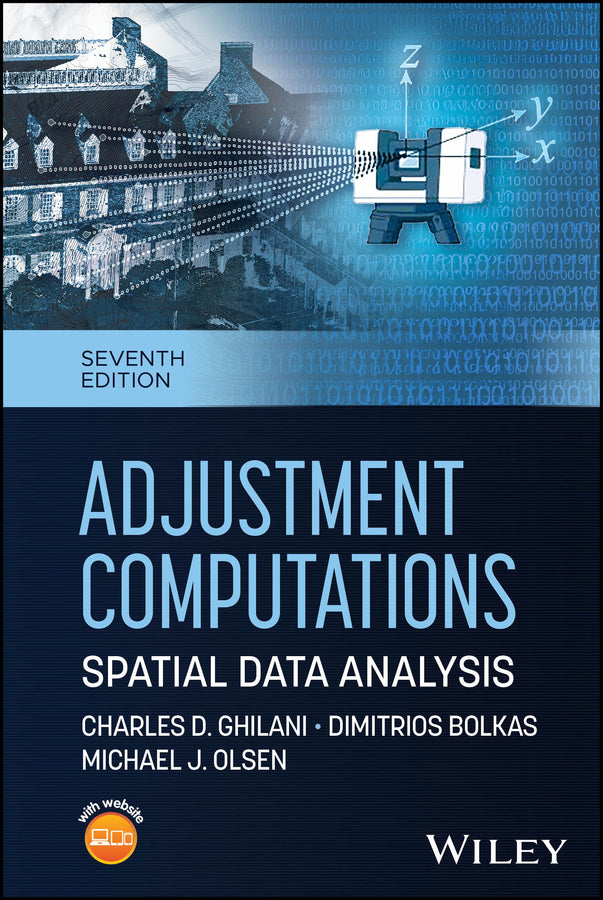
Adjustment Computations
Spatial Data Analysis
Charles D. Ghilani (Author), Dimitrios Bolkas (Author), Michael J. Olsen (Author)
9781394341313, Wiley
Hardback, published 25 June 2026
800 pages
23.1 x 15.8 x 3.3 cm, 1.043 kg
Provides Comprehensive, Up-to-Date Guidance on Spatial Data Accuracy As modern surveying, mapping, and geospatial technologies continue to evolve, the need for precise data adjustment and error analysis has never been greater. Adjustment Computations: Spatial Data Analysis, Seventh Edition, remains the definitive guide to understanding, applying, and mastering least squares and related techniques that ensure the accuracy of spatial datasets. This updated edition integrates advances in spatial technologies, with new chapters covering laser scanning, point cloud processing, and parametric model estimation. Updated discussions of ASPRS standards, NSRS updates, and current computational tools reflect the latest professional practices and technologies. The text maintains its clear, pedagogical structure with concise chapters, worked examples, and practical software applications. Providing the analytical tools to deliver high-quality spatial data for diverse applications, this book: Ideal for undergraduate and graduate courses in surveying, geomatics, and geospatial analysis, Adjustment Computations: Spatial Data Analysis, Seventh Edition, supports curricula in civil engineering, geosciences, and GIS programs. It is also a useful reference for professional surveyors and geospatial analysts seeking to enhance data accuracy and reliability.
Preface xvii Acknowledgments xxiii About the Companion Website xxv 1 Introduction 1 1.1 Introduction 1 1.2 Direct and Indirect Measurements 2 1.3 Measurement Error Sources 2 1.4 Definitions 3 1.5 Precision versus Accuracy 4 1.6 Redundant Observations in Surveying and Their Adjustment 7 1.7 Advantages of Least Squares Adjustment 8 1.8 Overview of the Book 10 Problems 10 2 Observations and Their Analysis 13 2.1 Introduction 13 2.2 Sample versus Population 13 2.3 Range and Median 14 2.4 Graphical Representation of Data 15 2.5 Numerical Methods of Describing Data 18 2.6 Measures of Central Tendency 19 2.7 Additional Definitions 19 2.8 Alternative Formulas for Determining Variance 22 2.9 Numerical Examples 25 2.10 Root Mean Square Error and Mapping Standards 29 2.11 Derivation of the Sample Variance (Bessel’s Correction) 32 2.12 Software 33 Problems 34 Practical Exercises 37 3 Random Error Theory 39 3.1 Introduction 39 3.2 Theory of Probability 39 3.3 Properties of the Normal Distribution Curve 42 3.4 Standard Normal Distribution Function 44 3.5 Probability of the Standard Error 47 3.6 Uses for Percent Errors 49 3.7 Practical Examples 50 Problems 53 Programming Problems 55 4 Confidence Intervals 57 4.1 Introduction 57 4.2 Distributions Used in Sampling Theory 59 4.3 Confidence Interval for the Mean: t Statistic 64 4.4 Testing the Validity of the Confidence Interval 67 4.5 Selecting a Sample Size 67 4.6 Confidence Interval for a Population Variance 69 4.7 Confidence Interval for the Ratio of Two Population Variances 70 4.8 Software 73 Problems 75 5 Statistical Testing 81 5.1 Hypothesis Testing 81 5.2 Systematic Development of a Test 84 5.3 Test of Hypothesis for the Population Mean 86 5.4 Test of Hypothesis for the Population Variance 88 5.5 Test of Hypothesis for the Ratio of Two Population Variances 91 5.6 Using Software 94 Problems 95 6 Propagation of Random Errors in Indirectly Measured Quantities 99 6.1 Basic Error Propagation Equation 99 6.2 Frequently Encountered Specific Functions 104 6.3 Numerical Examples 105 6.4 Software 109 6.5 Conclusions 111 Problems 111 Practical Exercises 114 7 Error Propagation in Angle and Distance Observations 115 7.1 Introduction 115 7.2 Error Sources in Horizontal Angles 116 7.3 Reading Errors 116 7.4 Pointing Errors 118 7.5 Estimated Pointing and Reading Errors with Total Stations 119 7.6 Target Centering Errors 120 7.7 Instrument Centering Errors 122 7.8 Effects of Leveling Errors in Angle Observations 126 7.9 Numerical Example of Combined Error Propagation in a Single Horizontal Angle 128 7.10 Using Estimated Errors to Check Angular Misclosure in a Traverse 130 7.11 Errors in Astronomical Observations for Azimuth 132 7.12 Errors in Electronic Distance Observations 137 7.13 Centering Errors When Using Range Poles 138 7.14 Software 139 Problems 140 Programming Problems 143 8 Error Propagation in Traverse Surveys 145 8.1 Introduction 145 8.2 Derivation of Estimated Error in Latitude and Departure 146 8.3 Derivation of Estimated Standard Errors in Course Azimuths 148 8.4 Computing and Analyzing Polygon Traverse Misclosure Errors 148 8.5 Computing and Analyzing Link Traverse Misclosure Errors 154 8.6 Software 158 8.7 Conclusions 159 Problems 159 Programming Problems 163 9 Error Propagation in Elevation Determination 165 9.1 Introduction 165 9.2 Systematic Errors in Differential Leveling 165 9.3 Random Errors in Differential Leveling 169 9.4 Error Propagation in Trigonometric Leveling 173 Problems 177 Programming Problems 179 10 Weights of Observations 181 10.1 Introduction 181 10.2 Weighted Mean 183 10.3 Relationship Between Weights and Standard Errors 185 10.4 Statistics of Weighted Observations 186 10.5 Weights in Angle Observations 187 10.6 Weights in Differential Leveling 188 10.7 Practical Examples 189 Problems 192 11 Principles of Least Squares 195 11.1 Introduction 195 11.2 Fundamental Principle of Least Squares 196 11.3 The Fundamental Principle of Weighted Least Squares 198 11.4 The Stochastic Model 199 11.5 Functional Model 199 11.6 Observation Equations 201 11.7 Systematic Formulation of the Normal Equations 203 11.8 Tabular Formation of the Normal Equations 205 11.9 Using Matrices to Form the Normal Equations 206 11.10 Least-Squares Solution of Nonlinear Systems 209 11.11 Least-Squares Fit of Points to a Line or Curve 213 11.12 Calibration of an EDM Instrument 216 11.13 Least-Squares Adjustment Using Conditional Equations 217 11.14 The Previous Example Using Observation Equations 219 11.15 Software 221 Problems 221 12 Adjustment of Level Nets 227 12.1 Introduction 227 12.2 Observation Equation 227 12.3 Unweighted Example 228 12.4 Weighted Example 230 12.5 Reference Standard Deviation 233 12.6 Another Weighted Adjustment 234 12.7 Software 237 Problems 240 Programming Problems 244 13 Precisions of Indirectly Determined Quantities 245 13.1 Introduction 245 13.2 Development of the Covariance Matrix 245 13.3 Numerical Examples 249 13.4 Standard Deviations of Computed Quantities 251 Problems 254 Programming Problems 256 14 Adjustment of Horizontal Surveys: Trilateration 257 14.1 Introduction 257 14.2 Distance Observation Equation 259 14.3 Trilateration Adjustment Example 261 14.4 Formulation of a Generalized Coefficient Matrix for a More Complex Network 268 14.5 Computer Solution of a Trilaterated Quadrilateral 268 14.6 Iteration Termination 272 14.7 Software 274 Problems 276 Programming Problems 281 15 Adjustment of Horizontal Surveys: Triangulation 283 15.1 Introduction 283 15.2 Azimuth Observation Equation 284 15.3 Angle Observation Equation 286 15.4 Adjustment of Intersections 288 15.5 Adjustment of Resections 293 15.6 Adjustment of Triangulated Quadrilaterals 298 Problems 303 Programming Problems 310 16 Adjustment of Horizontal Surveys: Traverses and Horizontal Networks 313 16.1 Introduction to Traverse Adjustments 313 16.2 Observation Equations 314 16.3 Redundant Equations 314 16.4 Numerical Example 315 16.5 Minimum Amount of Control 322 16.6 Adjustment of Networks 322 16.7 χ 2 Test: Goodness-of-Fit 330 Problems 331 Programming Problems 341 17 Adjustment of GNSS Networks 343 17.1 Introduction 343 17.2 GNSS Observations 344 17.3 GNSS Errors and the Need for Adjustment 347 17.4 Reference Coordinate Systems for GNSS Observations 347 17.5 Converting Between the Terrestrial and Geodetic Coordinate Systems 350 17.6 Application of Least Squares in Processing GNSS Data 353 17.7 Network Preadjustment Data Analysis 356 17.8 Least Squares Adjustment of GNSS Networks 363 Problems 369 Programming Problems 382 18 Coordinate Transformations 383 18.1 Introduction 383 18.2 The Two-Dimensional Conformal Coordinate 384 18.3 Equation Development 384 18.4 Application of Least Squares 386 18.5 Two-Dimensional Affine Coordinate Transformation 389 18.6 The Two-Dimensional Projective Coordinate Transformation 392 18.7 Three-Dimensional Conformal Coordinate Transformation 394 18.8 Statistically Valid Parameters 400 Problems 404 Programming Problems 410 19 Error Ellipse 411 19.1 Introduction 411 19.2 Computation of Ellipse Orientation and Semiaxes 413 19.3 Example Problem of Standard Error Ellipse Calculations 418 19.4 Another Example Problem 420 19.5 The Error Ellipse Confidence Level 421 19.6 Error Ellipse Advantages 423 19.7 Other Measures of Station Uncertainty 426 19.8 Check Points 433 Problems 434 Programming Problems 435 20 Constraint Equations 437 20.1 Introduction 437 20.2 Adjustment of Control Station Coordinates 437 20.3 Holding Control Station Coordinates and Directions of Lines Fixed 443 20.4 Helmert’s Method 446 20.5 Redundancies in a Constrained Adjustment 451 20.6 Enforcing Constraints through Weighting 451 Problems 453 Practical Problems 455 21 Blunder Detection in Horizontal Networks 457 21.1 Introduction 457 21.2 A Priori Methods for Detecting Blunders in Observations 458 21.3 A Posteriori Blunder Detection 460 21.4 Development of the Covariance Matrix for the Residuals 462 21.5 Detection of Outliers in Observations: Data Snooping 464 21.6 Detection of Outliers in Observations: The Tau Criterion 466 21.7 Techniques Used in Adjusting Control 468 21.8 A Data Set with Blunders 469 21.9 Some Further Considerations 477 21.10 Survey Design 479 21.11 Software 481 Problems 482 Practical Problems 487 22 The General Least-Squares Method and Its Application to Curve Fitting and Coordinate Transformations 489 22.1 Introduction to General Least-Squares 489 22.2 General Least-Squares Equations for Fitting a Straight Line 489 22.3 General Least-Squares Solution 491 22.4 Two-Dimensional Coordinate Transformation by General Least-Squares 495 22.5 Three-Dimensional Conformal Coordinate Transformation by General Least-Squares 501 Problems 503 Programming Problems 507 23 Three-Dimensional Geodetic Network Adjustment 509 23.1 Introduction 509 23.2 Linearization of Equations 511 23.3 Minimum Number of Constraints 517 23.4 Example Adjustment 517 23.5 Building an Adjustment 524 23.6 Comments on Systematic Errors 526 23.7 Software 529 Problems 531 Programming Problems 534 24 Combining GNSS and Terrestrial Observations 535 24.1 Introduction 535 24.2 The Helmert Transformation 537 24.3 Rotations Between Coordinate Systems 541 24.4 Combining GNSS Baseline Vectors with Traditional Observations 542 24.5 Another Approach to Transforming Coordinates Between Reference Frames 546 24.6 Other Considerations when Localizing a Survey 549 24.7 Using Total Station Pseudo-Observations 551 24.8 Building a Stochastic Model 556 24.9 Least-Squares Adjustment using Pseudo-Observations 560 24.10 Software 562 Problems 563 Programming Problems 566 25 Analyses of Adjustments 567 25.1 Introduction 567 25.2 Basic Concepts, Residuals, and the Normal Distribution 567 25.3 Goodness-of-Fit Test 571 25.4 Comparison of GNSS Residual Plots 574 25.5 Use of Statistical Blunder Detection 576 Problems 577 26 Terrestrial Laser Scanning and Uncertainty Estimation 579 26.1 Introduction 579 26.2 Laser Scanner Coordinates 580 26.3 Beam Divergence and Incidence Angle Effects 583 26.4 Range and Angular Uncertainty 586 26.5 Error Propagation of Laser Scanner Measurements 589 26.6 Registration and Its Uncertainty 593 26.7 Point Cloud Uncertainty 596 26.8 Survey Planning 599 26.9 Conclusions 607 26.10 Software 608 Problems 608 27 Plane, Three-Dimensional Objects, and Elevation Model Estimation with Point Clouds 615 27.1 Introduction 615 27.2 Plane Fitting with Point Clouds 616 27.3 Sphere and Cylinder Estimation with Point Clouds 628 27.4 RANSAC Estimation 645 27.5 Polynomial and Elevation Estimation with Point Clouds 645 27.6 Software 649 Problems 649 28 Computer Optimization 657 28.1 Introduction 657 28.2 Storage Optimization 658 28.3 Direct Formation of the Normal Equations 660 28.4 Cholesky Decomposition 662 28.5 Forward and Backward Solutions 662 28.6 Using the Cholesky Factor to Find the Inverse of the Normal Matrix 664 28.7 Spareness and Optimization of the Normal Matrix 664 Problems 670 Programming Problem 671 Appendix A Introduction to Matrices 673 A.1 Introduction 673 A.2 Definition of a Matrix 673 A.3 Size or Dimensions of a Matrix 674 A.4 Types of Matrices 675 A.5 Matrix Equality 676 A.6 Addition or Subtraction of Matrices 677 A.7 Scalar Multiplication of a Matrix 677 A.8 Matrix Multiplication 677 A.9 Computer Algorithms for Matrix Operations 681 A.10 Use of the Matrix Software 683 Problems 685 Programming Problems 687 Appendix B Solution of Equations by Matrix Methods 689 B.1 Introduction 689 B.2 Inverse Matrix 689 B.3 The Inverse of a 2 × 2 Matrix 690 B.4 Inverses by Adjoints 692 B.5 Inverses by Elementary Row Transformations 693 B.6 Example Problem 696 B.7 Eigenvalues and Eigenvectors 698 Problems 700 Programming Problems 702 Appendix C Nonlinear Equations and Taylor’s Theorem 703 C.1 Introduction 703 C.2 Taylor Series Linearization of Nonlinear Equations 703 C.3 Numerical Example 705 C.4 Using Matrices to Solve Nonlinear Equations 706 C.5 Simple Matrix Example 707 C.6 Practical Example 708 C.7 Concluding Remarks 710 Problems 711 Programming Problems 712 Appendix D The Normal Error Distribution Curve and Other Statistical Tables 713 D.1 Development for Normal Distribution Curve Equation 713 D.2 Other Statistical Tables 721 Appendix E Confidence Intervals for the Mean 733 Appendix F Companion Website 739 F.1 Introduction 739 F.2 File Formats and Memory Matters 740 F.3 Software 740 F.4 Using the Software as an Instructional Aid 743 Appendix G Answers to Selected Problems 745 Bibliography 751 Index 757
Subject Areas: Civil engineering, surveying & building [TN]