Freshly Printed - allow 7 days lead
Couldn't load pickup availability
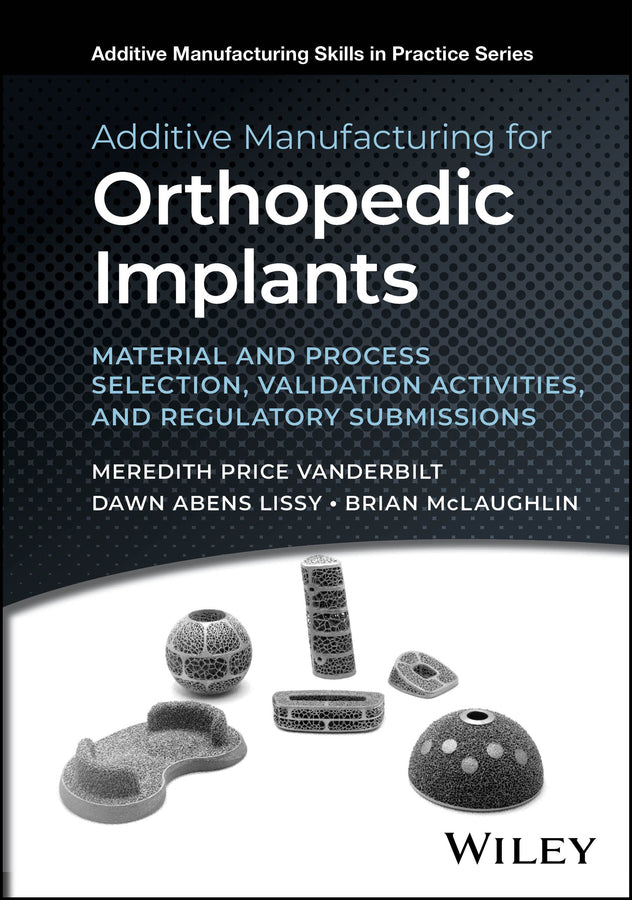
Additive Manufacturing for Orthopedic Implants
Material and Process Selection, Validation Activities, and Regulatory Submissions
Meredith Price Vanderbilt (Author), Dawn Abens Lissy (Author), Brian McLaughlin (Author)
9781394215218, Wiley
Hardback, published 3 March 2026
176 pages
26.7 x 19.1 x 2.8 cm, 0.522 kg
Offers a practical roadmap for successfully applying additive manufacturing to orthopedic implants As additive manufacturing (AM) transforms the orthopedic implant landscape, professionals are facing a growing need for guidance that connects advanced manufacturing techniques with practical regulatory and validation requirements. Additive Manufacturing for Orthopedic Implants: Material and Process Selection, Validation Activities, and Regulatory Submissions delivers exactly that—a clear, concise resource designed specifically for engineers, designers, and regulatory specialists working at the intersection of innovation and compliance. Written by seasoned professionals with deep experience in additive technologies, mechanical testing, and regulatory environments, this book walks readers through the critical steps involved in developing spine, hip, knee, shoulder, and other implant products using additive manufacturing. The content spans the full product lifecycle, from design and prototyping to process validation and FDA submission preparation. Key insights into various AM technologies and post-processing methods are grounded in real-world examples and case studies that illuminate common challenges and successful solutions. Providing the essential tools for navigating a complex and rapidly evolving field, Additive Manufacturing for Orthopedic Implants: Integrating insights from multiple disciplines, including biomedical engineering, regulatory affairs, and quality assurance, Additive Manufacturing for Orthopedic Implants: Material and Process Selection, Validation Activities, and Regulatory Submissions is essential for professionals working in medical device manufacturing, particularly those developing orthopedic implants using additive technologies. It is also suitable for graduate-level courses in biomedical engineering, additive manufacturing, and medical device design.
Preface xi Acknowledgment xii Chapter 1 Introduction: Additive Manufacturing for Medical Devices 1 1.1 Additive Manufacturing for Medical Devices – An Overview 1 1.2 Additive Manufacturing for Medical Devices – The Benefits and Drawbacks 2 1.3 Additive Manufacturing – Market Size for Medical Devices 4 References 5 Chapter 2 Current and Future Applications of Additive Manufacturing in Orthopedics 7 2.1 History of Patient- Specific Orthopedic Devices 8 2.2 Additive Manufacturing Market Size and Share 8 2.3 Current Uses of Additive Manufacturing in Orthopedics 10 2.4 Future Applications 14 2.5 Conclusion 16 Table of Figure 16 References 16 Chapter 3 Types of Additive Manufacturing Technologies 19 3.1 Background and History of Additive Manufacturing Technologies 20 3.2 Seven Types of Additive Manufacturing Technologies 21 3.3 Additive Manufacturing Technologies with Medical Device Applications 42 3.4 Future Medical Applications of Additive Manufacturing Technologies 44 Tables of Figures 45 References 46 Chapter 4 Design Considerations 49 4.1 Stages of Orthopedic Device Design and Development 49 4.2 Design Criteria for Orthopedic Devices 53 4.3 Additive Manufacturing Design Considerations 55 Table of Figures 60 References 60 Chapter 5 Materials 63 5.1 Material Savings: Get- To- Fit 63 5.2 Recycle and Reuse 64 5.3 Material Properties for Orthopedics 65 5.4 Metals 68 5.5 Polymers 72 5.6 Ceramics 73 5.7 Conclusion 74 Table of Figure 74 References 74 Chapter 6 Process Validation (IQ, OQ, PQ) 77 6.1 Introduction to Process Validation 77 6.2 IQ and Equipment Verification 79 6.3 Operational Qualification 84 6.4 Performance Qualification 87 6.5 Process Validation Summary 89 Table of Figure 89 References 89 Chapter 7 Postprocessing of Additive Manufactured Orthopedic Implants 91 7.1 The Need for Postprocessing for Additive Manufactured Orthopedic Implants 92 7.2 FDA Guidance and ASTM Guidelines 92 7.3 Postprocessing Methods 93 7.4 Conclusion 98 Table of Figure 99 References 99 Chapter 8 Facility Requirements for Metal Additive Manufacturing 101 8.1 Introduction 102 8.2 Facility Location and Power 102 8.3 Equipment and Infrastructure 103 8.4 Metal Additive Machine Selection 104 8.5 Powder Handling and Storage 106 8.6 Quality Control Equipment 107 8.7 Operator Training and Safety 108 8.8 Fire Suppression Systems 109 8.9 Emission Control and Environmental Regulations 109 8.10 Medical Device Regulations and Regulatory Compliance 110 8.11 Conclusion 111 Table of Figures 111 References 111 Chapter 9 Powder Reuse and Testing 113 9.1 Introduction 114 9.2 Material Selection 114 9.3 Raw Material Storage and Handling 116 9.4 Powder Analysis 116 9.5 Powder Reuse 118 9.6 Combining Virgin and Reused Powder Batches 120 9.7 Conclusion 121 References 121 Chapter 10 Final Inspection – Lot Release Testing 123 10.1 Regulatory Compliance 123 10.2 Visual Inspection Techniques 125 10.3 Nondestructive Testing 126 10.4 Destructive Testing 127 10.5 Emerging Technologies 129 10.6 Conclusions 129 References 130 Chapter 11 Regulatory Filings 133 11.1 Creation and Evolution 134 11.2 Quality Management Systems 136 11.3 US and EU Device Clearance/Approval Schemes Compared 142 11.4 US Regulatory 142 11.5 EU Regulatory 146 11.6 Additional Considerations for Additively Manufactured Devices 150 Table of Figures 151 References 152 Chapter 12 Device and Material Enhancements 153 12.1 Surface Coatings 154 12.2 Osseointegration- Improving Characteristics Possible with AM 157 12.3 Antibacterial and Antimicrobial Characteristics Possible with AM 159 12.4 Looking Ahead 160 Tables of Figures 160 References 160 Index 163
Subject Areas: Mechanical engineering & materials [TG]