Freshly Printed - allow 8 days lead
Couldn't load pickup availability
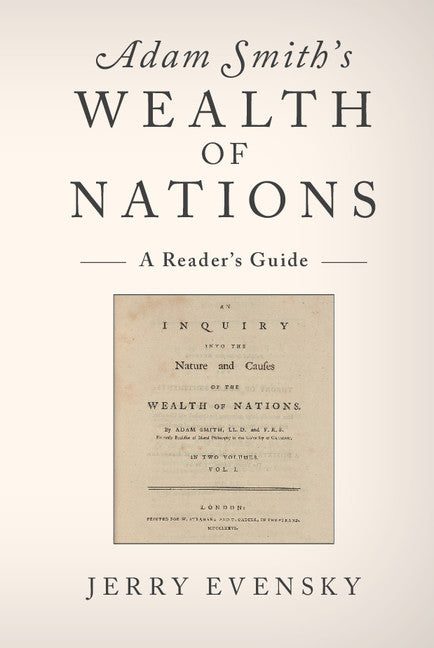
Adam Smith's Wealth of Nations
A Reader's Guide
Jerry Evensky's analysis walks the reader through The Wealth of Nations, highlighting the work's relationship to Smith's larger moral philosophy.
Jerry Evensky (Author)
9781107043374, Cambridge University Press
Hardback, published 25 August 2015
293 pages
23.5 x 15.8 x 2 cm, 0.53 kg
'… Evensky's work is important not only for the history of economic thought, but also for elucidating the foundation of the market economy.' Shinji Nohara, Journal of the History of Economic Thought
Adam Smith's The Wealth of Nations is regarded by many as the most important text in the history of economics. Jerry Evensky's analysis of this landmark book walks the reader through the five 'Books' of The Wealth of Nations, analyzing Smith's terms and assumptions and how they are developed into statements about economic processes in Book I, his representation of the dynamics of economics systems in Book II, and his empirical case for his model in Book III. With that framework in place, Evensky examines Smith's critique of alternative models, mercantilism and physiocracy, in Book IV, and Smith's presentation of the policy implications of his analysis presented in Book V. This guide highlights the nexus of Smith's economics and his work on ethics and jurisprudence, and in doing so Evensky sets his examination of The Wealth of Nations into a larger, holistic analysis of Smith's moral philosophy.
Prologue
1. Adam Smith's moral philosophical vision: the context of his economic analysis
2. An inquiry: Book I
3. An inquiry: Books II and III
4. An inquiry: Book IV
5. An inquiry: Book V
Epilogue: Adam Smith and laissez-faire.
Subject Areas: Economic history [KCZ], Political economy [KCP], History of ideas [JFCX], History of Western philosophy [HPC]