Freshly Printed - allow 7 days lead
Couldn't load pickup availability
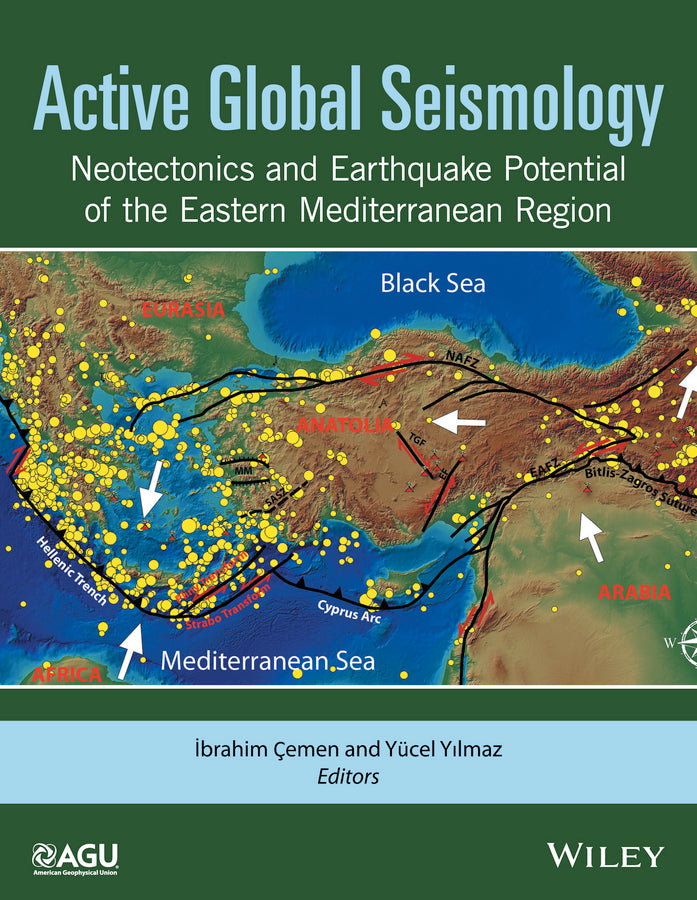
Active Global Seismology
Neotectonics and Earthquake Potential of the Eastern Mediterranean Region
İbrahim Çemen (Edited by), Yucel Yilmaz (Edited by)
9781118944981, Wiley
Hardback, published 9 June 2017
306 pages
28.2 x 21.3 x 2 cm, 1.066 kg
Neotectonics involves the study of the motions and deformations of the Earth's crust that are current or recent in geologic time. The Mediterranean region is one of the most important regions for neotectonics and related natural hazards. This volume focuses on the neotectonics of the Eastern Mediterranean region, which has experienced many major extensive earthquakes, including the devastating Izmit, Turkey earthquake on August 17, 1999. The event lasted for 37 seconds, killing around 17,000 people, injuring 44,000 people, and leaving approximately half a million people homeless. Since then, several North American, European, and Turkish research groups have studied the neotectonics and earthquake potential of the region using different geological and geophysical methods, including GPS studies, geodesy, and passive source seismology. Some results from their studies were presented in major North American and European geological meetings. This volume highlights the work involving the Eastern Mediterranean region, which has one of the world's longest and best studied active strike-slip (horizontal motion) faults: the east-west trending North Anatolian fault zone, which is very similar to the San Andreas fault in California. This volume features discussions of: Active Global Seismology is a valuable resource for geoscientists, particularly in the field of tectonophysics, geophysics, geodynamics, seismology, structural geology, environmental geology, and geoengineering. Read an interview with the editors to find out more:
https://eos.org/editors-vox/neotectonics-and-earthquake-forecasting
Contributors vii Preface ix 1 Neotectonics and Earthquake Potential of the Eastern Mediterranean Region: Introduction 1 Part I: Morphotectonic Characteristics of Neotectonics in Anatolia and Its Surroundings 9 2 Morphotectonic Development of Anatolia and the Surrounding Regions 11 3 Diversion of River Courses Across Major Strike‐Slip Faults and Keirogens 93 Part II: Neotectonics of the Aegean-Western Anatolian Region 103 4 Effect of Slab‐Tear on Crustal Structure in Southwestern Anatolia: Insight From Gravity Data Modeling 105 5 Geodynamical Models for Continental Delamination and Ocean Lithosphere Peel Away in an Orogenic Setting 121 6 Major Problems of Western Anatolian Geology 141 7 The Çataldağ Plutonic Complex in Western Anatolia: Roles of Different Granites on the Crustal Buildup in Connection With the Core Complex Development 189 Part III: Seismotectonics in the Eastern Mediterranean Region 223 8 Fault Structures in Marmara Sea (Turkey) and Their Connection to Earthquake Generation Processes 225 9 North Aegean Active Fault Pattern and the 24 May 2014, Mw 6.9 Earthquake 239 10 Seismic Intensity Maps for the Eastern Part of the North Anatolian Fault Zone (Turkey) Based on Recorded and Simulated Ground‐Motion Data 273 Index 289
Ibrahim Çemen and Yücel Yılmaz
Yücel Yılmaz
A. M. Celâl Şengör
Rezene Mahatsente, Süleyman Alemdar, and Ibrahim Çemen
Oğuz H. Göğüş, Russell N. Pysklywec, and Claudio Faccenna
Yücel Yilmaz
Ömer Kamacı, Alp Ünal, Şafak Altunkaynak, Stoyan Georgiev, and Zeki M. Billor
Mustafa Aktar
Sotiris Sboras, Alex Chatzipetros, and Spyros B. Pavlides
Aysegul Askan, Shaghayegh Karimzadeh, and Mustafa Bilal
Subject Areas: Earth sciences [RB]