Freshly Printed - allow 4 days lead
Couldn't load pickup availability
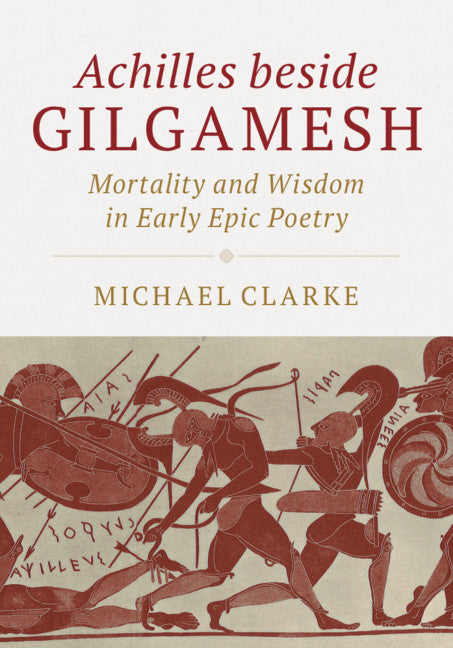
Achilles beside Gilgamesh
Mortality and Wisdom in Early Epic Poetry
Interprets the poetic meaning of the Iliad in relation to the heroic literature of the Ancient Near East.
Michael Clarke (Author)
9781108481786, Cambridge University Press
Hardback, published 28 November 2019
920 pages, 3 b/w illus. 28 colour illus.
25.2 x 18.1 x 2.5 cm, 0.94 kg
'Engaging, up-to-date, and deeply informed across disciplinary lines, this is an important resource for those interested in classics, mythology, and world literature.' P. E. Ojennus, Choice
It is widely recognised that the epics of Homer are closely related to the earlier mythology and literature of the Ancient Near East, above all the Babylonian Epic of Gilgamesh. But how should this influence our response to the meaning and message of either poem? This book responds to this question through an experiment in intertextual reading. It begins by exploring Gilgamesh as a work of literature in its own right, and uses this interpretation as the springboard for a new reading of the Homeric epic, emphasising the movement within the poem - beginning from a world of heroic action and external violence, but shifting inwards to the thoughts and feelings of Achilles as he responds to the certainty that his own death will follow that of his best friend. The book will be of interest both to specialists and to those coming to ancient literature for the first time.
1. Introduction
2. Divinity, humanity and wisdom
3. Gilgamesh and glory
4. Gilgamesh confronts death
5. Interlude on Homer and the muse
6. The race of half-gods
7. The plan of Zeus
8. The coming of Achilles
9. The strife of the Iliad
10. Achilles looks inward
11. The death of the friend
12. Achilles responds
13. From lamentation to vengeance
14. Achilles like a lion
15. Mortality and wisdom
16. The truths of lamentation
Conclusion: the slender-winged fly.
Subject Areas: Classical Greek & Roman archaeology [HDDK], Ancient history: to c 500 CE [HBLA], Literary studies: classical, early & medieval [DSBB]