Freshly Printed - allow 7 days lead
Couldn't load pickup availability
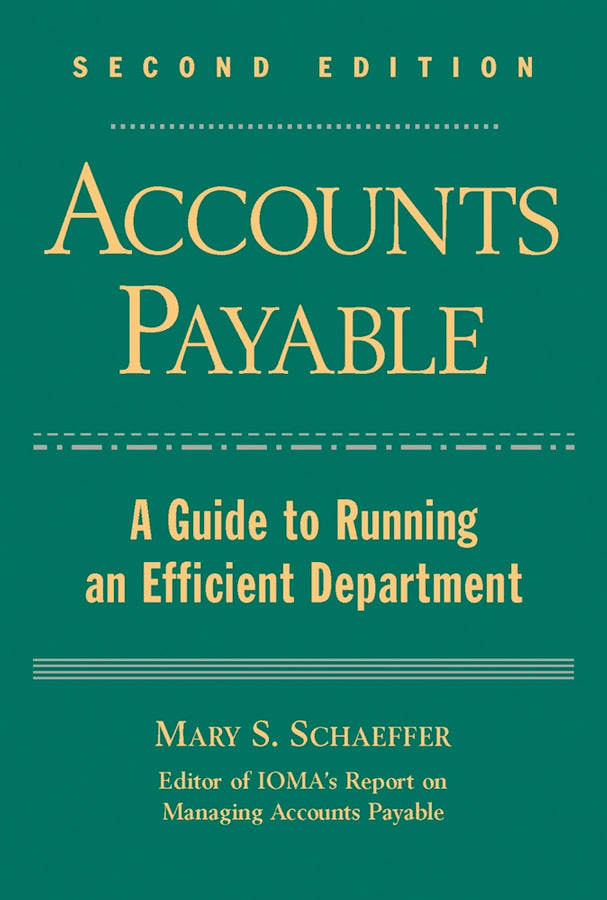
Accounts Payable
A Guide to Running an Efficient Department
Mary S. Schaeffer (Author), (Author)
9780471636908, Wiley
Hardback, published 10 September 2004
432 pages, Tables: 10 B&W, 0 Color
23.6 x 16 x 2.7 cm, 0.699 kg
Get the most complete guide to running a valuable accounts payable department with Accounts Payable, Second Edition. This updated edition continues where the successful first edition left off, providing all the critical information and guidance top professionals need to run an efficient department, complete with coverage of the innovative issues now facing the field and new material on: Order your copy today! .
Preface xxi Acknowledgments xxiii Part One Processing 1 1 Invoice Handling 3 1.1 Introduction 3 1.2 The Invoice 4 1.3 Purchase Orders 5 1.4 Receiving Documents 6 1.5 Proper Invoice Handling 7 1.6 When Accounts Payable Receives Invoices Last 8 1.7 Entry by Month-End 9 1.8 Timely Approvals 10 1.9 Unidentified Invoices Sent to Accounts Payable 10 1.10 Use Best of Terms 11 1.11 Strategies to Use When Short-Paying Invoices 12 1.12 Goods Improperly Ordered Outside Purchasing 12 1.13 Nonpurchase Order Buying 13 1.14 Encouraging Others to Follow Accounts Payable’s Guidelines 14 1.15 Invoices without Invoice Numbers 14 1.16 Invoice Amnesty Day 14 1.17 Keeping Difficult Invoices from Disappearing 15 1.18 Using Vendor Statements: Theory 16 1.19 Using Statements: Reality 17 1.20 Filing: Batch versus Alpha Filing 18 1.21 Reducing the Number of Invoices 18 1.22 Handling Bills with Remittance Advices 21 2 Alternatives to the Three-Way Match 23 2.1 Introduction 23 2.2 Assumed Receipt 23 2.3 Evaluated Receipt Settlement 25 3 Check Preparation Printing and Filing 33 3.1 Introduction 33 3.2 A More Common Approach 33 3.3 Manual Signatures 33 3.4 Authorized Signers 34 3.5 Proper Check-Signing Procedures and Control 35 3.6 Limiting Time Spent Getting Checks Signed 37 3.7 Mailing versus Picking Up Checks 39 3.8 Check Filing 40 3.9 Time-Saving Techniques in the Check Production Cycle 41 3.10 Canceled Checks and Irate Vendors 43 4 Automated Clearinghouse and Direct Deposit 47 4.1 Introduction 47 4.2 Direct Deposit 47 4.3 Other Common Examples 47 4.4 Combining Electronic Billing And Payments 48 4.5 Terminology 48 4.6 Check Truncation and Check Conversion 49 4.7 What Companies Are Doing Today 49 4.8 Case Study: How One Company Gets Suppliers to Accept ACH Payments 49 4.9 The Future 50 5 Making International Payments 52 5.1 Introduction 52 5.2 Foreign Exchange 53 5.3 Bank Account Issues 53 5.4 Payment Mechanisms 53 5.5 International Payment Service 54 5.6 Benefits of International Payment Services 54 5.7 Payments to NAFTA Partners 55 Part Two Controls 57 6 Exception and Rush Processing 59 6.1 Introduction 59 6.2 Dealing with the Issue 60 6.3 Hard-Line Approach 62 6.4 Identify Rush-Check Troublemakers 62 6.5 Modify Systems and Procedures to Reduce the Need for Rush Checks 63 6.6 Publish a Newsletter 64 7 Errors and Duplicate Payments 67 7.1 Introduction 67 7.2 Statistics 67 7.3 Types of Erroneous Payments 68 7.4 Low-Tech Solutions 68 7.5 High-Tech Solutions 69 7.6 Employees: Your Most Important Resource 69 7.7 Tolerance Levels 70 7.8 Handling Discrepancies 70 7.9 Accuracy and Timeliness 71 7.10 Timing Issues 74 7.11 Eliminating Duplicate Payments without an Auditor 74 7.12 Duplicate Pay Audits: The Future of Accounts Payable and AP Audits 75 8 Paying When the Original Invoice Is Not Available 79 8.1 Introduction 79 8.2 Who Pays from Copies 79 8.3 Controls When Using Copies 80 8.4 Common Techniques to Ensure a Second Payment Will not Be Made 81 8.5 Controls When Paying from Copies 81 9 Master Vendor Files 84 9.1 Introduction 84 9.2 The Data 84 9.3 Cleanup Policies 85 9.4 When to Set Up a New File 85 9.5 Maintenance Policies 86 9.6 Good Master Vendor Policies 86 9.7 Establishing Vendor Naming Conventions 87 9.8 Tips on Setting Up the Master Vendor File 88 9.9 New Vendor Setup 89 9.10 Adjustments, Corrections, and Additions 91 9.11 Maintaining the Master Vendor File 91 Part Three Cash Management 93 10 Terms and Taking Discounts 95 10.1 Introduction 95 10.2 Should the Discount be Taken? 95 10.3 An Ongoing Process 98 10.4 Possible Problems When Paying Late 99 10.5 Are All Possible Discounts Being Taken? 100 10.6 Should You? 101 11 Cash Management 104 11.1 Introduction 104 11.2 Why Discuss Cash Management in Accounts Payable? 104 11.3 Payment Timing 105 11.4 Maximize Float 106 11.5 Purchasing Cards 107 11.6 Bank Fees 107 11.7 ACH Background 107 11.8 ACH: Types of Corporate Payments 108 11.9 Clean-Desk Syndrome 109 11.10 Games Companies Play 110 12 Petty Cash 111 12.1 Introduction 111 12.2 Petty Cash No-Nos 111 12.3 Recommended Procedures 112 12.4 Other Recommended Procedures 113 13 Payment Timing 114 13.1 Introduction 114 13.2 Can Another Day be Squeezed out of Payables? 114 13.3 Timing Payments in Difficult Times 114 13.4 Stretching Vendor Payments 115 13.5 Place Smaller Orders 115 13.6 Talk to Vendors 115 13.7 A Formalized Approach 116 14 Audits and the Outside Accountant’s Management Letter 119 14.1 Introduction 119 14.2 Most Notable Payables Issues 119 14.3 Using This Information 122 Part Four Travel and Entertainment 125 15.1 Introduction 127 15.2 The Problem 127 15.3 Solutions 128 15.4 How Much Checking Is Enough? 131 15.5 T&E Manual 134 15.6 Policy and Procedures Changes 135 15.7 What About Electronic Receipts? 136 15.8 Faster Employee Reimbursements 137 15.9 E-Tickets 138 16 Handling Electronic T&E Reports 139 16.1 Introduction 139 16.2 Advantages 139 16.3 Homegrown Systems 140 16.4 Third-Party Electronic Software 142 16.5 E-Tickets 142 17 Automating the T&E Report Process 146 17.1 Introduction 146 17.2 Making the Most of Direct Deposit 146 17.3 Spreadsheet Approach 147 17.4 One-Card Intranet-Based Solution 148 17.5 In-House versus Third Party 148 18 Value-Added Tax Refunds 150 18.1 Introduction 150 18.2 What is Vat? 150 18.3 Assistance Available 151 18.4 Vat Reclaim Companies 151 18.5 Time Limitations: Deadlines 151 18.6 Focus on Vat-Friendly Countries 152 18.7 Focus on Vat-Valuable Expenses 152 Part Five Technology 155 19 Electronic Data Interchange 157 19.1 Introduction 157 19.2 What Is EDI? 157 19.3 TECHNICAL Basics: introduction 157 19.4 Why EDI? 158 19.5 Getting Started 160 19.6 Business Infrastructure Requirements 161 19.7 Managing Accounts Payable EDI 162 19.8 Accounts Payable EDI Opportunities 162 19.9 Accounts Payable EDI Success Factors 163 19.10 Systems Requirements 163 19.11 Trading Partner Directory 166 19.12 EDI Standards 166 19.13 Effect on Supplier Partnerships 167 19.14 Convincing Management 167 19.15 FEDI Applications 168 19.16 Cost-Justifying FEDI 168 19.17 Getting Up the EDI Learning Curve 168 19.18 Internet EDI 170 19.19 Web EDI: An Idea Whose Time Has Come 171 19.20 Security and Standards Issues 171 19.21 Why the Internet? 171 19.22 Special Application: ACH Debits for Tax Payments 172 20 Imaging 175 20.1 Introduction 175 20.2 Poor Man’s Imaging 175 20.3 Planning for Full-Scale Imaging 176 20.4 Using Full-Scale Imaging with E-Mail 176 20.5 Imaging on a Smaller Scale 176 20.6 Overview 177 20.7 Imaging in Practice: Growing Pains 179 20.8 Legal Acceptance 180 20.9 Disaster Recovery 180 20.10 Frequently Asked Questions about Imaging 181 20.11 Preparing Documents for Imaging 182 21 The Internet, E-Mail, and E-Invoicing 184 21.1 Introduction 184 21.2 E-Mail 184 21.3 The Internet 185 21.4 Case Study: An Accounts Payable Department Web Site 187 21.5 What to Include on an Accounts Payable Web Page 191 21.6 Electronic Invoicing 191 21.7 Everyday AP uses for the Internet 194 21.8 Case Study: Putting the Web to Work for Accounts Payable 196 22 Encryption and Digital Signatures 200 22.1 Introduction 200 22.2 Basics 200 22.3 Case Study 203 23 E-Marketplaces and XML 206 23.1 Introduction 206 23.2 E-Marketplaces 206 23.3 XML 208 23.4 How Accounts Payable Professionals Can Prepare Themselves 208 23.5 How to Participate in the E-Commerce Revolution 209 Part Six Specialty Topics 211 24 Purchasing Cards 213 24.1 Introduction 213 24.2 What Is a Purchasing Card? 214 24.3 How a Purchasing Card Differs from a Consumer or Corporate Card 214 24.4 Why Use a Purchasing Card? 215 24.5 How Does the Purchasing Card Work within the Company? 215 24.6 Plan Administrator 215 24.7 User Feedback 215 24.8 Vendor Feedback 216 24.9 Control Features 217 24.10 Maximizing Cost Savings 219 24.11 Considering a Program 221 25 Post Audit Firms 223 25.1 Introduction 223 25.2 Why Are Accounts Payable Audit Firms Necessary? 224 25.3 How Post Audit Firms Work 224 25.4 Accounts Payable Benefits 225 25.5 Costs 225 25.6 Getting Money Back 226 25.7 Selecting the Best Profit Recovery Firm 226 25.8 Other Considerations 228 25.9 Reaction to Profit Recovery Firms 228 25.10 Self-Auditing 228 25.11 Self-Auditing for Duplicate Payments 229 25.12 Current State of Duplicate Payment Audit Industry 229 26 Benchmarking 230 26.1 Introduction 230 26.2 What is Benchmarking? 230 26.3 Sources of Benchmarking Data 232 26.4 Benchmarking Applications 232 26.5 Case Study: How to Start or Improve a Benchmarking Program 234 Part Seven Regulatory Issues 239 27 Form 1099 and Form 1042-S 241 27.1 Introduction 241 27.2 Background 241 27.3 Best 1099 Practice 242 27.4 What if the 1099 Is Not Filed? 242 27.5 Who Should Receive a 1099? 243 27.6 Letters Instead of W-9s 244 27.7 B-Notices 244 27.8 Types of Payments Reflected on 1099S 246 27.9 More Help from the IRS 246 27.10 It’s 1099 Time: Changes Implemented in 2002 246 27.11 1042-S 249 28 Sales and Use Tax 250 28.1 Introduction 250 28.2 Defining Sales and Use Tax 250 28.3 Education 251 28.4 Policies and Procedures 252 28.5 Sales and Use Tax Audits 252 28.6 Sales and Use Tax Terminology 254 28.7 Types of Sales and Use Tax 254 28.8 Keeping Up To Date 254 28.9 Use Tax and Nexus 255 28.10 Specialized Software 255 28.11 Additional Learning Opportunities 256 28.12 Help Others Help Accounts Payable 256 28.13 Industry-Specific Sales and Use Tax Advice 259 28.14 Avoiding a Sales and Use Tax Disaster 262 28.15 Conclusion 263 29 Escheatment 264 29.1 Introduction 264 29.2 What Is Escheatment? 264 29.3 What If You Do Not Escheat? 265 29.4 Dilemma 265 29.5 What Can Be Done? 266 29.6 Necessary Documentation 266 29.7 Software Solutions 266 29.8 What Can Accounts Payable Professionals Do? 267 29.9 What If You Have Not Been Escheating? 268 29.10 Professional Organizations for Unclaimed Property Owners 268 29.11 Typical Unclaimed Property Experience 268 29.12 An Unclaimed Property Game Plan 270 Part Eight Management Issues 273 30 Ethics 275 30.1 Introduction 275 30.2 Sections of Sarbanes-Oxley Act Pertinent to Accounts Payable 275 30.3 Cascading Certifications 276 30.4 Sarbanes-Oxley Act: A Case Study 276 30.5 Foreign Payments 278 30.6 Office of Foreign Assets Control 279 30.7 What This Means to Accounts Payable 279 31 Disaster Recovery 281 31.1 Introduction 281 31.2 Personnel Travel Policies 281 31.3 Telephone Trees 282 31.4 Computer Backups 283 31.5 Protecting Paper 283 32 Outsourcing 284 32.1 Introduction 284 32.2 Why Companies Do Not Outsource Accounts Payable 284 32.3 When Outsourcing Makes Sense 284 32.4 Hiring an Outsourcer 285 32.5 Outsourcing: A Case Study 286 33 Management Techniques 289 33.1 Introduction 289 33.2 Six Sigma 289 33.3 Balanced Scorecard 290 Part Nine Department Management 291 34 Making Your Accounts Payable Department First-Rate 293 34.1 Introduction 293 34.2 Typical Accounts Payable Department 293 34.3 Who Runs the Department? 294 34.4 Hiring Practices 294 34.5 How to Assemble an Accounts Payable Dream Team 296 34.6 Procedures Manual 299 34.7 The Impact of Technology on Accounts Payable Departments 301 34.8 Outsourcing 303 35 Managing the Staff 307 35.1 Introduction 307 35.2 Training 307 35.3 Finding Challenging Work for the Staff 310 35.4 Listening Skills 310 35.5 Hiring Staff 312 35.6 Overtime: A Serious Issue 313 35.7 Managing a Unionized Staff 314 36 Staff Motivation and Morale 319 36.1 Introduction 319 36.2 Motivation Techniques 319 36.3 Evaluating Your Motivation Skills 321 36.4 Motivating the Seemingly Unmotivatable 324 36.5 Using the Staff Knowledge as Company Resource 325 36.6 Dealing with Poor-Attitude Problems 325 36.7 Getting the Accounts Payable Staff to Take on More Work 327 36.8 A Realistic Approach to Motivating Accounts Payable Staff 327 36.9 Improving the Image of Accounts Payable 330 37 Working with and for Purchasing and Other Departments 332 37.1 Introduction 332 37.2 Why Interdepartmental Cooperation Is Important 333 37.3 Basic Approaches 333 37.4 Handling the Big Issues 336 37.5 Getting a Customer Service Mentality in Accounts Payable 338 37.6 Quick Answers to Common Problems 341 Part Ten Fraud 345 38 Check Fraud 347 38.1 Introduction 347 38.2 Check Fraud as Growth Industry 347 38.3 Legal Issue of Reasonable Care 348 38.4 Corporate Responsibility 348 38.5 Controls 348 38.6 If Preprinted Check Stock Is Used 349 38.7 Check Security Features 349 38.8 Short-Circuiting the Forger 350 38.9 Taking Reasonable Care 351 38.10 Positive Pay 353 38.11 Reverse Positive Pay 353 38.12 Ongoing Fraud Problems 353 38.13 A Total Fraud Protection Program 354 38.14 Identifying Fraudulent Checks Quickly 354 38.15 Segregation of Duties 355 38.16 Account Reconciliation 355 38.17 Accounts Payable Controls 356 38.18 Payment Pitfalls: What Your Banks May Not Tell You 356 38.19 Laws Covering Check Fraud 358 38.20 Positive Pay: The Next Generation 359 39 Employee Fraud 360 39.1 Introduction 360 39.2 Be Aware of Typical Candidates 360 39.3 What Can Go Wrong 360 39.4 Steps to Prevent Cash Fraud 361 39.5 Exercise Patience 362 39.6 Call in the Professionals 362 39.7 When Fraud has been Identified 363 39.8 Dealing with the Aftermath 364 39.9 Preventing Fraud in the Future 364 40 Vendor Fraud 366 40.1 Introduction 366 40.2 Master Vendor File 366 40.3 Con Artist Vendors 369 40.4 Scam Solutions 371 40.5 Vendor Profile Forms 372 Part Eleven Accounts Payable Today and in the Future 375 41 Professionalism in the Field 377 41.1 Introduction 377 41.2 Evaluating the Big Picture 377 41.3 Leadership and Preparation 378 41.4 Technology 378 41.5 Communication 379 41.6 Relevant Trends 380 41.7 Gaining the Attention of Management 380 41.8 How to Win Approvals on Accounts Payable Proposals 381 41.9 Taking Control of Your Own Destiny 383 41.10 Certification 383 41.11 Conferences 383 41.12 Accounts Payable in the Twenty-First Century 384 42 Salaries and Titles in Accounts Payable Today 386 42.1 Introduction 386 42.2 Basic Data 386 42.3 Bonuses 388 42.4 Education 390 42.5 Effects of Industry and Company Size 390 42.6 Trends 392 42.7 Reevaluating AP Positions for Grade-Level Changes 392 42.8 Titles 393 Appendix Accounts Payable Resources 397 Index 399
14.4 Sarbanes-Oxley Effect 123
15 Handling Travel and Entertainment Reports 127
Subject Areas: Finance & accounting [KF]