Freshly Printed - allow 10 days lead
Couldn't load pickup availability
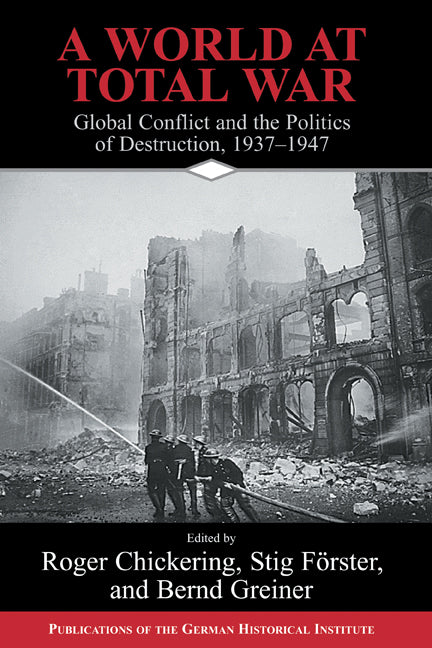
A World at Total War
Global Conflict and the Politics of Destruction, 1937–1945
This volume presents the results of a conference on the history of total war.
Roger Chickering (Edited by), Stig Förster (Edited by), Bernd Greiner (Edited by)
9780521834322, Cambridge University Press
Hardback, published 20 December 2004
408 pages
23.4 x 18 x 3.4 cm, 0.67 kg
Review of the hardback: 'Within the covers of this book is such a wealth of information that it makes it almost compulsory reading for any student of WW2.' Open History
This volume presents the results of a fifth and final conference on the history of total war. It is devoted to the Second World War, which many scholars regard as the paradigmatic instance of total war. In considering the validity of this proposition, the authors address a broad range of analytical problems that this vast conflict posed in the arenas of Europe and Asia. They analyze modes of combat, war aims, the mobilization of economies and societies, occupation regimes, the vulnerability of noncombatants, and the legal and moral issues raised by the industrialized warfare of the mid-twentieth century. The volume will be of interest to all students of war and society in the modern era.
Introduction: are we there yet? World War II and a theory of total war Roger Chickering and Stig Förster
Part I. The Dimension of War: 1. Total war: the global dimensions of conflict Gerhard L. Weinberg
2. Total war: the conduct of war, 1939–1945 Hew Strachan
3. The ultimate horror: total war and genocide Stig Förster and Myriam Gressler
Part II. Combat: 4. Germany and the Battle of the Atlantic Holger Herwig
5. From 'Blitzkrieg' to 'total war': Germany's war in Europe Jürgen Förster
6. Global yet not total: the US war effort and its consequences Dennis Showalter
Part III. Mobilizing Economies: 7. The USSR and total war: why didn't the Soviet economy collapse? Mark Harrison
8. Blood, sweat, and tears: British mobilization for World War II Stephen Broadberry and Peter Howlett
9. The impact of compulsory labor on German society at war Hans Mommsen
Part IV. Mobilizing Societies: 10. Fantasy, reality, and modes of perception in Ludendorff's and Goebbels' concepts of 'total war' Martin Kutz
11. The Home Front in 'total war': women in Germany and Britain in the Second World War Jill Stephenson
12. Women in the Soviet war effort John Barber
13. The spirit of St Louis: mobilizing American politics and society 1937–1945 Bernd Greiner
Part V. The War against non-Combatants: 14. Partisan war in the Belorussia, 1941–1944 Hans-Heinrich Nolte
15. Allied bombing and the destruction of German cities Richard Overy
16. 'Accidental judgments, casual slaughters': Hiroshima, Nagasaki and total war Robert Messer
Part VI. Criminal War: 17. Sexual violence and its prosecution: courts martial of the Wehrmacht Birgit Beck
18. Ideologies of difference and the turn to atrocity: Japan's war on China Louise Young
19. On the road to total retribution? The international debate on the punishment of war crimes, 1872–1945 Daniel Segesser
Conclusion: 20. Some concluding reflections Michael Howard.