Freshly Printed - allow 10 days lead
Couldn't load pickup availability
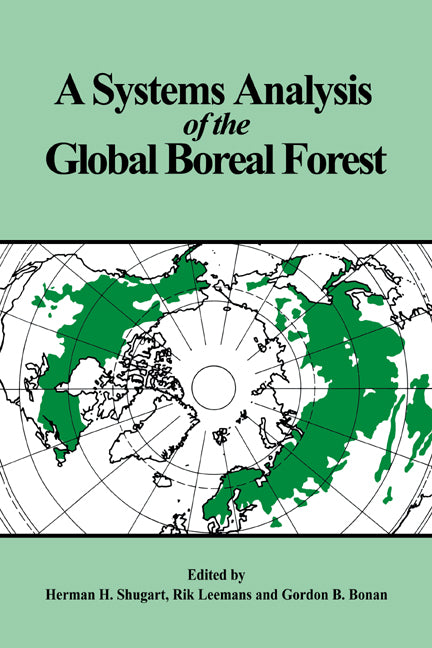
A Systems Analysis of the Global Boreal Forest
This book provides a synthesis of the important patterns and processes which occur in boreal forests and reviews the principal mechanisms which control the forests' pattern in space and time.
Herman H. Shugart (Edited by), Rik Leemans (Edited by), Gordon B. Bonan (Edited by)
9780521619738, Cambridge University Press
Paperback / softback, published 7 March 2005
580 pages, 103 b/w illus. 22 maps 62 tables
23.3 x 15.3 x 3 cm, 0.793 kg
The boreal forests of the world, geographically situated to the south of the Arctic and generally north of latitude 50 degrees, are considered to be one of the earth's most significant terrestrial ecosystems in terms of their potential for interaction with other global scale systems, such as climate and anthropologenic activity. This book, developed by an international panel of ecologists, provides a synthesis of the important patterns and processes which occur in boreal forests and reviews the principal mechanisms which control the forests' pattern in space and time. The effects of cold temperatures, soil ice, insects, plant competition, wildfires and climatic change on the boreal forests are discussed as a basis for the development of the first global scale computer model of the dynamical change of a biome, able to project the change of the boreal forest over timescales of decades to millennia, and over the global extent of this forest.
List of contributors
1. Introduction Herman H. Shugart, Rik Leemans and Gordon B. Bonan
Part I. Processes in Boreal Forests Gordon B. Bonan: 2. Silvics of the circumpolar boreal forest tree species Nedialko Nikolov and Harry Helmisaari
3. The reproductive process in boreal forest trees John C. Zasada, Terry L. Sharik and Markku Nygren
4. Soil temperature as an ecological factor in boreal forests Gordon B. Bonan
5. Fire as a controlling process in the North American boreal forest Serge Payette
6. The role of forest insects in structuring the boreal landscape C. S. Holling
Part II. Patterns in Space and Time in Boreal Forests Herman H. Shugart: 7. The transition between boreal forest and tundra Luc Sirois
8. The southern boreal-northern hardwood forest border John Pastor and David J. Mladenoff
9. Transitions between boreal forest and wetland F. Z. Glebov and M. D. Korzukhin
10. Remote sensing technology for forest ecosystem analysis K. Jon Ranson and Darrel L. Williams
11. The nature and distribution of past, present and future boreal forests: lessons for a research and modeling agenda Allen M. Solomon
Part III. Computer Models for Synthesis of Pattern and Process in the Boreal Forest Rik Leemans: 12. Individual-tree-based models of forest dynamics and their application in global change research Herman H. Shugart and I. Colin Prentice
13. Population-level models of forest dynamics M. D. Korzukhin and M. Ya. Antonovski
14. A spatial model of long-term forest fibre dynamics and its applications to forests in western Siberia M. Ya. Antonovski, M. T. Ter-Mikaelian and V. V. Furyaev
15. A simulation analysis of environmental factors and ecological processes in North American boreal forests Gordon B. Bonan
16. The biological component of the simulation model for boreal forest dynamics Rik Leemans
17. Role of stand simulation in modeling forest response to environmental change and management interventions Peter Duinker, Ola Sallnäs and Sten Nilsson
18. Concluding comments Herman H. Shugart, Rik Leemans and Gordon B. Bonan
References
Index.
Subject Areas: Ecological science, the Biosphere [PSAF]