Freshly Printed - allow 10 days lead
Couldn't load pickup availability
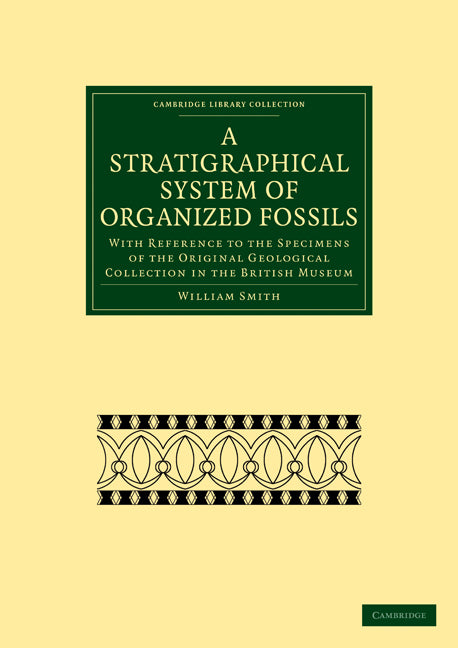
A Stratigraphical System of Organized Fossils
With Reference to the Specimens of the Original Geological Collection in the British Museum
The first published catalogue of a fossil collection arranged using a stratigraphic system, first published in 1817.
William Smith (Author)
9781108021159, Cambridge University Press
Paperback / softback, published 28 October 2010
150 pages, 3 tables
29.7 x 21 x 0.8 cm, 0.38 kg
William Smith (1768–1839) was a civil engineer and canal surveyor known as the 'Father of Geology' who developed and pioneered the concept of stratigraphy. Through his work with canal building Smith become familiar with many different types of rock throughout Britain. He realized that fossils were specific to a certain strata of rock and that rock strata could be identified and correlated by the fossils they contained. Smith used this knowledge to publish the renowned first geological map of Britain in 1815. This volume, first published in 1817, contains Smith's catalogue of his fossil collection for the British Museum. Smith catalogues the fossils according to the rock strata and location in which they were found, together with a brief description of the fossil. This volume was the first published example of rock strata used as a cataloguing principle which demonstrated the practical nature of Smith's system of stratigraphy.
Introduction
Geological table of British organized fossils
London clay
Crag
Chalk
Green sand
Brick-earth
Portland rock
Oaktree clay
Coral rag and pisolite
Clunch clay and shale
Kelloways stone
Cornbrash
Forest Marble
Clay over the upper oolite
Upper oolite
Fuller's earth rock
Under oolite
Sand and sandstone
Marlstone
Stratigraphical table of Echini
Observations on Echini.
Subject Areas: Geology & the lithosphere [RBG]