Freshly Printed - allow 10 days lead
Couldn't load pickup availability
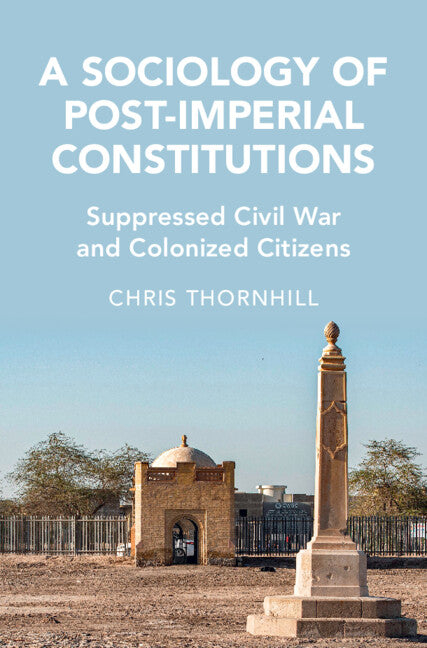
A Sociology of Post-Imperial Constitutions
Suppressed Civil War and Colonized Citizens
This book explains how democratic constitutions were created by imperialism and how they have been detached from their military origins.
Chris Thornhill (Author)
9781316513941, Cambridge University Press
Hardback, published 12 December 2024
580 pages
23.6 x 16 x 3.4 cm, 0.984 kg
'Chris Thornhill's erudite and thought-provoking book … offers a new sociological interpretation of the history of constitutions, claiming that modern democratic constitutions were fundamentally shaped by imperialism and military dynamics from the eighteenth century onwards. … This new approach challenges common perceptions of constitutions as instruments of rational state building, social integration, democratic stabilization, and pacification. … Recommended … wholeheartedy - to a specialized academic readership, with a background in sociology, political science, law, anthropology, and post-/decolonial studies, along with politically minded scholars in religious studies.' Martin Ramstedt, Journal of Law and Society
Covering the period from the eighteenth century to the present, A Sociology of Post-Imperial Constitutions combines global history and historical legal sociology to explain how democratic constitutions were created by imperialism and military policies related to imperialism. It challenges common views about the relation between democracy and peace, examining how, in different locations and different periods, the constitutional ordering of citizenship both reflected and perpetuated warfare. It also isolates the features of constitutional systems that have been successful in obviating military violence, separating democracy from its military origins. It discusses how the emergence of democratic government after 1945 depended on a dialectical transformation of the war/law nexus in constitutional rule. It then assesses ways in which, and the reasons why, many contemporary constitutions have begun to remilitarize their societies and to rearticulate military constructs of legitimacy.
1. Imperialism and the origins of constitutions
2. Constitutions and the persistence of empires
3. Imperialism and global civil war
4. Imperial nations in the Iberian region
5. Military constitutions in and after the Ottoman empire
6. World law and occupation constitutions
7. The occupation constitution II: changing security constitutions
8. The occupation constitution III: constitutions without war
9. Constitutions after war
10. New security constitutions.
Subject Areas: Constitutional & administrative law [LND]