Freshly Printed - allow 10 days lead
Couldn't load pickup availability
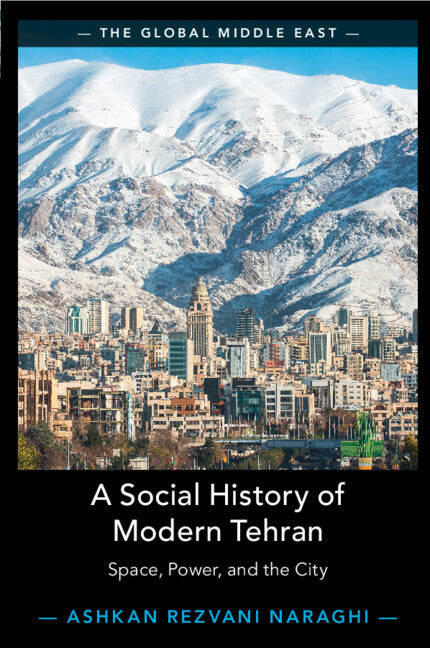
A Social History of Modern Tehran
Space, Power, and the City
Outlines how Tehran's social spaces were transformed by shifting discourses and practices from the nineteenth to the mid-twentieth century.
Ashkan Rezvani Naraghi (Author)
9781009188913, Cambridge University Press
Paperback / softback, published 5 June 2025
488 pages
22.8 x 15.1 x 2.6 cm, 0.71 kg
'This book is an incredibly rich mine of information for anyone interested in social history. As a scholar working on political contention and mobilizations, I appreciated Naraghi's mastery in explaining that the socially embedded knowledge of how and where to protest builds upon existing spatial practices of communal life and how such knowledge has changed across the decades as a reflection of the meaning of 'living together'. Intertwining cultural history, human and political geography, economic, gender, and class analysis, [this] is a must-read for any scholar interested in Iran and an extremely beneficial reading for social scientists in general.' Paola Rivetti, American Historical Review
Tehran, the capital of Iran since the late eighteenth century, is now one of the largest cities in the Middle East. Exploring Tehran's development from the nineteenth to the mid-twentieth century, Ashkan Rezvani Naraghi paints a vibrant picture of a city undergoing rapid and dynamic social transformation. Rezvani Naraghi demonstrates that this shift was the product of a developing discourse around spatial knowledge, in which the West became the model for the social practices of the state and sections of Iranian society. As traditional social spaces, such as coffee houses, bathhouses, and mosques, were replaced by European-style cafes, theatres, and sports clubs, Tehran and its people were irreversibly altered. Using an array of archival sources, Rezvani Naraghi stresses the agency of everyday inhabitants in shaping urban change. This enlightening history not only allows us to better understand the contours of contemporary Tehran, but to develop a new way of imagining, talking about, and building 'the city'.
Foreword by Arshin Adib-Moghaddam
Preface by Jennifer A. Jordan
Introduction
1. Segmented society and the social production of communal spaces
2. Segmented society and spaces of political mobilization
3. Iranian travelers and the production of spatial knowledge
4. The Qajar court and the city: spatial strategies of the state in the nineteenth century
5. The interwar period and middle-class urbanism
6. The age of social movements: the transformation of political public space
Conclusion
Appendix: protest, political gatherings, and parades between 1941 and 1953
Bibliography
Index.
Subject Areas: Politics & government [JP], Social & cultural history [HBTB], Middle Eastern history [HBJF1]